


Celebrating a Century of Vision and Valor
July 10, the world comes together in awe to celebrate the centennial birthday of a man whose name has become synonymous with visionary leadership, bold reform, and principled statesmanship—Tun Dr. Mahathir Mohamad. As he turns 100, Dr. Mahathir is not only being remembered as Malaysia’s longest-serving Prime Minister (1981–2003, and again 2018–2020), but also as a giant whose influence has reached beyond national boundaries, shaped regional geopolitics, and resonated in global discussions on justice, governance, and development.
There have been few leaders in the modern era who have so single-mindedly determined the destiny of their nation and yet maintained such a strong voice for the Global South. His legacy is not only imprinted on the architectural and industrial modernity of Malaysia—from the Petronas Twin Towers to Putrajaya—but also in the aggressive role Malaysia played on the world stage in advocating Muslim unity, Asian self-determination, and South-South solidarity.
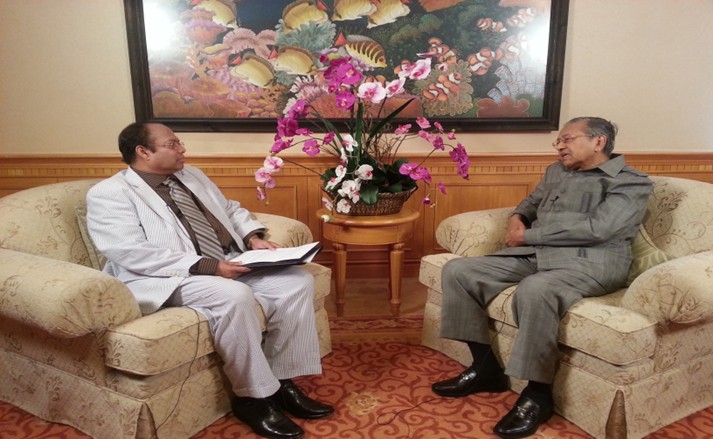
In 2016, I had the privilege of sitting down with Dr. Mahathir in Kuala Lumpur for an exclusive interview as part of a regional series on Asian leadership and diplomacy for the Kuwait Times. What emerged was a riveting portrait of a thinker who is profoundly disturbed by the fault lines of the Muslim world, the moral bankruptcy of Middle Eastern leadership, and the unfulfilled potential of countries like Bangladesh. In his typical candor and simplicity, he reflected on the global imbalance of power, the need for intellectual reform within Muslim societies, and the compelling urgency of self-reliance founded upon moral governance.
On this milestone anniversary, this article seeks not just to pay tribute to the monumental achievements of the father of modern Malaysia but to revisit the timeless wisdom he shared that day—wisdom that still resonates so powerfully in a world still struggling to end inequality, conflict, and leadership deficits. Dr. Mahathir’s century-long journey instructs us that revolutionary transformation is possible when vision is coupled with courage, and when politics is guided not by populism, but by principle.
Architect of Modern Malaysia: Vision 2020 and Beyond
Dr. Mahathir’s most enduring legacy is his transformation of Malaysia from an agrarian economy to a vibrant industrialized country. His Vision 2020, launched in 1991, was not only an economic plan but a national crusade—a fully developed, just, technologically advanced Malaysia by the year 2020.
Among his main accomplishments are:
- Industrial Diversification: Transitioning Malaysia from dependence on rubber and tin to a robust manufacturing and electronics giant.
- Infrastructure Boom: Launching of mega-projects such as the North–South Expressway, KL Tower, Putrajaya (administrative capital), and the Petronas Twin Towers—once the world’s tallest buildings and a global symbol of Malaysia’s ambition.
- Education and Innovation: Development of multimedia super corridors, cyber cities, and universities such as Universiti Teknologi Malaysia to lead STEM development.
- Bumiputera Empowerment: Economic empowerment policies to enhance the position of the Malay majority while maintaining multi-ethnic harmony.
Dr. Mahathir’s pragmatic nationalism, economic openness, and state-led development provided a new model for the Global South. As he articulated during our 2016 interview, “Modernity is not imitating the West—it is learning, adapting, and developing our own way with pride.”
Bridging Nations: Dr. Mahathir Mohamad’s Pragmatic Engagement with Singapore
One of the most strategically significant aspects of Dr. Mahathir Mohamad’s foreign policy was his deft and pragmatic handling of Malaysia–Singapore relations despite a historically complex and sometimes tense bilateral relationship, founded upon deep economic interdependence, historical rivalry, and different political trajectories. Mahathir recognized early in his premiership that Malaysian prosperity and regional stability were inextricably linked to a healthy partnership with its southern neighbor.
Throughout his tenure, he pursued a path of robust diplomacy, leavened by economic realism, engaging often in open debate with the Singaporean leadership on challenging issues such as water agreements, land reclamation disputes, and the future of the Causeway and railway land in the island republic. Despite disagreement, however, Dr. Mahathir maintained negotiating channels open, pointing to his commitment to sovereign equality and mutual respect.
His term was marked by efforts to promote cross-border investment, trade, and transport connectivity, a reflection of his belief that both nations—despite their differences—could gain from strategic cooperation rather than confrontation. Dr. Mahathir’s re-opening of talks on the Kuala Lumpur–Singapore high-speed rail project, and its subsequent shelving, was especially conspicuous, reflecting his preference for advancing regional integration while safeguarding national interest.
Dr. Mahathir also continually emphasized the imperative of ASEAN unity and Asian values-based regionalism, in which Malaysia and Singapore could jointly foster economic resilience, technological advancement, and diplomatic non-alignment in a multipolar world. While his rhetoric occasionally varied from Singapore’s technocratic style, the two countries ultimately respected his status as a regional statesman who, even when he disagreed, practiced the principle of dialogue instead of discord.
Overall, Dr. Mahathir’s relations with Singapore mirrored his broader geopolitical vision: to stand up with national pride, bargain hard, but always seek common ground in the interests of peace and regional development.
A Defiant Voice for Justice in the Muslim World
We spoke about the Middle East’s burning crises—the Syrian civil war, the Israeli Palestinian conflict, and the collapse of state power in Libya and Iraq. Dr. Mahathir attributed blame to both Western interventionism and the internal failure of Muslim leadership.
“You can’t bomb a nation into democracy,” he said. “The Muslim world must find its own solutions—rooted in justice, education, and leadership integrity. Otherwise, we are only trading one tyranny for another.”
Dr. Mahathir’s longstanding solidarity with Palestine, his condemnation of American double standards, and his critiques of sectarianism in the Islamic world had made him a personality worthy of admiration in the Global South. He was one of the few Muslim leaders who had criticized Saudi Arabia’s internal repression and American collusion in regionally destabilizing actions. He stubbornly refused to take the script on the Iraq War, the “War on Terror,” and the post-9/11 Islamophobia that had gripped the West.
Thoughts on Bangladesh: Hope, Dignity, and Governance
I questioned Dr. Mahathir about Bangladesh, and his answer was cautious but hopeful.
“Bangladeshis are intelligent and resilient people,” he responded. “The answer is in governance—if corruption is controlled and merit is rewarded, the country can develop faster than we imagine.”
Bangladesh’s progress in garment exports, microfinance experiments like Grameen Bank, and the increased deployment of Bangladeshi peacekeepers struck him. But he was also concerned about political instability, bureaucratic inertia, and dependence on remittance flows.
His message to future Bangladeshi leaders was clear: invest in education, develop clean politics, and prioritize long-term national interests over short-term ones.
The Return of the Reformist: The 2018 Political Miracle
And perhaps the most dramatic turn in Dr. Mahathir’s political life was at the age of 92, when he emerged from retirement to challenge and bring down his former protégé, Najib Razak, in the 2018 general election. Leading the Pakatan Harapan coalition, he proved that the passion for reform can transcend age and party boundaries.
This record-breaking comeback was driven by his quest to revive Malaysia’s democratic institutions and put an end to the worldwide 1MDB scandal. In his brief second term, Dr. Mahathir initiated institutional reforms, restarted anti-corruption investigations, and sought to revive public faith in government.
“Democracy is not a license to loot—it is a sacred trust,” he said in an interview with me, a line that rings out today as a warning to all emerging democracies.
Global Thought Leadership: From South-South Cooperation to East Asian Identity
Dr. Mahathir was not content to be a national leader. He advocated a New Asian Century, calling for developing nations to rise with dignity. His proposal for an East Asian Economic Caucus during the 1990s, which was resisted at the time, anticipated the RCEP and ASEAN+3 arrangements of today.
He was equally a leading advocate of South-South Cooperation, speaking at NAM and OIC summits for a multipolar world order. His vision was for a world in which smaller nations did not merely follow but led the international debate on trade, technology, and human rights.
A Conversation with Dr. Mahathir Mohamad: Reflections on the Middle East and Look East Vision
Excerpt from the Author’s 2016 Interview for Kuwait Times
In 2016, I had the privilege of conducting an in-depth interview with Tun Dr. Mahathir Mohamad in Kuala Lumpur for Kuwait Times. What unfolded during that hour-long conversation was not just a recap of a statesman’s long career but an intensely analytical reflection on two regions central to his geopolitical imagination: the Middle East and East Asia.
The Middle East: A Call for Integrity, Unity, and Internal Reform
Dr. Mahathir was not mincing his words in describing the mounting crises throughout the Arab world—civil wars, sectarian fissures, foreign interventions, and loss of sovereignty in countries like Iraq, Syria, and Libya. His criticism was negative and constructive.
“The problem with the Middle East is that power is more precious to leadership than people,” he said. “You cannot build a strong country on oil wealth alone, it requires justice, education, and unity.”
He berated the cycle of foreign interventionism by Western powers, especially that he argued tended to leave countries more shattered than before. But he was also unsparing about Arab regime domestic failures—lack of accountability, cronyism, suppression of dissent, and unwillingness to modernize governing structures.
Dr. Mahathir lamented the lack of Muslim unity that, in his view, had allowed external forces to exploit internal divisions. He urged Middle Eastern countries to:
- Massively invest in education and technological independence.
- Prefer intra-regional trade to dependence on the West.
- Reform religious institutions to promote tolerance and critical thinking.
“Religion should guide moral action, not suppress inquiry. That’s what we lost,” he said, echoing his longstanding advocacy of Islamic modernism.
The Look East Policy: A Blueprint for the Muslim World
Moving from critique to strategy, Dr. Mahathir addressed the ongoing relevance of his Look East Policy—a policy first mooted in the early 1980s that called for Malaysia to emulate the work ethic, discipline, and technological achievements of countries like Japan and South Korea instead of Western models. The West teaches liberalism, while East Asia teaches discipline and a sense of responsibility to society. That is what the developing world has to learn if they ever want genuine independence,” he said.
He made the case in our conversation that the Middle East must take the same turn, learning from East Asia’s success in post-war reconstruction, educational excellence, and strong state institutions. He cited Japan’s innovative culture and South Korea’s investment in human capital as models of how values such as integrity, tenacity, and national pride can be translated into economic strength and global respect.
Dr. Mahathir believed that cultural pride, more than mere opposition to Western hegemony, held the key to successful development. He presumed that Muslim nations could arise if they drew upon their own moral and cultural resources, embracing the managerial efficacy and models of development of the East.
This 2016 interview stripped bare Dr. Mahathir’s urbane global vision—one founded upon self-reliance, moral leadership, and rejection of victimhood and dependency. His insights remain bitingly relevant today as the Middle East continues to be trapped in instability and as Global South countries look for alternative models of development and governance.
“We must stop relying on others to save us,” he concluded. “We can remake ourselves—if we have the will and the courage.” That single quote encapsulates the theme of Dr. Mahathir Mohamad’s legacy: uncompromising, unapologetic, and firmly committed to the idea that leadership begins with self-transformation.
Conclusion: A Life Larger Than Politics
As Dr. Mahathir Mohamad starts his second century, his legacy is not in buildings or policy papers. It lives in the assertive confidence of a rising nation, the courage to confront powerful interests, and the belief that integrity can be a currency of governance.
His life testifies that leadership, when founded on vision, conviction, and moral courage, can indeed bend history in the path of progress.
As he once cited the Quran in our interview: “Indeed, Allah does not change the condition of a people until they change what is in themselves.” (Surah Ar-Ra’d 13:11).
On this centennial celebration, we honor not just a man, but a movement, a vision, and an example of principled, productive, and purposeful leadership. Happy 100th Birthday, Tun Dr. Mahathir Mohamad. Your legacy inspires the world still.

0 Comments
LEAVE A COMMENT
Your email address will not be published