

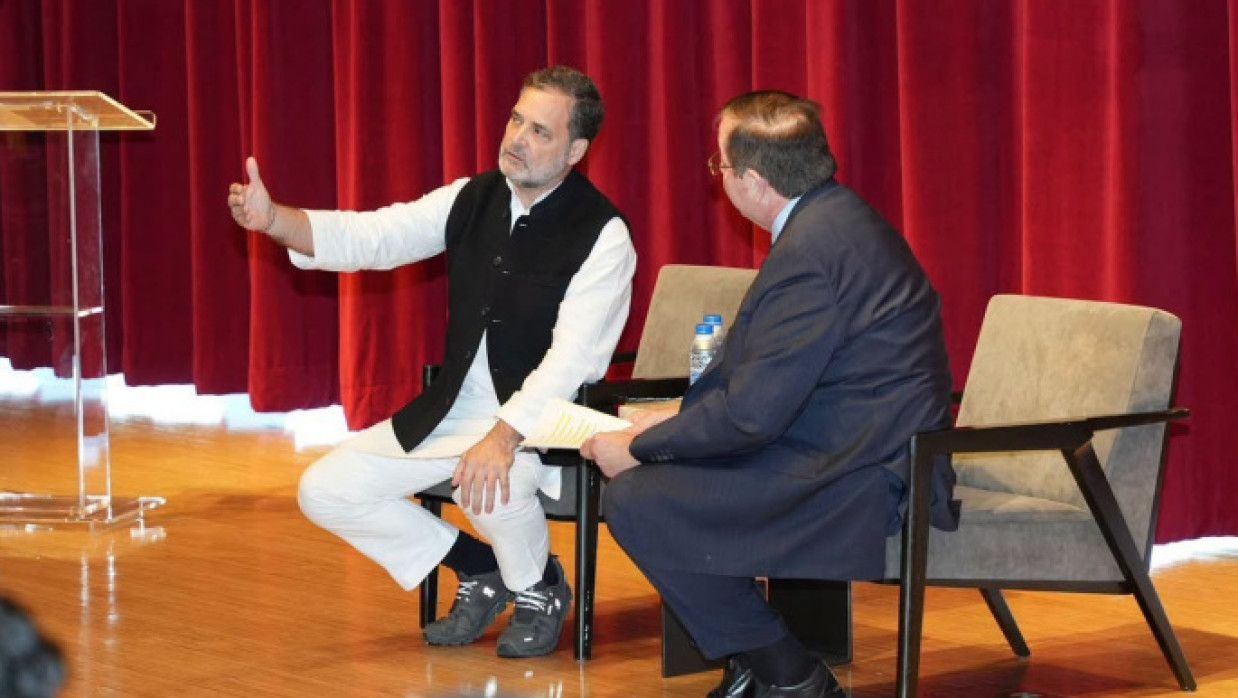
For decades, idealism and morality have shaped India's external relations. Nehru was a firm supporter of all movements against colonialism and foreign domination, including the right of the Palestinians to establish their own state. Over time, however, India has moved towards very close ties with Israel under the Modi government. So it is telling that Rahul Gandhi now appears to have come to a similar view, at least to some extent. To what extent is the BJP's ideology and line on international relations and morality now accepted across Indian politics? And what place is left for idealism, supporting just causes around the world, and standing up for other oppressed peoples?
On November 18, at the University of Chicago, Rahul Gandhi said that India should have good relations with Israel, buy weapons and other products, and so on. He felt it was in India's interests to do so, and asked why other countries should dictate its policy. He did deplore the attacks by Hamas on October 7, as well as the actions by Israel since then. In a tweet, he went on to say that India should continue its close strategic ties with Israel, but this should not mean that it turns a blind eye to what was happening to the Palestinians. India should condemn such acts, since "one abomination does not lead to or justify others".
But he clearly felt obliged to defend ties with Israel, leading many to ask how far his stance differed from the Modi government's. Many academics, editors, writers, activists, and politicians took exception to his comments. For example, Apoorvanand, a professor at Delhi University, was critical of seeking close ties with a regime which many believed was perpetrating genocide, and said this was inconsistent with basic tenets which all democratically elected politicians must follow. Arfa Khanum Sherwani, among others, deplored that he was loath to use the word "genocide" to describe Israel's actions. Pinarayi Vijayan, from the Left, felt that no considerations of India's strategic interests should require such a compromise of basic moral and human values. Dipankar Bhattacharya of the CPI(ML) asked to what extent India could profess to follow an independent line in international affairs, if it sought ever closer ties with a regime suspected of heinous crimes.
It is clear, therefore, that a gulf exists between Gandhi and many others in opposition politics. He would probably say, not unnaturally, that as with all countries, India's relations and arms purchases from others would largely be dictated by its own interests. Others would feel there came a point where these considerations should give way to avoiding complicity in flagrant breaches of humanitarian law.
The disagreement cannot be understood without examining India’s historical relationship with Palestine and Israel.
Under Nehru, India emerged as a prominent supporter of anti-colonial movements and the political aspirations of peoples living under foreign domination. India opposed the partition of Palestine in 1947 and subsequently recognized Israel in 1950, although full diplomatic relations were not established until 1992. New Delhi recognized the Palestine Liberation Organization as the legitimate representative of the Palestinian people in 1974 and formally recognized the State of Palestine in 1988.
India had good reason to support this principle, given its own history as a colony and the importance it attached to independence and the right of peoples to determine their own political futures.
Only in January 1992 did a Congress government led by Narasimha Rao decide to establish formal, full diplomatic relations with Israel. Many factors contributed, including broader changes after the end of the Cold War, developments in the peace process (notably the Madrid Conference), and a desire for various types of military hardware.
All subsequent Indian governments have been willing to develop various aspects of their relations with Israel, including various surveillance systems, missiles, drones, farming techniques, and other areas, including intelligence. This has been more overt under the Modi government, as shown, inter alia, by the Prime Minister's 2017 visit to Israel.
It therefore seems likely that Israel will continue to be a significant supplier to India of military and other technology. Given the degree of involvement by all parties in deepening and widening these links over several years, it would be very hard for the Congress to be highly critical of the BJP.
However, no amount of consistency over time can remove the need to review existing positions if the situation changes significantly.
There can be little doubt that events in Gaza have significantly affected attitudes towards Israel around the world. Large numbers of dead and injured civilians, the virtual total displacement of populations, widespread destruction and impediments to the provision of adequate relief, all give rise to very serious questions regarding the manner in which hostilities are being waged, and the care shown towards the civilian population.
These concerns are heightened by proceedings in various international judicial fora. South Africa's action under the Genocide Convention will focus attention from all quarters on the duties imposed by that Convention. It is clear from the indications given by the ICJ in its provisional orders that it considers it vital that the range of acts forbidden by the Convention should not be committed against the Palestinian people, and that appropriate relief reach them. These are not the Court's findings.
Action is also proceeding before the ICC to establish personal liability for a range of crimes. Israel denies any charge of genocide, asserting that it is acting against Hamas as a consequence of the events of 7 October. It is difficult, however, to view the large-scale loss of life, injury and other damage suffered by civilians, and the highly contentious issues of law arising, as matters which India can or should ignore.
Clearly, India need not cut off all diplomatic contacts simply because of another government's actions and policies. It will often be necessary and desirable to maintain such contacts even with very objectionable regimes. But important issues arise around providing military hardware and related assistance, know-how, funds, and so on, which may be used in ways contrary to international law.
It is arguable that important moral and political distinctions exist between buying and selling weapons. But both raise obvious issues for the states and private companies concerned. At a minimum, there would seem to be justification for careful, open examination of proposed purchases, adequate assurances as to their ultimate employment, and drawing the appropriate line between what India requires for its own defensible interests and other supplies and assistance.
Gandhi’s critics therefore raise a legitimate concern, even if their demand for complete disengagement does not necessarily provide a workable diplomatic strategy.
The controversy also exposes differences within the Gandhi family. Priyanka Gandhi Vadra has adopted a more outspoken position on Palestinian rights, while Sonia Gandhi has questioned aspects of India’s changing approach toward Israel. Rahul Gandhi appears more determined to demonstrate that Congress can govern without abandoning established strategic partnerships. This may reassure sections of India’s security establishment, but it risks alienating supporters who expect a clearer distinction between Congress and the BJP.
Given India's desire to be a significant player on the world stage, this question deserves debate. Strategic autonomy would be meaningless if it extended only to choosing between various arms vendors. At a minimum, it would have to include a willingness to admonish friends and allies and support international law and the rights of others.
As a member of the Third World, India has naturally tried to build support and influence throughout Africa, Asia, and the Middle East, and will be judged, to some extent, on how consistently it acts in line with its professed beliefs.
There is no doubt that India should follow a foreign policy dictated by its own best interests. But these are much wider than acquiring the best and most advanced weaponry, favorable alliances, and so on. Standing and reputation in world affairs, adherence to basic human rights, and an orderly international community would all figure prominently.
It will therefore be significant how far Rahul Gandhi is prepared to go in qualifying his support for close ties with Israel in the face of grave infringements of human rights.
Strategic alliances and co-operation should not imply wholesale acceptance of another country's policies and actions. There would seem to be scope for India to act in accordance with its traditional sympathy for the rights of the Palestinians.
This question goes to the heart of much current political discourse around the world. To what extent are States prepared to subscribe to human rights in general terms, but consider them open to modification to suit their own interests? Much will depend on India's willingness to stand by certain principles and the degree of consistency with which it does so.


0 Comments
LEAVE A COMMENT
Your email address will not be published