

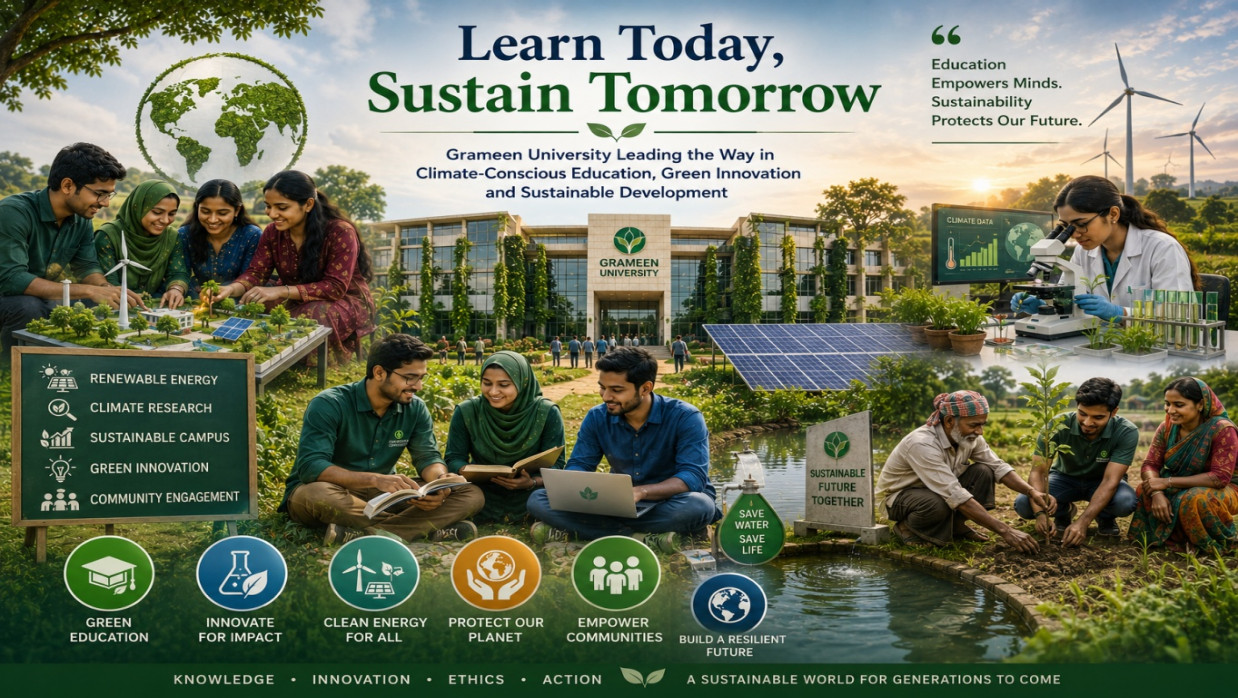
“Protecting the planet is not merely an environmental obligation—it is a moral responsibility to future generations.”
— Inspired by the philosophy of Professor Muhammad Yunus
The challenge of climate change has become a key one for the twenty-first century, posing threats to ecosystems, economies, health, food security, and social stability worldwide. Countries like Bangladesh, which are at a developing stage, have come to face problems such as rising sea levels, intense cyclones, floods, river erosion, salinity, loss of biodiversity, and increased climate change-induced displacements. Although various strategies are being developed by governments, international bodies, and civil society to adapt to and mitigate climate change, universities play a unique role in this context.
Inspired by Nobel Laureate Professor Muhammad Yunus’ philosophy of Social Business and human-centered development, Grameen University has the opportunity to become a pioneering institution in environmental sustainability and climate leadership. Rather than treating environmental stewardship as a peripheral concern, the University can integrate sustainability into every dimension of institutional life—from curriculum design, research, and campus operations to entrepreneurship, community engagement, and international collaboration. By educating environmentally responsible leaders and fostering green innovation, Grameen University can help transform climate challenges into opportunities for inclusive development and sustainable prosperity.
The article seeks to identify ways in which Grameen University can serve as a role model for environmentally conscious higher education, highlighting the important roles universities play in environmentalism, technology, and sustainable human development beyond their roles as places of intellectual inquiry.
Climate Change and the Responsibility of Universities
Climate change is no longer a mere environmental issue; it is an urgent human issue that affects all facets of society. Global warming, extreme weather, loss of biodiversity, and natural disasters pose serious risks to human livelihood, agriculture, public health, and the economy.
Universities have an important place in this effort. In addition to creating scientific knowledge, they are educating future politicians, engineers, businessmen, teachers, reporters, scientists, and other decision-makers who will influence the world for many years to come.
Higher education therefore carries a profound responsibility—not simply to study environmental problems but to cultivate the intellectual, ethical, and technological capacity required to solve them. Grameen University can embrace this responsibility by placing sustainability at the center of its institutional identity.
Bangladesh: The Testbed for Climate Adaptation and Resilience Across the Globe
Few nations comprehend the harsh truth of climate change better than Bangladesh.
Even though Bangladesh’s contribution to global greenhouse gas emissions is minuscule, Bangladesh faces some of the worst climate problems in the world, such as:
• rising sea levels,
• coastal erosion,
• floods,
• cyclones,
• saltwater intrusion,
• riverbank erosion,
• water scarcity,
• agriculture vulnerability,
• climate-induced migration.
But at the same time, Bangladesh is also known for its resilience and unique adaptation practices.
Community-based disaster preparedness, renewable energy initiatives, microfinance, women’s leadership, and grassroots entrepreneurship have attracted international recognition.
Grameen University can build upon these national strengths by becoming an international center for climate education, sustainable innovation, and resilience research.
Sustainability as an Institutional Philosophy
Environmental sustainability should not be confined to a single academic department or environmental science program.
Instead, it should become an institutional philosophy influencing every aspect of university life.
The principles of sustainability that Grameen University follows may be the following:
• Curriculum
• Research
• Design of campus
• Procurement
• Energy use
• Waste reduction
• Transport
• Water
• Food production and management
• Relations with community
This way, the problem of sustainability will become a part of the culture of the university rather than just a separate course.
Integrating Sustainability Across Academic Disciplines
Addressing climate change requires interdisciplinary thinking.
Every academic discipline has an important contribution to make.
Business programs can emphasize sustainable entrepreneurship, environmental accounting, circular economy models, ESG (Environmental, Social, and Governance) practices, and Social Business solutions.
Engineers can develop green energy technology, climate-resilient structures, and sustainable production systems.
The field of agricultural sciences can ensure climate-smart agriculture, efficient irrigation, biodiversity protection, and regenerative agriculture.
Health scientists can study climate-related illnesses, nutrition, the environment, and public health.
Communication and journalism students can enhance their knowledge and skills in environmental communication, climate literacy, and science journalism.
Computer science students can develop artificial intelligence applications for disaster prediction, precision agriculture, environmental monitoring, and resource management.
Public policy programs can examine environmental governance, climate finance, adaptation strategies, and international climate diplomacy.
With interdisciplinary learning, sustainability is made a collective responsibility throughout the entire University.
Social Business and Green Innovation
Professor Muhammad Yunus's theory of Social Business offers an effective framework for tackling environmental issues.
Contrary to being seen as a cost, Social Business shows how environmentally friendly businesses can be both financially sustainable and socially responsible at the same time.
Grameen University has the potential to instill environmental sustainability awareness in students regarding undertaking environmentally sustainable business practices, which include but are not limited to:
• Renewable energy;
• Solar energy;
• Recycling;
• Circular economy;
• Sustainable agriculture;
• Water treatment systems;
• Green building design;
• Green transportation;
• Biodegradable products; and
• Environmental restoration.
Students are informed that there is no contradiction between environmental sustainability and economic development.
A Living Laboratory for Sustainable Campuses
A university committed to sustainability must demonstrate its values through its own operations.
Grameen University can develop its campus as a demonstration site for environmentally responsible actions.
Examples of the projects include:
• solar buildings,
• rainwater harvesting,
• eco-friendly architecture,
• Energy-efficient infrastructure,
• Water efficiency,
• Zero-waste initiatives,
• Biodiversity of the campus,
• Electric mobility,
• Sustainable landscaping, and
• Environmentally friendly procurement.
The students get involved in designing and improving the systems which turn the university into a learning tool in its own right.
Scientific Research for Climate Resilience
Science plays an important role in solving environmental issues.
Research institutions could be developed at Grameen University on topics like:
• Adaptation to climate change,
• Renewable energy,
• Preparedness for disaster,
• Biodiversity conservation,
• Sustainable agriculture,
• Circular economy,
• Environmental economics,
• Climate finance,
• Environmental health, and
• Green technology.
The faculty and students collaborate with the local community in developing measures suitable for the environment in Bangladesh.
The results of such research can have significance both locally and internationally.
Community Involvement in Environmental Stewardship
Environmental sustainability will not be achieved by academic institutions only.
Community participation is required in environmental protection efforts.
There are opportunities for Grameen University to work with:
villages,
municipalities,
schools,
NGOs and community-based organizations in:
• tree planting campaigns;
• awareness on environmental issues;
• waste management;
• water conservation;
• clean energy programs;
• climate change adaptation;
• sustainable agriculture;
• disaster preparedness campaigns.
The students benefit from learning in practice, while the community benefits from science and innovation. The process is reciprocal.
Raising Climate-Aware Leaders
Climate change leaders should be knowledgeable and responsible.
Climate change leadership calls for ethics, holistic thinking, collaboration, and forward planning.
Grameen University endeavors to create graduates who have:
• environmental awareness,
• ethical leadership,
• innovativeness,
• resilience,
• interdisciplinarity,
• creative entrepreneurship,
• global citizenship,
• civic responsibility.
The above characteristics will prepare students to become leaders in government, industry, nonprofit organizations, research institutes, and international organizations that address environmental issues.
International Collaboration for Global Sustainability
Climate change is not confined to any nation.
Solutions to climate change need international collaboration.
Grameen University can collaborate with:
• top universities;
• institutes of climate change research;
• UN bodies;
• development organizations;
• environmental NGOs;
• international foundations;
• green technology companies.
Collaboration will take the form of:
• Joint Research,
• Faculty Exchange,
• Student Exchange,
• Climate Change Conferences,
• Innovation Competitions,
• Policy Dialogues,
• Sustainable Development Projects.
Advancing the Sustainable Development Goals
Environmental Sustainability at Grameen University directly supports many United Nations Sustainable Development Goals.
Those include:
• Goal 4: Quality Education;
• Goal 6: Clean Water and Sanitation;
• Goal 7: Affordable and Clean Energy;
• Goal 9: Industry, Innovation and Infrastructure;
• Goal 11: Sustainable Cities and Communities;
• Goal 12: Responsible Consumption and Production;
• Goal 13: Climate Action;
• Goal 14: Life Below Water;
• Goal 15: Life On Land;
• Goal 17: Partnerships For The Goals.
In doing so, the University works towards global sustainability goals through its teaching, research, innovation, and outreach programs.
Opportunity for Bangladesh to Lead Globally
Bangladesh has become an example of the world in terms of climate resilience, community adaptation, renewable energy innovations, and grassroots environmental activism.
The Grameen University could capitalize on its leadership role and become a worldwide center of excellence in environmentally conscious higher education.
Being based on the concepts of Social Business, sustainability, innovation, and community involvement, this university becomes particularly important for the countries facing the same environmental issues.
People from other countries could learn from Bangladesh's experience and contribute to its further development through international cooperation.
Challenges and the Way Forward
Achieving environmental sustainability is impossible without long-term commitments from the institutions involved. Financing, faculty development, interdisciplinary cooperation, technological infrastructure, and a cultural shift become inevitable.
Universities need to face not only environmental but also economic challenges and constantly evaluate their sustainability efforts.
However, all these challenges also create a unique opportunity for universities.
Conclusion
In the modern era, environmental sustainability cannot be considered optional in university education; it should be recognized as an essential responsibility of institutions that aspire to serve humanity in the 21st century. With the ongoing transformation of economies, societies, and ecologies driven by climate change, universities need to move beyond concern for sustainability issues and take active steps to address them. Following the ideas of Professor Muhammad Yunus on the principles of Social Business and innovative ethics, Grameen University has unique potential to demonstrate how education can serve as an engine of environmental protection and sustainable development.
By incorporating sustainability into its curriculum, research efforts, campus practices, entrepreneurship, and outreach programs, the University will graduate students who are not only scientifically minded but also ethically minded and able to solve existing environmental problems. Through green inventions, sustainable energy sources, climate change adaptation, and community involvement, the University embraces the concept that there is no distinction between human development and environmental protection.
As Bangladesh is increasingly recognized worldwide for its fortitude and innovative approaches to coping with climate change, Grameen University has an opportunity to become a global symbol of environmentally oriented higher education. With knowledge, collaboration, and deliberate action, it can cultivate a whole new generation of leaders who understand sustainability not just as an environmental necessity but as a basis for sustainable prosperity, equality, and the dignity of people. Thus, Grameen University emphasizes that the future of higher education lies not only in expanding knowledge but also in saving the planet and empowering people to create a green future.


0 Comments
LEAVE A COMMENT
Your email address will not be published