

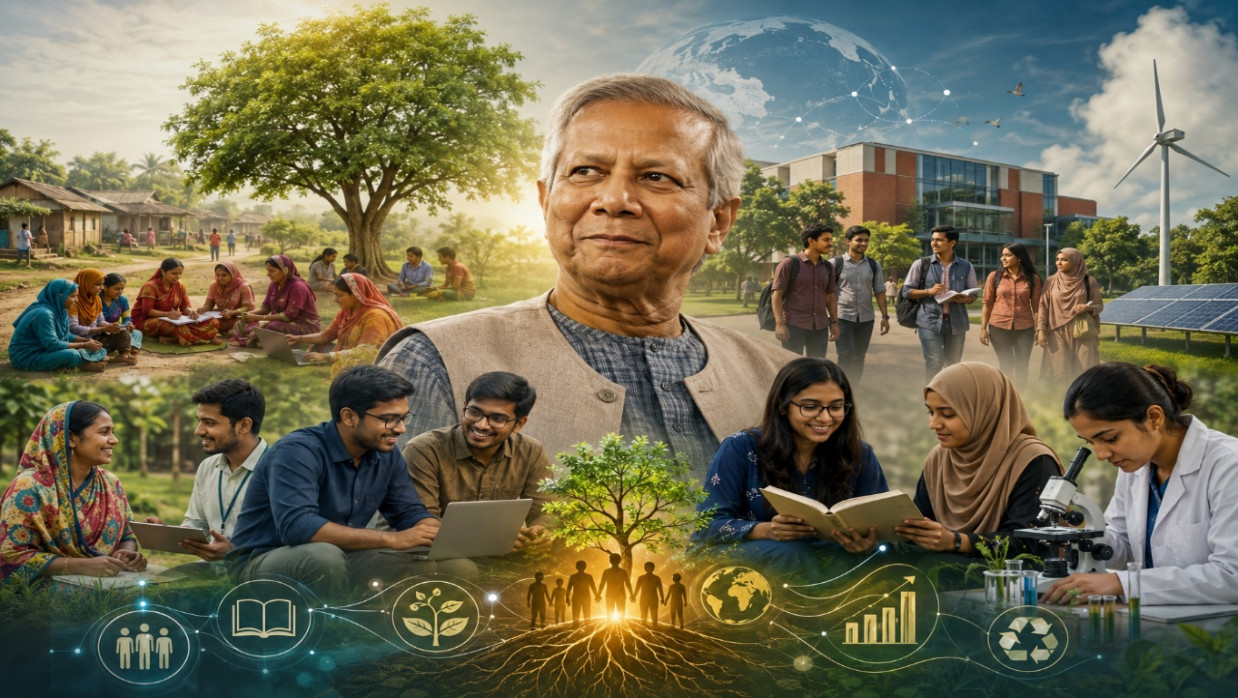
"Education is not only about making a living but rather about equipping people with the ability to change their life and the society they are in." For decades, universities have been places of knowledge creation and enhancement. Scientists, engineers, doctors, lawyers, businessmen, and policymakers have been developed within university walls and have played a vital role in shaping the history of human civilization. However, despite the incredible progress in science, technology, the economy, and education, humanity faces numerous persistent problems, such as poverty, inequality, environmental pollution, social exclusion, and widening gaps between those with opportunities and those without.
The vision behind Grameen University seeks to answer that question with a bold and innovative approach. Inspired by the social business philosophy and human-centered development principles championed by Nobel Peace Prize laureate Muhammad Yunus, Grameen University represents an ambitious effort to redefine the purpose of higher education in the twenty-first century.
Unlike other universities that view higher education solely as preparation for jobs, Grameen University recognizes the value of education in solving social problems and in developing individuals' potential to grow and prosper.
A New Paradigm for Higher Education
The current higher education paradigm has primarily been founded on the transfer of knowledge and preparing graduates for future professions. Although this approach has made considerable contributions to economic prosperity, it has not paid much attention to social justice and sustainable development.
Grameen University, however, is trying to overcome the boundaries of this old-fashioned concept through social innovation. In other words, Grameen University aims to be an institution responsible not just for producing experts but also for cultivating socially engaged leaders and entrepreneurs who can find solutions to the world's most acute problems.
It is based on the understanding that modern society needs universities that help address problems such as poverty, unemployment, climate change, public health inequalities, and food insecurity. Thus, through education, people can be transformed.
Education as an Instrument for Poverty Alleviation
The most prominent element in the Grameen ideology is the strong belief in poverty alleviation. The Grameen approach has shown for decades that people considered economically weaker actually had great entrepreneurial potential when given opportunities.
Grameen University extends this philosophy into the realm of higher education.
Rather than treating poverty merely as a subject for academic analysis, the institution seeks to equip students with practical tools to develop innovative solutions that improve the lives of marginalized populations. Students are encouraged to explore real-world challenges and design sustainable interventions that create economic opportunities and strengthen communities.
The educational program recognizes that lack of money is not only a definition of poverty but also a problem caused by limited opportunities in education, health care, information technology, finance, and social networks. By combining all of these in its academic programs, Grameen University aims to develop students who understand the root causes of poverty and how to combat it.
Social Business as a Transformative Educational Framework
At the heart of the Grameen vision lies the concept of social business—a model that uses entrepreneurial principles to address social problems while maintaining financial sustainability.
Whereas conventional companies tend to emphasize profit maximization, social enterprises are meant to address human problems such as hunger, unemployment, environmental destruction, health care problems, and lack of educational opportunities, among others.
Grameen University is well-poised to become the leading university in the world in applying the concept of social business within the framework of higher education programs.
Such an approach transforms entrepreneurship from a purely commercial pursuit into a vehicle for social innovation and community development.
Bridging the Gap Between Academia and Society
It is one of the age-old criticisms of higher education that academics are in silos from the very societies they work for. Important research findings remain within the pages of scholarly journals, while important social issues remain unsolved.
Grameen University seeks to bridge this gap by encouraging meaningful engagement between students, faculty, and local communities.
Learning extends beyond classrooms and laboratories into villages, urban neighborhoods, social enterprises, development organizations, and grassroots initiatives. Students gain firsthand exposure to social challenges while communities benefit from innovative ideas and collaborative problem-solving.
The result is a symbiotic relationship wherein knowledge moves in two ways. The communities act as participants in learning rather than just recipients of knowledge, while students gain greater insight into the workings of society and human needs.
Advancing Inclusion and Equity
Educational disparity is one of the greatest challenges facing sustainable development. Millions of people have not been able to overcome challenges linked to their economic status, location, gender, disabilities, and social standing.
A university grounded in the Grameen philosophy has the potential to become a powerful advocate for educational inclusion.
By expanding access to quality education and creating supportive pathways for underrepresented populations, Grameen University can help reduce social disparities and expand opportunities for upward mobility.
Very important is the part that women could play in such a transformational vision. The Grameen revolution proved that empowering women economically and socially was highly effective. Taking this idea further into higher education will help foster a new breed of female leaders, innovators, entrepreneurs, researchers, and policymakers.
Sustainability as a Core Academic Mission
The twenty-first century is defined by unprecedented environmental challenges. Climate change, biodiversity loss, resource depletion, and environmental degradation threaten the well-being of communities around the world, particularly in developing countries.
Universities can no longer treat sustainability as a peripheral concern. Instead, it must become a central component of teaching, research, and institutional practice.
Grameen University is uniquely positioned to integrate sustainability across disciplines, encouraging students to develop solutions that balance economic development with environmental stewardship. Whether through renewable energy initiatives, sustainable agriculture, climate resilience research, or green entrepreneurship, this is an era of unparalleled environmental problems. The effects of climate change, biodiversity loss, resource depletion, and environmental degradation pose serious threats to the health of communities worldwide, especially in developing nations.
Institutions of higher learning can no longer be content with treating sustainability on the periphery; rather, it should be integrated into all aspects of their work.
Grameen University is well-positioned to achieve this end by encouraging its students to develop solutions that reconcile economic growth with sustainability. Entrepreneurship, the institution can contribute meaningfully to global sustainability efforts.
In doing so, it aligns itself with the broader objectives of the United Nations Sustainable Development Goals and the growing global movement toward responsible development.
Preparing Leaders for an Uncertain Future
The rapid pace of technological development is reshaping the nature of industry, the world of work, and society itself. Technologies of artificial intelligence, automation, biotechnology, and digital platforms are changing the way we live our lives and work.
There is no denying the great potential of these technologies, but there are also ethical, economic, and social issues that need to be addressed.
Grameen University has the opportunity to equip its students not just to live through technological change but to ensure that innovations benefit humankind.
Such leadership will be essential in addressing future challenges that transcend national borders and require collaborative, interdisciplinary solutions.
A Global Model from Bangladesh
Perhaps one of the most inspiring dimensions of Grameen University is its potential to demonstrate that transformative educational innovation can emerge from the Global South.
For too long, educational models have largely flowed from developed nations to developing countries. Grameen University offers the possibility of reversing this dynamic by presenting a distinctly Bangladeshi contribution to global educational thinking.
In the same way that microcredit changed the global discussion of poverty reduction and financial services, a university based on the philosophy of social business, respect for humanity, and sustainability would be an institution capable of impacting the global higher education system.
The success of such an endeavor would prove that innovative solutions to problems plaguing the world are possible when coming from countries normally perceived as recipients of development aid.
Challenges and Opportunities Ahead
Grameen University has a very ambitious vision, and implementing it will require considerable effort and innovation.
On the one hand, the university should strive to maintain academic standards while keeping its programs relevant, financially viable yet accessible, internationally excellent, and not forgetting its community-based nature.
On the other hand, the university should navigate the fast-changing educational environment, marked by digitization, labor market changes, and diverse societal expectations.
However, these challenges can also become opportunities. By being innovative within the framework of its own principles, the university can become a pioneering educational institution.
For a social business-focused university to succeed, it cannot be limited to forward-thinking policies and groundbreaking initiatives alone. Rather, what is required is the recruitment of faculty members and administrators who will really commit themselves to the philosophy of social business. Hence, the process of hiring faculty members and administrators should go beyond the usual requirements for academic qualifications and accomplishments to the demonstrated dedication to social innovations, poverty alleviation, ethical leadership, sustainability, and community involvement. As such, faculty members are responsible for molding students' character and way of thinking, while administrators set the organization's culture and strategy. In this light, it is crucial for the university’s top leadership to be involved in the hiring process to ensure that all hires align with the institution's mission and vision. This way, it is possible to develop a community of academics and leaders who will have high levels of both academic excellence and commitment to making an impact on society.
Conclusion: A University with a Social Mission
There is much more to the issues facing the world today than meets the eye. There is a need to reinvent education, development, leadership, and social responsibilities.
Grameen University is among the important steps being taken towards the reinvention of the idea of a university and the services it provides. It moves away from the idea that the main purpose of a university is just to create graduates with degrees and diplomas.
In this modern world where inequality and uncertainty are prevalent, universities have to offer more to the world than just the creation of knowledge.
A success for Grameen University will mean not only joining the ranks of other universities but also standing out as one of the greatest examples of how education can be one of the best tools for human social change.
As Muhammad Yunus always emphasizes to the world, "poverty is not created by poor people. Poverty is created by the institutions and concepts that we have created as a society". This is one of the reasons why it is crucial to reinvent the idea of higher education and why Grameen University is trying to become the agent of this social change.


0 Comments
LEAVE A COMMENT
Your email address will not be published