

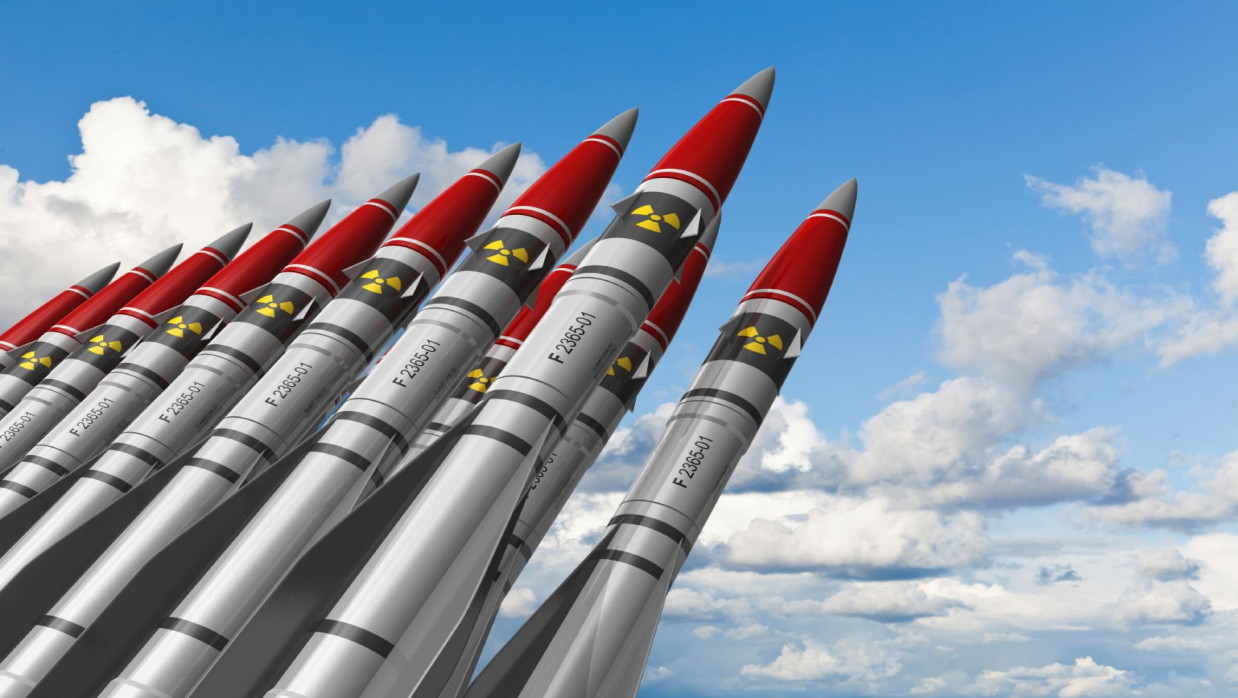
India’s reported move toward testing an extended-range, nuclear-capable ICBM, widely associated with a next-generation system beyond the Agni-V, has reopened an uncomfortable question for the international community: when does deterrence begin to look less like security and more like unchecked strategic ambition?
According to statements attributed to India’s Defence Research and Development Organisation (DRDO), the proposed missile- often referred to as Agni-VI- could carry multiple warheads and reach distances of up to 12,000 kilometers. At that range, the system extends far beyond South Asia’s immediate deterrence environment, theoretically putting not just China, but parts of Europe, the Middle East, and even North America within reach. This is not a marginal upgrade; it is a qualitative shift.
From New Delhi’s standpoint, the rationale follows a familiar script. Indian strategists argue that evolving capabilities are necessary to maintain credible deterrence against China, particularly as Beijing modernizes its nuclear forces and expands its strategic reach. In this view, longer-range missiles and MIRV technology enhance survivability and ensure second-strike capability- cornerstones of deterrence stability in classical nuclear theory.
Yet this justification raises more questions than it resolves.
If China is the principal concern, India’s existing arsenal already provides substantial coverage. Systems like Agni-V have long been capable of reaching key Chinese targets. Pakistan, similarly, is already fully encompassed within India’s current strike envelope. So what strategic gap does a 12,000-kilometer ICBM actually fill? The answer, uncomfortably, appears to lie beyond the region.
Historically, intercontinental-range nuclear systems emerged within clearly defined adversarial frameworks. The Cold War saw the United States and the Soviet Union build arsenals explicitly aimed at each other, structured around mutual vulnerability and deterrence stability. China’s nuclear modernization, too, has been anchored in its strategic competition with the United States. Pakistan’s nuclear capability, for its part, developed in direct response to India’s earlier nuclearization, rooted in a specific and localized security dilemma.
India’s trajectory appears different. Its expanding range and payload capabilities suggest an ambition that is no longer confined to regional deterrence. Whether framed as a quest for great-power status or as a response to shifting global hierarchies, the result is the same: the gradual transformation of India from a regional nuclear actor into a potential global threat.
This evolution carries risks that extend far beyond South Asia.
First, the introduction of MIRV-capable, long-range systems can destabilize deterrence by incentivizing counterforce strategies. Multiple warheads increase the temptation to target an adversary’s nuclear forces preemptively, compressing decision-making timelines and raising the risk of miscalculation. In a region already marked by short warning times and persistent political tensions, such shifts are particularly dangerous.
Second, the political context cannot be ignored. Under Prime Minister Narendra Modi, India’s strategic posture has increasingly intersected with a more assertive and ideologically driven national security narrative. Critics argue that this environment- often associated with the broader ideology of Hindutva- has lowered thresholds for risk-taking, as seen in episodes of cross-border escalation and military signaling. The concern is not simply about capability, but about the willingness to use or threaten it in moments of crisis.
The reference to operations such as “Op Sindoor” feeds into a broader perception of strategic impulsiveness. In a nuclearized environment, even limited conventional actions can carry escalatory risks. When layered atop expanding nuclear capabilities, the margin for error narrows further.
This brings us to the most pressing question: is the international community paying attention?
For decades, global non-proliferation efforts have focused on preventing horizontal spread- new states acquiring nuclear weapons. Less attention has been paid to vertical expansion within existing nuclear states, particularly those outside the traditional P5 framework. India’s growing missile capabilities challenge this complacency. If left unexamined, they risk normalizing a new tier of nuclear competition, one that blurs the line between regional deterrence and global power projection.
For Western policymakers, the issue is particularly delicate. India is often viewed as a strategic partner in balancing China, leading to a degree of tolerance- or at least muted criticism- of its military modernization. But strategic convenience should not come at the expense of strategic clarity. The same capabilities that enhance India’s deterrence posture vis-à-vis China also expand its reach in ways that affect the broader international system.
The erosion of arms control frameworks, the modernization of arsenals by major powers, and the advent of new technologies- from hypersonics to AI-enabled targeting- have collectively destabilized the nuclear landscape. India’s trajectory is part of this larger pattern, and it deserves scrutiny on its own terms.
The implications are immediate and concrete. Islamabad must account not only for India’s existing capabilities but also for the doctrinal shifts that new technologies may enable. This reinforces the logic of maintaining credible deterrence, while also underscoring the importance of restraint and risk-reduction measures.
Ultimately, the debate over extended-range ICBMs is not just about one missile system. It is about the direction of nuclear politics in the 21st century. Are we moving toward a more stable equilibrium, grounded in mutual deterrence and transparency? Or are we entering an era where technological ambition outpaces strategic wisdom?
The answer will depend not only on India’s choices, but on how the rest of the world responds. The question, therefore, is not rhetorical: is the West watching- or is it choosing not to?


0 Comments
LEAVE A COMMENT
Your email address will not be published