

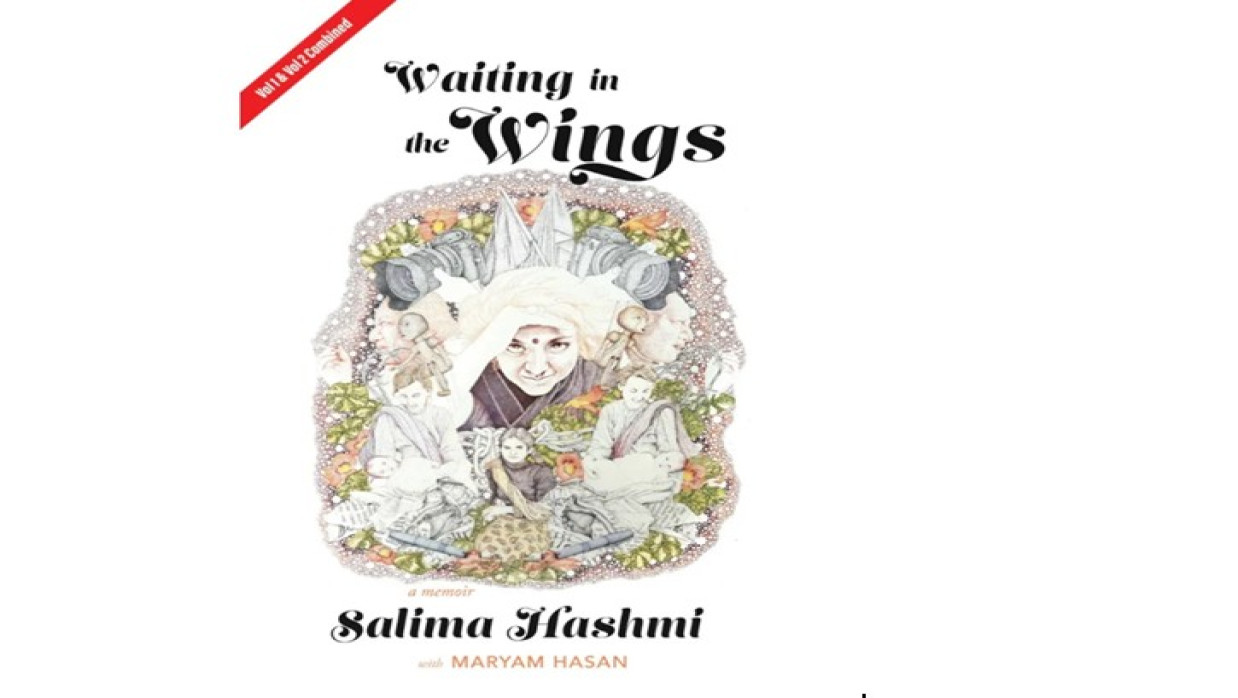
“Waiting in the Wings”, a memoir, is a story of a polymath, a saga of an artist, a portrayal of a wordsmith, a history of an art historian, a teacher and of an academic and public intellectual, Ms. Salima Hashmi.
Salima Hashmi has come up with her highly engaging memoirs, journey into the checkered and fractured history of the Sub Continent. What makes her task more challenging is the stark reality that she, Ms. Hashmi happens to be the eldest daughter of the world-renowned and much-admired progressive Urdu poet, Faiz Ahmed Faiz, a recipient of the Lenin Peace Prize. ”Waiting in the Wings” impels a reader to reflect on how the writer’s life had been intertwined with the trials and tribulations of her father, Faiz Ahmed Faiz.
Deeply aware of the larger picture, Salima is conscious that her life has been only a minuscule part.
Born in Delhi in December 1942 to a father hailing from Sialkot and a mother, Alys, an English woman Salima Hashmi was brought up in a very cosmopolitan and enlightened environment.
The partition of the Subcontinent in 1947, which witnessed unremitting communal mayhem left a lingering trauma on the mind of Salima. She vividly remembers a Centre in Lahore of women and children who had been abducted or got lost, where volunteers were making desperate and painstaking efforts to find their near and dear ones, the children glaring with stony looks through the windows, women with half clothed, begging for a piece of cloth to cover their body. These sights of lost and bewildered souls left an indelible mark on Salima’s heart.
Yearning for peace ran through her veins. In later part of her life while in London along with her husband, Shoaib Hashmi, she was involved in demonstrations and protests against injustices, home and abroad, chanted anti-Vietnam war slogans, faced the baton-charging mounted London police. on numerous occasions.
As a peacenik such protest marches were in her veins. In her book she vividly recalls massacre of the Sikhs in Murree in 1947, a family of Sikhs who were returning from Srinagar were killed mercilessly.
Sensing communal tension, the family with some other travelers decided to break the journey at the hill station. There was a pal of gloom over the idyllic hill station. The ladies decided to hold a peace march to lower down the tempers. As a four-year-old girl, on the persuasion of her mother, Alys Faiz, Salima while riding on a donkey with a white flag firm in her hand led a protest March against the frenzy.
To escape the communal riots the Sikhs boarded a packed train to travel via Lahore to Amritsar, Sikh’s spiritual capital. Ladies and children on the station were scampering in desperation to find a toe hold in the train and make an exit to Amritsar for good. It was a bedlam at every station, some were lucky and some not so lucky to get on the train.
People were slitting each others throat along communal divide. A sensitive soul like Faiz on the traumatic tragedy had reasons to pen down deeply painful verses,
“yeh daagh daagh Ujala, yeh shub gazeeda seher,
“wo intizar thha jiska yeh wo seher tau nahi”
With blight patches on the brightness, the dawn is so dark,
This was not the dawn we had been waiting for.
Faiz joined the British Army during the Second World War. In view of the war situation his credentials as member of the Indian Communist Party were relegated for a while. Alys Faiz had a similar background and had remained active member of the British Communist Party of its Indian League. Faiz moved up the trajectory by dint of his merit and handled press and publication department with remarkable ease. His old friend Mian Iftikhar Uddin was launching a newspaper, Pakistan Times, from Lahore and he wanted Faiz to join as its Chief Editor. Faiz resigned from the army as Lt. Colonel and came to Lahore and joined The Pakistan Times.
In March 1951 when Salima was over eight years old and the younger sister Muneeza was hardly four, misfortune struck. Faiz while still in bed was whisked away at early hours by some unknown people to an unknown place. Young Alys Faiz’s desperate bid to save his father from the unknown intruders was of no avail. Next day it was learnt that a conspiracy to overthrow the civilian government by some disgruntled army officers and a few communist leaders was unearthed which allegedly, included Faiz, Hussain Ata and Sajjad Zaheer aka Bunnay Mian, Secretary General of communist party. Sajjad Zaheer as a progressive writer had earned name and fame as the author of an experimental novel in Urdu, ‘London ki aik raat’
On the military side, General Akbar, his wife Nasim and a few more officers were allegedly involved. These officers were highly irked over the dithering of Liaqat government on the Kashmir front. The Pakistani troops were close to Srinagar when they were asked to pull back. It was also rumored that army had purchased the weapons but they were never delivered at the front. They felt let down. With the detention of Faiz, Alys, Faiz’s English wife with the two daughters was left high and dry with nothing to fallback on. Alys as a sole bread earner started working in The Pakistan Times, commuting daily to the office on a bicycle. This was how the family met the expenses for their upkeep. The first meeting of imprisoned Faiz with the family took place at Lyallpur jail after a few months. It was a moving scene and touching moments beyond comprehension.
Salima Hashmi informs in her book that the trial of the “conspiracy case” commenced in Hyderabad jail where Faiz was along with other accused persons were kept. Meeting Faiz at Hyderabad jail in regular intervals put extra burden on Faiz’s wife Alys’ meagre budget. To save money, Alys would travel in inter or third class coaches.
Husyen Shaheed Suharwardhy, a great lawyer and once the Prime Minister of Pakistan, was the defense counsel of Faiz. The trial concluded with handing down of four years sentence to Faiz. He was now moved to central Jail Montgomery along with two other convicts. It offered him better lodging, a mud plastered two room accommodation with a small court yard. It has now been converted into Faiz Museum.
‘Mushaqqati’, convicts under rigorous sentence, were at a liberty to sing while in the museum.
“Qafas udaas hae yaro, saba say kuchh tau Kaho,
Jo kooway yaar say niklay tau Sooway daaf chaley.”
‘Caged prison is so sad, oh friends, ask the gentle breeze,
Starting from beloved’s lane, it should now cascade towards the gallows.
Sajjad Zaheer was lodged in Machh jail notoriously known for the inclement weather. As luck would have it, the Constituent Assembly declared the conspiracy act as void, paving the way for the release of the prisoners. Sajjad Zaheer after his release decided to return to India and devote his time to the cause of progressive writers.
Later in life Salima Hashmi continued to probe her father about the conspiracy case. Faiz confided that he attended two meetings and admitted that the idea was impractical. Disgruntled army officers were giving vent to their disillusionment with the Liaqat government.
Salima Hashmi informs her in her book that Faiz’s woes didn’t stop here. He was again detained and locked in Lahore fort by the military government of Ayub khan. It was for a few months. After his release he was soon preoccupied with Lahore Art council for the promotion of art and culture. Faiz spent his later years in Beirut and London.
Salima got into National college of Art. During the time NCA was undergoing massive transformation into a modern Art institution by the untiring efforts of its Dutch American principal, Mark Ritter Solenenburgh. He later helped Salima to concentrate on Bath Art School, helping her advance her career trajectory.
According Salima her stay in England, initially at Bath School of art and design and then at London with her husband Shoaib Hashmi had been rewarding. There were occasions to hang out with old pals like Tariq Ali, leftist activist, Salman Taseer, her first cousin, and other stalwarts such as Rashid Rehman and Sohail Iftikhar. She speaks of them with a warmth and fondness.
In 1967 the news of Che Guevara’s brutal assassination saddened Salima immensely though to Faiz, her father it was a moment of celebration as Che was now larger than life and became in death, a lifelong threat to his detractors. Salima was moved, seeing the way her father, a revolutionary himself, immortalized Che, another revolutionary.
Salima’s forays into the Pakistan Television from 1970 onward were another enlivening experience. She was now paired with Shoaib Hashmi as presenter of most popular satirical programmes while excelling in mimicry. In fact through the PTV in Pakistan she pioneered the art of using Mimicry as a tool of critiquing the society’s missteps.
While describing Faiz as a father, Salima is vociferous, she paints her father larger than life and deservingly, so. However, this does not mean that Salima in any manner viewed Alys, her English mother any less. Salima portrays her mother as someone who never brooked indolence. To Salima, her mother Alys, was a house keeper, bread-earner, a disciplinarian, and a brave person. Salima is also genuinely proud of her younger sister, Muneeza, who marked her name in the Pakistan Television, excelling both in the field of program production and in senior management positions.
While reflecting on the bygone years Salima feels that to a degree she was able to imbibe creativity of her brilliant husband Shoaib Hashmi, but their opinion was always out of sync with the people at the helm notwithstanding its consequences. Yet she had been so successful to make best out of her life.
The two sisters, Salima Hashmi and Muneeza Hashmi, with a close circle of friends made a bold and innovative move a few years ago to set up Faiz Foundation, a non-profit organization with Faiz festival, among other chores, being its regular annual feature. It draws swathe of intellect from all parts of the country and from abroad. What started as a measured step has evolved into an enduring movement spiraling and connecting all forms of art, literature and vibrant social themes. A bridging bond between people of diverse opinions but with a yearning for uninterruptible discourse. On occasions resonance of GenZ from the open lawns of Jawahar Lal Nehru University, Delhi, sounds so familiar to the thronging crowd at Alhamra, Lahore;
“Hum dekhengay,
Laazim hae kay hum bhi dekhain gay,
Jub Zulum o sitam kay Koh-i-giraan,
Rooi ki tarah urr jaaen gay,”
We will see it, we would definitely see, we will see,
When hefty mountains of injustice and oppression,
Would Fly away like wisp of cotton.
Portrayed in her book, “Waiting in the Wings” Salima Hashmi’s life journey conveys this message clearly that yearning for justice can only be delayed but not denied.

0 Comments
LEAVE A COMMENT
Your email address will not be published