

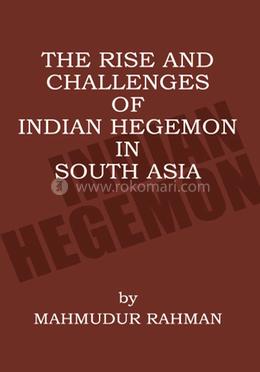
 photo : rokomari
The Rise and Challenges of Indian Hegemon in South Asia (2025)
by Mahmudur Rahman
Ananya, 464, ISBN: 9789849667936; USD 50.
Reviewed by Dr. Serajul I. Bhuiyan
Introduction
Against the context of strategic uncertainty, disputed sovereignties, and the remaking of power in the geopolitics of Asia, The Rise and Challenges of Indian Hegemon in South Asia is an opportune and thought-provoking intervention. Authored by Dr. Mahmudur Rahman, a trenchant intellectual voice and dissident journalist-turned-public intellectual, the book presents a scathing critique of mainstream narratives that celebrate India’s rise as benevolent or necessary. With clarity, passion, and piercing analytical acumen, Rahman offers not just a scholarly critique, but a radical reconsideration of the regional power dynamics—laying bare what he sees as the contradictions and coercions inherent in India’s hegemonic aspirations.
Drawing upon a rich tapestry of international relations theory, historical precedents, and diplomatic case studies, the author interrogates the mythos of Indian exceptionalism and exposes the fragile scaffolding beneath New Delhi’s self-proclaimed leadership in South Asia. Far from being a mere descriptive account, this work is a critical dissection of India’s strategic behavior—how it oscillates between soft power diplomacy and hard power coercion, between idealist rhetoric and realist action.
What distinguishes the book is not merely its academic gravitas but also the moral clarity with which it formulates the issue of hegemony. Rahman situates India’s regional ambitions within a broader postcolonial logic of remembrance and power projection, offering readers a penetrating examination of how dominance is exercised, challenged, and even resisted by the smaller powers constituting the South Asian periphery.
Whereas regionalism has to fight both the centrifugal pull of nationalism and the centripetal push of globalization, this book challenges academics, policymakers, and South Asians generally to reflect on what leadership there should be. Should regional peace be best delivered by a single hegemon or pluralized and cooperative forms? Can India reconcile its grand power ambitions with the democratic aspirations of neighbors?
In addressing these questions, The Rise and Challenges of Indian Hegemon in South Asia does not merely diagnose an illness—it sparks a debate that is necessary on the future of the region itself. It is a landmark book in South Asian studies, international relations, and postcolonial political theory, by an author who is not afraid to ask the hard questions that many in academia and diplomacy like to overlook.
Framing Indian Hegemony: Aspirations and Realities
The book starts on a rich note by analyzing the ideational and conceptual space from which India is trying to build hegemony over the region. With great ease, the author references both the realist and constructivist schools of international relations thought to place India as a “reluctant hegemon”—a state fortunate enough to have old ambitions of hegemony over South Asia but burdened with internal contradictions and external skepticism. This reluctant hegemon is neither entirely assertive nor completely passive; instead, it is placed in a state of strategic ambiguity, oscillating between normative leadership and coercive diplomacy.
India’s postcolonial identity is central to its hegemonic rhetoric. Having emerged from the experience of colonialism with a civilizational self-confidence and a commitment to anti-imperial solidarity, India positioned itself as the moral pivot of South Asia—a unifying force and a catalyst for regional cooperation. Its Nehruvian policy of non-alignment, its championing of South-South solidarity, and its leadership in peacekeeping and decolonization movements comprised the ethical essence of its soft power politics.
But, as the book compellingly argues, this idealized self-image regularly collides with the complex realities of power politics. India’s foreign policy has tended to tread a tightrope—alternating between Gandhian idealism and Kautilyan pragmatism. It preaches democracy, non-intervention, and intra-regional peace in one breath; it employs economic blockades, water-sharing disputes, border militarization, and electoral interference in neighboring states in the next. This posture-practice contradiction—where the rhetoric of good leadership is put alongside coercive policies—undermines India’s credibility of regional ambitions.
Moreover, the book identifies key structural and normative constraints that are slowing India’s rise as a consensual hegemon. Structurally, India faces chronic asymmetries of power allocation, economic dependence, and diplomatic leverage in the region. Normatively, its reputation of arrogance, centralism of power, and insensitivity to deference has pushed even traditionally close countries to the margins.
The author is especially perceptive in showing how India’s desire to be the leading power in the region is consistently foiled by its failure to generate confidence. Its sporadic involvement in regional multilateralism, discriminatory use of bilateralism to marginalize opposing voices, and inability to materialize on long-nourished deals—such as the Teesta water-sharing deal or the reinvigoration of SAARC—merely provide fodder to the idea of India as a selfish, rather than a responsible power.
By situating India’s foreign policy in this complex environment—highlighted by historical weight, strategic inconsistency, and contested legitimacy—the author demonstrates that hegemonic ambition without shared confidence and institutional reliability proves to be an exercise in futility. India possesses material capability and demographic weight to assume leadership, but a deficit in regional acceptance and moral consistency still blocks its path to sustainable leadership.
In substance, the book’s initial chapters present a firm intellectual foundation: South Asia’s regional hegemony can never be claimed—it has to be gained by being steady, empathetic, and generous in one’s vision of regionalism. India’s hegemonic venture will remain fractured, its power dispersed, and its leadership tested so long as it fails to synchronize its desires with its deeds.
Case Studies in Bilateral Strain
The book’s strength lies in its very detailed case studies, offering country-by-country observations of India’s bilateral relations:
- Bangladesh: The book recognizes conventional ties and coordination in 1971 and water-sharing treaties, but refers to persistent issues on the Teesta River issue, trade imbalances, and border deaths. India’s in-depth internal communal politics (e.g., CAA/NRC) adds further pressure on the relationship.
- Nepal and Bhutan: The 2015 Nepal blockade is mentioned as a tipping point that energized anti-India sentiment and pushed Kathmandu into the arms of Beijing. Bhutan, long deferential, is reconsidering its diplomatic approach in the wake of perceived Indian assertiveness.
- Maldives and Sri Lanka: India’s meddling in Sri Lankan internal politics and its hesitant foray into the Maldives are used as examples of overextension that have given China a strategic beachhead in the subcontinent.
- Pakistan: The book characterizes India-Pakistan tensions as a perpetual tinderbox that rationalizes India’s regional militarism on the back of SAARC’s promise.
Each case points to India’s struggle to transition from a regional influencer to a respected leader. Hegemony, the author argues, cannot exist in an environment of asymmetric coercion and ideological difference.
Regionalism Undermined: The SAARC–BIMSTEC Divide
Perhaps the most extraordinary and most sobering strength of The Rise and Challenges of Indian Hegemon in South Asia is its negative critique of India’s ambivalent approach to regional institutions—namely, the South Asian Association for Regional Cooperation (SAARC) and the Bay of Bengal Initiative for Multi-Sectoral Technical and Economic Cooperation (BIMSTEC). The book contends that India, rhetorically committed to regional integration, has been the reason for stagnation and dysfunction of South Asia’s centerpiece multilateral forum, SAARC. This paradox, according to the book, exposes the reach of India’s hegemonic project and probes the more profound crisis in regionalism itself.
SAARC, formed in 1985 with the noble mission of fostering economic cooperation, peace, and collective advancement of the people of South Asia, has been a massive failure. Despite being home to nearly one-quarter of the world’s population, the region remains one of the most economically unintegrated blocks on earth—with intra-regional commerce mixed at around 5%, compared to well over 25% in ASEAN. The author squarely attributes much of this paralysis to India’s prolonged rivalry with Pakistan, which has turned SAARC into a hostage of bilateral animosities. New Delhi’s repeated boycotts of SAARC summits, most notably the cancellation of the 2016 Islamabad summit following the Uri attack—have contributed to a diplomatic stalemate, rendering the institution nearly defunct.
In this vacuum, India has increasingly promoted BIMSTEC as a preferred alternative. With seven South and Southeast Asian members—Bangladesh, India, Myanmar, Sri Lanka, Thailand, Nepal, and Bhutan—BIMSTEC is a form that the Indian policymaker imagines as a more efficient and “politics-free” platform. But, as this book perceptively observes, this change is more an experiment in strategically sidelining Pakistan than a search for true regionalism. Through aligning India’s regional approach with the Bay of Bengal and the Indo-Pacific, BIMSTEC furthers India’s geopolitical interest: it strengthens the country’s “Act East” policy, resonates with U.S.-initiated Indo-Pacific thinking, and reconnects India at the crossroads of South and Southeast Asian strategic corridors.
But such practical engagement with multilateralism comes at a price. Genuine regional leadership is reported not to be based on exclusion and asymmetry. India’s selective approach erodes institutional confidence and reinforces the view among its smaller neighbors that multilateralism, led by New Delhi, will always remain in the service of India first. The marginalization of SAARC also undermines platforms that could also solve transnational challenges—such as climate change, migration, terrorism, and public health emergencies—that no single country in the region can solve by itself.
Also, the book queries whether concrete fruits complement India’s passion for BIMSTEC. As much as it has the promise, BIMSTEC is under-financed and politically lopsided, with members such as Myanmar being involved in internal volatility and Thailand being more or less absent. Lack of a solid institutional platform, binding obligations, and political will across the board makes BIMSTEC’s promise more wishful than realistic.
The author believes hegemonic leadership is about more than inviting summits or issuing statements—it is about moral legitimacy, institutional coherence, and the capacity to assimilate dissent. Until India prioritizes bilateral primacy above multilateral equity, its vision for the region will not be achieved, and its neighbors will keep looking for counterbalancing alliances—particularly with China.
In brief, this chapter is a stinging reminder that South Asian regionalism is a weak and impaired project, not because of a lack of frameworks, but because of a lack of trust. Unless India changes its role from that of “big brother” to a cooperative partner, the vision of an integrated, prosperous South Asia will remain a dream deferred.
Strategic Challenges: China, the US, and Domestic Turmoil
One of the key contributions of the book is its discussion of India’s external and internal challenges to hegemony:
- China: As China deepens its investments across South Asia in the Belt and Road Initiative, China is slowly encroaching on what India considers its traditional sphere of influence. From Nepal in the north to the Maldives in the south, Beijing is becoming more and more a counterbalance to Indian dominance.
- United States and the QUAD: India’s alignment with Western nations in the form of the Indo-Pacific strategy and the QUAD alliance, as argued by the author, is an externalization of its hegemonic desires that regional actors also see with suspicion of an impending Cold War nature.
- Domestic Issues: Most compellingly, it can be argued that India’s domestic political trajectory—growing Hindu nationalism, repression of the media, and democratic decline—is damaging its normative soft power. The moral high ground that has long justified its leadership in the region is fast disappearing.
Contribution and Critique
The Rise and Challenges of Indian Hegemon in South Asia is a model work of scholarship that weaves international relations theory and regional case studies deftly together with history and geopolitical analysis. It offers a robust interdisciplinary contribution—ranging from political science to strategic studies, postcolonial theory, and diplomatic history—to examine the parameters of Indian foreign policy behavior and its quest for South Asian regional hegemony. The book disproves conventional wisdom that draws regional leadership from the economic advantage and military might and shatters the misconception that size can be equal to undisputed mastery over neighbors.
One of the biggest strengths of the book is its comparative framework. By applying the same critical analysis to India’s bilateral relationship with every one of the South Asian neighbors, the author finds the same patterns of strategic inconsistency, coercive diplomacy, and promise-breaking. This comparative approach makes the argument more valid, illustrating that India’s challenges against hegemony are systemic and not isolated instances or personality-driven deviations. It also places India’s regional policies in the broader debate regarding global shifts of great powers, Chinese ascent, and the post-American Asian order.
The addition of the author’s critique of India’s selective multilateralism, domestic contradictions, and moral inconsistencies provides a richer texture to the argument. The book successfully makes the case that regional hegemony hinges not only on material capacities but also on legitimacy, trust-building, and inclusive engagement—so notoriously absent in India’s foreign policy in practice.
But while the book’s thesis in the middle is reasonable and supported, there are a few parts where the analysis can be enriched. For instance, the role of subnational actors, particularly India’s border states such as West Bengal, Assam, Punjab, and Tamil Nadu, is touched upon lightly when they have implications for the foreign policy dynamics. These states are often cultural and economic bridges (or fault lines) to neighboring nations such as Bangladesh, Nepal, Pakistan, and Sri Lanka. Their political alignments, identity politics, and vote arithmetic frequently shape the regional policies of the central government in ways worth exploring further.
Moreover, the book could also have benefited from a broader discussion of non-state and transnational threats increasingly defining regional geopolitics. Some examples are cross-border migration (i.e., the Rohingya crisis), human trafficking networks, environmental degradation, climate change-driven displacement, and pandemics, which are central to understanding power dynamics in South Asia beyond state-based frameworks. These threats usually lay bare the frailties of regional institutions and the weaknesses of hegemonizing postures but are under-analyzed in this volume.
Another layer that can enhance the analysis is the relationship between foreign policy and domestic populism. India’s recent Hindu nationalist revival and the use of foreign policy as a tool to bolster domestic credibility raise serious questions regarding the credibility and sustainability of India’s regional obligations. For example, anti-immigrant rhetoric and laws such as the Citizenship Amendment Act (CAA) and National Register of Citizens (NRC) have been a cause of concern in neighboring countries, particularly Bangladesh, but also Nepal and Sri Lanka. Still, domestic-to-external foreign policy connections are left somewhat subdued in the book.
Despite these lacunas, the book remains a rich and audacious contribution to South Asian geopolitics scholarship. It fills an essential gap in the literature by offering a bottom-up analysis of India’s neighborhood behavior and centering the agency and voices of smaller South Asian states—something that much of the existing IR literature tends to do without. The hard-headed skepticism of the author about India’s grand strategy offers a necessary counter-narrative to dominant discourses that build India as either a challenge-free or benevolent hegemon.
In summary, The Rise and Challenges of Indian Hegemon in South Asia is both an academic book and a strategic clarion call. It exhorts India—and the world—to acknowledge the mismatch between words and deeds, and to understand that stable leadership in South Asia must be based not on dominance, but on dialogue, equality, and reciprocal respect.
Conclusion
The Ascendancy and Dilemmas of Indian Hegemon in South Asia is a highly contemporary and acute analysis of the paradoxes defining India’s regional ambitions. Weaving together insightful empirical case studies with theoretical reflections, the author unmasks the tenuous foundations of India’s hegemonic posture. This posture tends to oscillate between aspiration and estrangement, confidence and contradiction. Anything other than a direct path to regional leadership, India’s journey is discovered to be full of strategic missteps, normative inconsistencies, and a perpetual inability to gain the confidence of its neighbors in South Asia.
Essentially, the book reexamines the very assumptions of hegemonic reasoning in the postcolonial environment. It deconstructs the idea that size on the map, demographic power, or economic prosperity automatically bestows leadership. Instead, it argues that legitimate regional leadership hinges on the norm of legitimacy, the rule of reciprocity, and compliance with normative regionalism. India’s repeated return to bilateralism, its hesitance to institutional multilateralism, and rising domestic polarization have not only isolated its neighbors but also opened up the possibilities of alternatives—chiefly with China and the other external actors.
What is evident in this critique is that India’s pose of regional dominance can no longer pass without challenge, and its leadership no longer inspires wonder but suspicion. The author calls for a paradigm shift in the exercise of power in the region—not coercive power or symbolic suzerainty, but productive diplomacy, mutually respectful engagement, and participatory contribution.
In a neighborhood bounded by shared histories but divided by deep political fault lines, this book is a bold reinterpretation of what South Asia could be if its most potent state chose empathy over entitlement, partnership over patronage.
The final insight is as profound as it is urgent: “A hegemon must not only dominate but must also lead—and leadership without legitimacy is no leadership at all.”
As we gaze toward the future of this subcontinent, we are cautioned by the timeless insight of American civil rights leader Dr. Martin Luther King Jr.:
“Power without love is reckless and abusive, and love without power is sentimental and anemic.”
It is when power is tempered by justice, and ambition is guided by humility, that the potential for a peaceful, cooperative South Asia can be fully realized.

0 Comments
LEAVE A COMMENT
Your email address will not be published