


 Pranaya Rana
There are decades when nothing happens, and then days when decades happen. Two days – 8 and 9 September – changed the face of modern Nepal, figuratively and literally. What is happening in the country now is unprecedented. The entire state apparatus has been swept away. Prime Minister K P Sharma Oli has resigned and the federal parliament is nominally suspended. The office of the president – held by Ram Chandra Poudel – is the last institution standing.
The media has been scrambling to cover the events of the past week. But with major media houses like Kantipur burnt down in riots, and no guardrails in online discourse on what is and is not true, Nepal is rife with misinformation, rumours and hearsay. It has not helped that the Gen Z protesters whose demonstration against nepotism and corruption set the whole train of events in motion do not have an official spokesperson or even an official leadership structure. In an information vacuum, fears have run high of a possible army coup, of Indian infiltration, of a return of the monarchy.
Here, I try to provide an overview of the Gen Z protests and the events that have unfolded over the past week. I hope this can serve as a resource for those both inside and outside Nepal seeking to better understand what has happened.
Let’s begin.
FOR WEEKS before the initial protests on 8 September, young Nepalis had been engaged in an online campaign loosely organised around the “NepoBaby” trend. This began in Indonesia, where mass protests have been ongoing for months, sparked by anger at the former president Joko Widodo and his eldest son, Gibran Rakabuming Raka. Widodo, who once contrasted himself with Indonesia’s old and nepotistic ruling families, the Yudhoyonos and the Sukarnos, faced backlash for steering Gibran into the office of vice president.
In Nepal, the NepoBaby campaign targeted the children of Nepal’s political and business elite. Among those in the crosshairs were Jayveer Singh Deuba, son of Sher Bahadur Deuba and Arzu Deuba – respectively, the president of the Nepali Congress and the serving foreign minister until the fall of the government on 9 September; Shrinkhala Khatiwada, daughter of the Communist Party of Nepal (Unified Socialist) politician Birodh Khatiwada and wife to the managing director of Kantipur Media Group, Sambhav Sirohiya; and Saugat Thapa, son of Bindu Kumar Thapa, a businessman and the minister of social development, youth and sports for Gandaki Province. Their lavish lives, on full display on social media, where they flaunted luxury goods and European vacations, were contrasted with the lives of ordinary Nepalis, many of whom live hand-to-mouth, and millions of whom go abroad to labour to be able to provide for their families.
The campaign reflected a broader frustration with the status quo. Nepal’s Gen Z came of age in the years following the end of the country’s civil war and the abolishment of the Nepali monarchy, now nearing two decades in the past. They were promised a “new Nepal” under a restored democracy and a new constitution, where they could lead better lives than those of their parents. Instead, Gen Z-ers were confronted with a failing economy, with few job prospects and an increasing societal push to migrate due to the lack of a worthwhile future in Nepal. As ordinary Nepali youth compared themselves to the children of the elite, many of them also from Gen Z, there was a swell of righteous anger.
This was what was happening when the social media ban hit. The Nepal government had for years been demanding that tech giants like Meta, Alphabet and X Corp register in Nepal in order to continue operating here. They had all refused for various reasons, most notably because Nepal’s parliament had passed no law compelling them to do so. The government’s insistence on their registration was based on a directive that it had issued on its own. When the matter came to the country’s Supreme Court, it also decided that social media companies needed to register. This was the impetus for the government to set a seven-day deadline for these companies to comply. When the deadline expired, the government proceeded with the ban.
For Gen Z, this was the final straw. The anger and frustration that had been building up online spilled over into a street protest. The feeling among Gen Z-ers was that the government was attempting to stifle free speech via the ban to prevent criticism of politicians’ children. On the morning of 8 September, young Nepalis turned out in the thousands to protest entrenched nepotism and corruption, and to assert their rights to free speech and peaceful assembly.
MONDAY, 8 September, started out lively, with singing, dancing and sloganeering as young protestors gathered in cities across the country. Teenagers, many bunking class and in their school and college uniforms, marched with placards condemning corruption and demanding better lives for all Nepalis. In central Kathmandu, where the largest protest gathered, the security forces were at first strangely quiet, even allowing protesters to break through a barricade without retaliation on their way towards the federal parliament. But then, a few hours in, things turned ugly. Some rowdier elements had joined the crowd by this point, mostly young men. As protesters attempted to enter the parliament building, the Nepal Police and the Armed Police Force employed deadly means of retaliation. Salvos of tear gas and water cannon gave way to rubber bullets and live ammunition, fired blindly into the crowd. A boy in a school uniform was shot in the head. Searing footage of him bleeding out very quickly went viral. By the end of the day, at least 19 protesters had been killed.
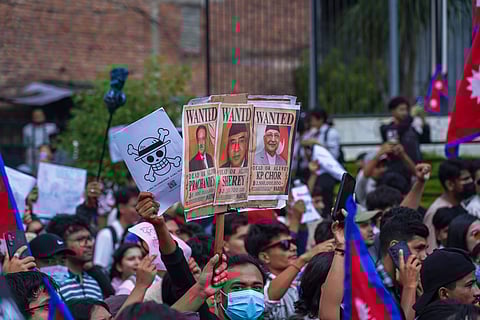
The shock, grief and outrage was almost universal. Nepalis of all ages believed that the government had murdered these protesters – children! – in cold blood. The home minister, Ramesh Lekhak, resigned that evening. Oli did not. Prithvi Subba Gurung, the minister for communication, responded haughtily to questions about Oli’s resignation, saying the prime minister would not go just because some people on the streets wanted him to.
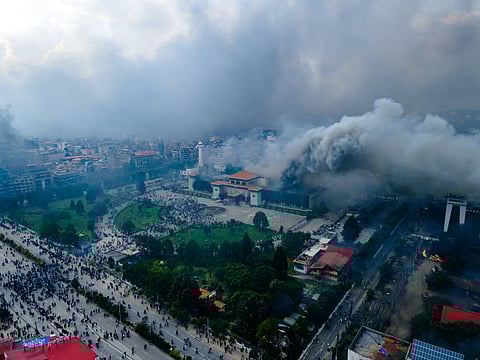
Tuesday, 9 September, dawned in anger. Despite curfews, crowds began to gather across the country. They were somewhat restrained at first, but rage quickly gave way to violence. Crowds stormed the houses of politicians and burnt them down. The leader of every one of the three biggest political parties – Deuba of the Nepali Congress, Oli of the Communist Party of Nepal (Unified Marxist–Leninist), the Maoists’ Pushpa Kamal Dahal – lost their homes. Oli and Dahal managed to escape unscathed in military helicopters, but Deuba was not so lucky. Protesters cornered and beat him and his wife, Arzu, in their home, before the army finally rescued them. The seats of all three branches of government were attacked and set alight: Singha Durbar, the seat of the executive; the federal parliament; and the Supreme Court.
Gen Z-ers disavowed the violence and called for protesters to go home. Infiltrators had orchestrated the attacks, they said. It was clear that not all the protesters were Gen Z-ers; many were older, and clearly experienced with violence. Some came armed with khukris and iron rods. On the capital’s Ring Road, I witnessed a policeman being dragged out and beaten to death. The men doing the beating were clearly not from Gen Z.
The Nepal Police and the Armed Police Force were helpless against violence at this scale. Afraid for their lives, they retreated, allowing the mob to take over. Protesters even seized weapons left behind by the police as they fled.
At around 10 pm, the Nepal Army finally deployed to restore control. By then, there had been rampant looting and arson. Many private businesses were broken into and set on fire, including outlets of the Bhat Bhateni supermarket chain and the headquarters of Kantipur, the country’s main media house – both widely seen as politically connected.
As of Friday, the army maintains strict curfews, with only intermittent breaks to allow people out to the shops. A total of 51 people are known to have died – the largest death toll of any public protest in Nepali history. And Nepal is staring at an uncertain future.
ON WEDNESDAY, 10 September, the chief of the Nepal Army, Ashok Raj Sigdel, asked Gen Z representatives to meet with him and the president, Ram Chandra Poudel – the last civilian leader left in high office. But the Gen Z protesters are not an organised group; they are simply a loose coalition of young people (many of whom, we should note, do not strictly fit within the Gen Z age range). Their demands are varied, but they broadly agree that their primary agenda is the creation of an interim government led by a person of their choosing. This interim government is to dissolve parliament and conduct new elections within six months.
Other demands include a fair and impartial investigation into the killings on 8 September, and criminal prosecution of everyone involved; an independent commission to probe the wealth and property amassed by politicians; an end to systemic corruption; and youth representation in all state organs. Some factions are also pushing to discard the current constitution and write a new one, and to institute a directly elected head of government (Nepal’s current constitution stipulates indirect election of the prime minister by parliament).
To hash out all these issues, Gen Z-ers have been holding public town hall-style meetings on the online platform Discord. There, thousands of young Nepalis have discussed their agendas as well as potential candidates to lead the interim government. The debates have been lively, albeit a little naive. But they have shown that young people are staking a claim to the governance of their country, and are interested in learning and grappling with affairs of the state. They are exercising their democratic rights as the most significant bloc of the Nepali population and the future of Nepal. They are also doing what has long been denied to them – leading the country.
On Wednesday, on Discord, Gen Z-ers voted for Sushila Karki, a former chief justice, to lead the interim government. The septuagenarian prevailed over other figures popular with Gen Z: Balendra Shah, the mayor of Kathmandu; Harka Sampang, the mayor of the city of Dharan; and Sagar Dhakal, a youth activist and aspiring politician.
Sushila Karki became Nepal’s first – and so far only – female chief justice in 2016, and retired the following year. She was not a career jurist, but a lawyer appointed to the Supreme Court in 2009 by the Judicial Council. This was during a Maoist-led government under Pushpa Kamal Dahal, and Dahal was part of the body in his capacity as prime minister. Karki was made the chief justice in 2016 by the Constitutional Council, a cross-party body that appoints members and chiefs to powerful constitutional bodies. It included Oli, then in an earlier stint as prime minister.
Although Karki cultivated a reputation as a no-nonsense chief justice who stood against corruption, there is one incident that has stained her legacy. In 2017, as head of the Judicial Council, she approved the appointments of 80 judges to High Courts across the country. The decision was criticised for being opaque and politically influenced. Karki argued that the appointments were necessary because the High Courts had been without judges for a long time. She also claimed that it was due to her efforts that the cohort of 80 judges had representation of disadvantaged groups, including women, Madhesis, Janajatis and Dalits (even if this representation was really quite minimal). She addressed this issue in a 2017 episode of the talk show Sajha Sawal.
Karki was accused of colluding with the government of the time, a coalition of the Maoists and the Nepali Congress. It was these same parties that subsequently turned on her. In 2017, when the government decided to appoint Jay Bahadur Chand to lead the Nepal Police, a Supreme Court bench led by Karki overturned the decision, arguing that the government had violated appointment regulations. Appointments like these are made on the basis of seniority, and Chand was number four by seniority in the police. The Maoists and the Congress filed an impeachment motion against Karki, alleging interference with the executive’s functioning. The lower house of parliament passed the motion, but this, too, was blocked from implementation by the Supreme Court. Responding to a writ petition, Justice Cholendra Shumsher Rana issued a stay order, arguing that the impeachment process was politically motivated and had violated constitutional norms. Karki returned to work and duly retired later that year.
Most Gen Z-ers I have spoken to did not know who Karki was before 9 September. On that day, she joined the crowds on the streets to protest Monday’s killings. In a widely circulated interview, a visibly upset Karki denounced the political establishment, demanded accountability for the deaths and placed the blame squarely on the government’s shoulders. Gen Z-ers were impressed that someone of her stature came out and spoke out at a time when most people of her generation were safe indoors. They began researching who she was. Karki’s hard stance against corruption during her judicial career, alongside her public exhortation to party leaders to hand over power to the next generation, resonated especially well. Gen Z-ers also considered that a former chief justice might be the right person to facilitate a transition to a more youth-friendly, corruption-free government.
As I write this, on Friday evening, news has just broken that Karki has reached an agreement with the president to become the interim prime minister. She is to be sworn in shortly and parliament is to be dissolved.
Nepal’s 2015 constitution does not envision anyone from outside the federal parliament becoming prime minister. Karki is not a parliamentarian. There is, however, the doctrine of necessity, a legal principle which states that extraordinary situations necessitate extra-constitutional methods. The president can appoint Karki as interim prime minister under this principle and a broad interpretation of Article 61 (4) of the constitution, which states that the president’s primary duties are “compliance and protection of the constitution.”
To preserve the sanctity of the constitution, Karki will have to swear her oath of office on the document and act in accordance with its provisions. She will not have a free hand to do whatever she likes. Everything she does, including dissolving the current parliament and calling for fresh elections, will have to conform to the law of the land. As a former chief justice, Karki will be well aware of this.
It is perhaps surprising that Karki won out among Gen Z-ers over Balendra Shah. A 30-something rapper-turned-politician, Balen, as he is known, may be Nepal’s most social media-savvy political figure, and he is immensely popular, especially among the youth. As the mayor of Kathmandu, he has won admirers among Gen Z for his decisive approach to work and his rejection of the established political parties. He also has detractors, who see him as draconian and a demagogue; his administration’s hounding of street vendors and landless squatters was widely condemned as lacking in empathy and punishing the poorest of Kathmandu’s poor. Shah ran for office in 2022 as an independent candidate and bested prominent candidates from the Nepali Congress and the CPN-UML.
Shah expressed solidarity with the Gen Z protests early on. While he refrained from participating directly in the protests, he supported them on social media. In the aftermath of the violence, he also called out Oli, labelling him a terrorist who had killed children.
But Shah did not appear interested in leading the interim government. Gen Z-ers’ attempts to reach him over the phone were reportedly rebuffed multiple times, as discussed over Discord. Instead, when Gen Z chose Karki, Shah swiftly endorsed her as the right choice. There is speculation that Shah would prefer to run in the next election and vie for the prime ministership rather than serve as interim prime minister for six months. Hami Nepal, one of the most visible groups within the Gen Z movement, has stated publicly that it would rather see Shah as prime minister for five years.
HAMI NEPAL is a non-profit humanitarian organisation, established after the devastating earthquake that hit Nepal in 2015 but formally registered in 2020 during the Covid-19 pandemic. It has undertaken a range of humanitarian missions – for instance, organising relief for victims of the 2023 Jajarkot earthquake. The group claims to be committed to transparency and posts details of its finances on social media. It is mentored by Sanduk Ruit, an ophthalmologist and humanitarian who is one of Nepal’s most beloved public personalities. His endorsement carries significant weight since Ruit is regarded as one of the few nationally (and globally) prominent Nepalis who has refused to play politics and remained committed to his own ideals and work. But Hami Nepal’s backers also include controversial figures like Deepak Bhatta, a businessman who has been accused of corruption, and Sulav Agrawal of Shanker Group, who was charged with black marketing during the Covid-19 pandemic.
It is unclear who first announced the 8 September protests, but Hami Nepal – and especially the group’s founder, Sudan Gurung – quickly became its main face. Hami Nepal was also the only registered organisation that claimed to be behind the protests, so attention naturally gravitated towards it when it came time to negotiate a way out of the political crisis. Gurung, ironically, is not a Gen Z-er, but a 36-year-old millennial. Since 8 September, Gurung has been the de facto leader of the Gen Z movement, negotiating with the army chief on its behalf.
Gurung’s visibility has led to him becoming a target. Rumours are swirling on social media, fanned primarily by Indian actors, that Gurung and Hami Nepal are backed by the CIA and other Western organisations. Their evidence is only that Hami Nepal counts among its supporters Coca-Cola, Students for a Free Tibet and the Barbara Foundation, a non-profit founded by a naturalised Nepali of American origin. The most recent allegation against Gurung is that he is a Christian Indian from Darjeeling and not even Nepali. This has led Gurung to post a copy of his citizenship certificate on Discord.
Besides Gurung, the Gen Z movement does not have many visible leaders. Within the movement, various groups are working independently, often with limited contact. Some groups have told me that they have reached out to others, asking for everyone to come together and form a common platform, but they have had little luck.
Some Gen Z individuals who were initially part of the transition negotiations have since bowed out. For instance, Rakshya Bam, a former member of the CPN-UML’s youth wing, said she left due to the presence of unwanted infiltrators like Durga Prasai. Prasai, a disgraced businessman, has in recent years become a belligerent opponent of federalism and secularism, and has called for Nepal to return to its former status as a Hindu kingdom. Others who initially met with the army chief on 9 September, like the environmental activist Tanuja Pandey, have alleged that they were “bypassed.”
There is currently no clarity as to which Gen Z representatives besides Gurung have spoken to the army chief at any length, or as to whether they have even met or spoken to the president. All of my attempts to uncover these details were rebuffed. On Discord, too, the vast majority of participants, including the moderators, are anonymous. Repeated entreaties from Discord members and social media users to reveal the names of all those involved in direct negotiations have gone unheeded. Either the movement is truly decentralised, with no one besides Gurung playing a decisive public role, or everything is being deliberately hidden. Time may tell which.
Meanwhile, the Nepal Army has been on the streets since Tuesday night and has not withdrawn. There is a persistent fear in civilian democracies that once an army exits its barracks, it is very difficult to get it to go back. This fear led to rumours that the army was holding political leaders, including the president, under house arrest, which led to demands that Poudel appear in public and address the nation. On Thursday night, rumours swelled that the army was going to mount a coup, or reinstate the king, or both. Nepalis woke up on Friday morning relieved, and still free citizens.
The Nepal Army and its chief, Sigdel, have shown little interest in taking over the country, which they could have easily done by now if they wished. Instead, Sigdel appears to be playing the role of referee, bringing Gen Z-ers and the president to the same table. However, there are suspicions that the army has its own designs.
At the beginning of negotiations, Sigdel took it upon himself to also invite Prasai, the royalist and disgraced businessman, as well as the Rastriya Swatantra Party (RSP). He called them “stakeholders” of the protests, even though neither was involved in them. The RSP, an upstart political outfit founded by the former television anchor Rabi Lamichhane – another figure now being talked about as a prime ministerial contender in the next election – bowed out. But Prasai remained persistent, showing up unannounced at meetings and professing his willingness to take leadership of the country. On Discord and on social media, Gen Z has roundly rejected Prasai.
On the streets, as the crisis has stretched on, the army has ceded some ground to civilian security forces. It still assumes responsibility for maintaining law and order, and for issuing daily updates on curfews and prohibitory orders, both of which remain in place.
The Nepal Army has so far made no statement on when it will hand control back to civilian police forces and go back to its barracks. Now, with a deal struck to appoint Karki as prime minister, it is time for the army to retreat.
NEPAL STANDS on the brink of a precipice. It is up to Gen Z to see whether the country takes flight or crashes to its doom. Nepal has never seen a crisis like this. All organs of the state except for the army are non-functional, and a popular uprising has rejected establishment political parties across the board. Gen Z has the initiative, but it is leaderless and divided into many factions, often with competing demands. The longer Gen Z takes to get better organised, and to at least elect a leadership council, the more time there is for unscrupulous actors to try and take advantage. Already, the “youth” leaders of the old political parties – men like Gagan Thapa, Bishwa Prakash Sharma, Yogesh Bhattarai, none of them younger than 49 – have issued statements expressing solidarity with the movement and promising to change their ways. On Wednesday, Oli himself wrote a letter to Gen Z, where he spoke more about his own contributions to national politics than the aspirations of the youth. Dahal has jumped in too, claiming that Gen Z and the Maoists share many agendas. The old establishment is already angling to make a comeback.
The danger is not just from the old political order but also from opportunists like Prasai. In an interview, he has already attempted to take credit for the protests, claiming they were “ours”. Disturbingly, he also said that either Gen Z must choose the leader of the interim government, or the army should take over, dissolve the constitution, and then hold elections. Earlier this year, Prasai was the prime instigator of pro-monarchy demonstrations in Kathmandu that turned violent and deadly. For him, any chaos is a Machiavellian opportunity to push his agenda of reinstating the monarchy and the Hindu state.
The expectations now are lofty: strong economic growth, a corruption-free society, and equal opportunity for all. They will be challenging to achieve, to say the least. Corruption has not been the only thing holding Nepal back; there are also geographical, geopolitical and infrastructural challenges, as well as an entrenched bureaucracy that largely remains rooted in the era of thumbprints on paper documents. Recovery is going to be difficult, especially given the untold billions of rupees in damage to public property. Rebuilding the Supreme Court, the parliament building and Singha Durbar will all be costly, and the public purse will have to bear that burden.
There is also little certainty that Karki will be able to hold an election within six months. In Bangladesh, after student protests forced out the discredited government of Sheikh Hasina, it has been over a year since an interim government under Muhammad Yunus took charge. It was only recently, after much pressure, that the interim government announced that a new election would take place in February. Karki has a Herculean task ahead of her, especially if she is to take the country as a whole with her and not just the Gen Z demographic.
Come election time, whenever that may be, who will contest the vote? The old political parties have been disgraced. Their leaders have been beaten and their offices torched. Who, if anyone, is going to run from these parties? The old parties have pledged introspection, but Nepalis have long known that their promises mean little. What is to prevent them from mounting a comeback and taking the country right back to where it was before 8 September? To push real change, Gen Z must commit to and pursue an electoral agenda, one that seeks to fill the federal parliament and provincial assemblies with credible young people.

Finally, there is the issue of representation. Gen Z is a generation of Nepalis everywhere, not just in Kathmandu. Yet with Kathmandu as the epicentre of the Gen Z movement, decisions made here are once again reverberating profoundly throughout the rest of Nepal – precisely what the federal system established after the civil war was intended to mitigate. How do Gen Z-ers in Nepal’s marginalised Madhes and Far West feel about Karki or the movement? What about Gen Z-ers who do not have access to the Discord server? This movement has upended the old order, but there must be care to ensure that the new order does not replicate the gender, class, caste, ethnic and regional divisions of the past.
As Nepal looks to a new but uncertain future, Nepalis must all remember that the old order was destroyed because it was grossly unequal. The same politicians who belittled and mocked Gen Z-ers now hide in fear from them, protected by the army in its Shivapuri barracks. This is a good sign: politicians should be afraid of the people they fail to serve. Old kinship networks, habits of political patronage and quid pro quo – all defining features of Nepali public life to date – must be dismantled and tossed on the pyre of history. Many past generations have failed to deliver a just Nepal that belongs to all Nepalis. Now Gen Z gets its chance.
The article appeared in himalmag
0 Comments
LEAVE A COMMENT
Your email address will not be published