


 Marlon Ariyasinghe
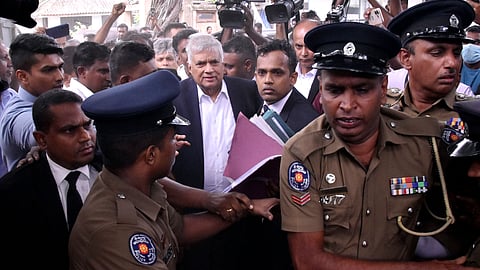
In a first for Sri Lanka, a former president is under arrest in connection with misuse of state funds. On 22 August, the Colombo Fort Magistrate’s Court ordered the arrest and remand of Ranil Wickremesinghe over allegations that he used public funds on a two-day personal visit to the United Kingdom in September 2023.
The move jolted the country’s political circles. Sri Lanka’s major political leaders appeared at the court in a show of support for Wickremesinghe, including the former president Maithripala Sirisena as well as the parliamentarian Namal Rajapaksa, the son and heir apparent of former president Mahinda Rajapaksa. Another former president, Chandrika Bandaranaike Kumaratunga, also chimed in, stating that the arrest was a serious threat to democracy. Sajith Premadasa, presently the leader of the opposition and head of the Samagi Jana Balawegaya (SJB), visited Wickremesinghe at the prison hospital where he was admitted soon after his arrest, as did former president Mahinda Rajapaksa.
Premadasa and Sirisena have long had public run-ins with Wickremesinghe. Premadasa’s split from Wickremesinghe’s United National Party (UNP) badly weakened the once-grand outfit, and Sirisena − who once governed with Wickremesinghe − famously removed Wickremesinghe as prime minister in Sri Lanka’s 2018 constitutional coup, replacing him with his arch rival (at the time, at least), Mahinda Rajapaksa. Yet Rajapaksa and his Sri Lankan Podujana Peramuna (SLPP) backed Wickremesinghe when Sri Lanka’s parliament − not the electorate − elected him executive president in 2022, soon after Mahinda’s brother Gotabaya was forced to flee the country after mass protests amid a calamitous economic crisis.
Now, the entire old guard – Premadasa, Mahinda Rajapaksa, Sirisena, Bandaranaike and others – have voiced support for Wickremesinghe. A couple of days after the arrest, opposition forces united against the government led by president Anura Kumara Dissanayake under the motto “Let’s defeat the constitutional dictatorship,” with current and former parliamentarians expressing solidarity with Wickremesinghe.
Sri Lanka’s politics has created strange bedfellows. Yet Sri Lankans, who have witnessed their leaders’ opportunistic makeups and breakups over the years, know the bed they share. It is a bed that expands and contracts as needed, that sees its sheets swapped at election time – yet the frame endures.
While the courts decide the legitimacy of Wickremesinghe’s arrest, all eyes are on the choreography of solidarity that has followed. The scenario evokes a popular maxim favoured by both Sirisena and Wickremesinghe: in politics, there are no permanent friends or enemies. This is especially so in Sri Lanka’s dynastic, nepotistic political tradition.
The closing of the varied ranks of the present opposition – against a government with a two-thirds parliamentary majority, led by the leftist Janatha Vimukthi Peramuna (JVP) and elected in the wake of the 2022 economic crisis by an electorate livid at the old establishment – is almost instinctive. Each player is calculating how to use the moment to personal advantage or for self-preservation; each still nurses ambitions of returning to power, including Mahinda Rajapaksa and his many family members.
Many of them downplay the allegations against Wickremesinghe – the use of LKR 16.6 million (roughly USD 53,000 at the time) to cover expenses for a ten-member delegation including Wickremesinghe, his wife and security detail on a personal visit – as trivial. But this was not trivial for a country that was then and is still recovering from bankruptcy, with millions struggling to put food on the table. There is a quiet fear running through Sri Lanka’s political class, many of whom have been accused of misusing state funds or flouting the law in the past, but have never faced legal consequences, that the wheels of justice could grind them down next.

But their response follows an old and tired script. They are falling back on what once worked: ad-hoc alliances, public displays of unity, media soundbites and carefully staged photo-ops. What they seem to miss – or refuse to accept – is that Sri Lanka’s political culture has shifted. The mass protests in 2022, which was called the Janatha Aragalaya or People’s Struggle, fundamentally reshaped the average person’s view of politics and the collective voter consciousness. Dissanayake of the JVP rode the Aragalaya’s ethos to achieve power at the head of the ruling National People’s Power (NPP) coalition. In the wake of the Aragalaya, voters are less tolerant of backroom bargains and dynastic manipulations. The reliable theatrics of the past no longer move the crowd, and popular success in Sri Lanka needs an updated playbook.
This applies to the NPP government as well. It is easy to forget, especially after voters chose the NPP to displace the old powers, that the JVP is itself a decades-old party, mired in Sri Lankan politics and with theatrics of its own. In this new political climate, the NPP too will have to adapt and develop new approaches – or risk the same fate of the discredited old forces.
THE DEFINING CHALLENGE for any post-Aragalaya government is to manage expectations. The NPP is discovering this in real time. Since the party took over the country’s administration last year, a series of missteps has sparked backlash: the resignation of Asoka Ranwala as speaker of the parliament after questions were raised over his educational qualifications; confusion and controversy around educational reform plans; and the failure to keep the election pledge of repealing the draconian Prevention of Terrorism Act.
There has also been a wave of industrial action and protests, including strikes by postal workers and non-academic university staff. At the same time, the government is contending with sensitive issues of transitional justice, still unresolved more than 15 years after the end of Sri Lanka’s civil war.
Ongoing excavations of mass graves at Chemmani in the country’s North and at the Colombo Port have unearthed hundreds of remains, thrusting Tamil disappearances and post-war accountability back into the national conversation. Further, the interrogation of the journalist Kanapathipillai Kumanan by the Counter Terrorism Investigation Department (CTID) in response to his reporting from Mullaitivu in Sri Lanka’s north has drawn strong domestic and international denunciation. For many in the North and the East, where the war’s effects endure most, all of this fits a familiar pattern of intimidation and surveillance, illustrating that the country’s coercive security architecture remains unchanged after the Aragalaya.
The education reforms plan, spearheaded by the prime minister, the NPP’s Harini Amarasuriya, exemplifies the larger problem. Most stakeholders agree that education reform is overdue and essential. Yet the government’s opaque, stop-start approach, and the perception of limited consultation around implementation of the reforms, have baffled supporters and critics alike.
Here the NPP’s inexperience shows – this is, after all, the first time the alliance and its constituents have ever wielded power. What is also on display is the broader communication deficit: a shortage of clear, timely explanations of policy and process. Without steady, accessible information in three languages – English, Sinhala and Tamil, ensuring access across Sri Lanka’s deep linguistic schisms – and a feedback loop the public can see, legitimacy erodes, compliance slows, and even defensible reforms look suspect.
It also appears that ministers within the NPP governing coalition don’t have much room to manoeuvre or the power to make decisions without consulting the party leadership, which is in line with the coalition-leader JVP’s hierarchical nature. There are murmurs of frustration within the alliance over this lack of agency.
Several ministers and NPP parliamentarians have faced public blowback for off-the-cuff remarks: for example, Kumara Jayakody’s tone-deaf assertion as the energy minister that Mannar, the site of a bird sanctuary where the government wants to build a wind farm despite local opposition, is not a bird paradise, but “just stale land.” Such condescension, echoed by other parliamentarians, has reinforced the impression of a government with a “we know best” attitude at odds with a post-Aragalaya electorate that expects to be treated as partners rather than mere spectators.
The government has taken many headline-grabbing actions this year with regard to implementing justice and the rule of law. It removed Deshabandu Tennakoon as the Inspector General of Police for abuse of power and misconduct. It pursued the arrest of Shasheendra Rajapaksa, the former state minister and nephew of Mahinda and Gotabaya Rajapaksa for corruption; the former minister Keheliya Rambukwella for money-laundering; and the former Ceylon Fishery Harbour Corporation chair Upali Liyanage for financial misconduct. It obtained the high-profile convictions of former minister Mahindananda Aluthgamage and the former North Central Province chief minister Ranjith Samarakoon on bribery and corruption charges respectively. Wickremesinghe’s highly publicised arrest has also attracted mass attention – and generated much divisive commentary. But the public is not so easily impressed.

Similar waves of arrests have come under past governments, with little eventual effect. Among the upper-middle class, impatience with the pace of change is growing. For many lower-middle-class and working-class voters, the overriding concern remains economic stability. They feel little has improved from last year, with rising prices remaining a major concern. There is, for now, a degree of cautious optimism; the public isn’t ready to turn on this government, especially given the nepotistic and parasitic governance of former administrations, led by many of the same figures now arrayed in the opposition. But patience is finite, and in the age of social media especially, sentiment can swing quickly.
SPEAKING TO THE PRESS after his visit to Wickremesinghe, Premadasa chose to focus on the YouTuber Sudaa (Sudantha Thilakasiri) who had predicted Wickremesinghe’s arrest. Earlier, on X (formerly Twitter), he questioned how a YouTuber could have known the details of an ongoing Criminal Investigation Department investigation. This is a fair question, but not a very interesting one. Leaks to the media are hardly unusual. The real story here is the conduct of the investigation and the politics around it.
Fixating on sideshows has become a pattern for Premadasa and his SJB – they repeatedly miss the point in volatile moments – which suggests an opposition not quite attuned to the public mood. That, in turn, speaks to a larger structural issue. The NPP’s electoral landslide in 2024 has produced a supermajority that towers over the parliament. In such scenarios, Sri Lankan politics tends to become lopsided: the governing power dictates tempo and framing, while the opposition retreats into quick jabs and personality drama. Sri Lanka has seen versions of this before, such as after the sweeping mandates for the Rajapaksas in 2010 and 2019.
The risk now is the same. With the government setting the agenda, the opposition’s incentives skew towards spectacle instead of substance. A capable opposition would meet that moment with calm, evidence-heavy critique, committee interventions that improve bills and policy reforms, and trilingual arguments that travel beyond Colombo. It would read the country’s many tensions – economic strain in the South; questions of justice, militarisation and land in the North and East – and translate this into credible policy alternatives rather than one-day talking points about supposed charlatans on YouTube. This kind of competence would not just strengthen the opposition, it would discipline the government. Absent such a recalibration, the NPP may face little resistance inside the parliament yet encounter growing turbulence outside it. Supermajorities often breed complacency. Weak oppositions invite trouble. Sri Lanka has paid the price before.
Sri Lanka’s new political culture demands not just better governance but a different kind of opposition: issue-based, evidence-heavy, trilingual, and rooted in the everyday economics of households as much as in constitutional design. The parliament now should not be a stage for recycled rivalries; it should be an arena for new political forces and ideas. On such a terrain, the old guard led by the Rajapaksas, Wickremesinghe and the rest would have little room left. The current opposition must adapt or risk sliding into oblivion come the next election.
Barring a shock – and there are still years to go for Sri Lanka’s next round of elections, with plenty of time for twists and turns – the signs suggest that Dissanayake will retain the presidency and the NPP will again command the next governing coalition. That does not mean the present government has a blank cheque, or that the opposition has nothing to do. A renewed opposition of new or overhauled parties, bold civic platforms and a politically conscious citizenry must be strong enough to question the government and, crucially, to press Dissanayake and the NPP on promises many voters expect to be honoured. Among these, crucially, is the dismantling of Sri Lanka’s malignant executive presidency, the main facilitator of the abuses of power the country has so long endured.
If Sri Lankan politics is to break its old loop, the “new” cannot be merely new faces at the top. It must be a new configuration of government, of the opposition, and of the relationship that both have to the electorate. That is how the next parliament can become better than this one, and how, at last, the country can close the door on the recursive spectres of the Bandaranaikes, the Rajapaksas and the Wickremesinghes.
The article appeared in himalmag

0 Comments
LEAVE A COMMENT
Your email address will not be published