


By Kenneth Katzman, Kathleen J. McInnis and Clayton Thomas*
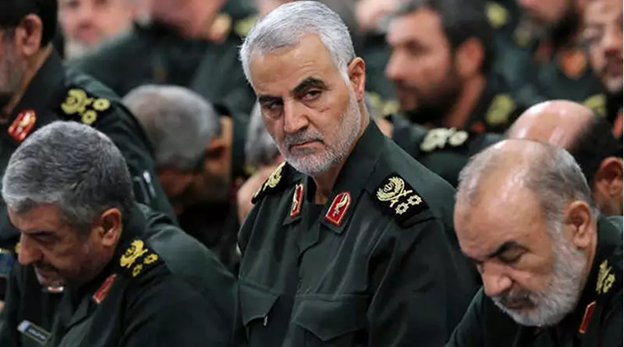
Since May 2019, U.S.-Iran tensions have heightened significantly, especially since U.S. military forces killed Qassem Soleimani, the commander of the Iran’s Islamic Revolutionary Guard Corps- Quds Force (IRGC-QF) and one of Iran’s most important military commanders, in a U.S. airstrike in Baghdad on January 2, 2020.
The Trump Administration, following its 2018 withdrawal from the 2015 multilateral nuclear agreement with Iran (Joint Comprehensive Plan of Action, JCPOA), has taken several steps in its campaign of applying “maximum pressure” on Iran. Iran and Iran-linked forces have attacked and seized commercial ships, caused destruction of some critical infrastructure in the Arab states of the Persian Gulf, and posed threats to U.S. forces and interests, including downing a U.S. unmanned aerial vehicle. Iran has reduced its compliance with the provisions of the JCPOA. The Administration has been deploying additional military assets to the region to try to deter future Iranian actions.
President Donald Trump has said he wants a diplomatic solution that would not only ease tensions but resolve broader disputes with Iran, centered on a revised JCPOA that encompasses not only nuclear issues but also Iran’s ballistic missile program and Iran’s support for regional armed factions. High-ranking officials from several countries have sought to mediate to try to de-escalate U.S.-Iran tensions by encouraging direct talks between Iranian and U.S. leaders. President Trump has stated that he welcomes talks with Iranian President Hassan Rouhani without preconditions, but no direct talks have been known to take place to date or are scheduled.
The U.S.-Iran tensions have the potential to escalate into significant conflict in the wake of Soleimani’s killing. Iran’s materiel support for armed factions throughout the region, including its provision of short-range ballistic missiles to these factions, and Iran’s network of agents in Europe, Latin America, and elsewhere, give Iran the potential to expand confrontation into areas where U.S. response options might be limited. The United States military has the capability to undertake a range of options against Iran, both against Iran directly and against its regional allies and proxies. A September 14, 2019, attack on critical energy infrastructure in Saudi Arabia demonstrated that Iran and/or its allies have the capability to cause significant damage to U.S. allies and to U.S. regional and global economic and strategic interests, and raised questions about the effectiveness of U.S. defense relations with the Gulf states in preventing future such Iranian attacks.
Members of Congress have received additional information from the Administration about the causes of the U.S.-Iran tensions and Administration responses. They have responded in a number of ways; some Members have sought to pass legislation requiring congressional approval for any decision by the President to take military action against Iran.
Context for Heightened US-Iran Tensions
U.S.-Iran relations have been mostly adversarial since the 1979 Islamic Revolution in Iran. U.S. officials and official reports consistently identify Iran’s support for militant armed factions in the Middle East region a significant threat to U.S. interests and allies. Attempting to constrain Iran’s nuclear program took precedence in U.S. policy after 2002 as that program advanced. The United States also has sought to thwart Iran’s purchase of new conventional weaponry and development of ballistic missiles.
In May 2018, the Trump Administration withdrew the United States from the 2015 nuclear agreement (Joint Comprehensive Plan of Action, JCPOA), asserting that the accord did not address the broad range of U.S. concerns about Iranian behavior and would not permanently preclude Iran from developing a nuclear weapon.1 Senior Administration officials explain Administration policy as the application of “maximum pressure” on Iran’s economy to (1) compel it to renegotiate the JCPOA to address the broad range of U.S. concerns and (2) deny Iran the revenue to continue to develop its strategic capabilities or intervene throughout the region.2 Administration officials deny that the policy is intended to stoke economic unrest in Iran.3
As the Administration has pursued its policy of maximum pressure, including imposing sanctions beyond those in force before JCPOA went into effect in January 2016, bilateral tensions have escalated significantly. Key developments that initially heightened tensions include the following.
- On April 8, 2019, the Administration designated the Islamic Revolutionary Guard Corps (IRGC) as a Foreign Terrorist Organization (FTO),4 representing the first time that an official military force was designated as an FTO. The designation stated that “The IRGC continues to provide financial and other material support, training, technology transfer, advanced conventional weapons, guidance, or direction to a broad range of terrorist organizations, including Hizballah, Palestinian terrorist groups like Hamas and Palestinian Islamic Jihad, Kata’ib Hizballah in Iraq, al-Ashtar Brigades in Bahrain, and other terrorist groups in Syria and around the Gulf…. Iran continues to allow Al Qaeda (AQ) operatives to reside in Iran, where they have been able to move money and fighters to South Asia and Syria.”5
- As of May 2, 2019, the Administration ended a U.S. sanctions exception for any country to purchase Iranian oil, aiming to drive Iran’s oil exports to “zero.”6
On May 3, 2019, the Administration ended two of the seven waivers under the Iran Freedom and Counter-Proliferation Act (IFCA, P.L. 112-239)—waivers that allow countries to help Iran remain within stockpile limits set by the JCPOA.7
On May 5, 2019, citing reports that Iran or its allies might be preparing to attack U.S. personnel or installations, then-National Security Adviser John Bolton announced that the United States was accelerating the previously planned deployment of the USS Abraham Lincoln Carrier Strike Group and sending a bomber task force to the Persian Gulf region.8
On May 24, 2019, the Trump Administration notified Congress of immediate foreign military sales and proposed export licenses for direct commercial sales of defense articles—training, equipment, and weapons—with a possible value of more than $8 billion, including sales of precision guided munitions (PGMs) to Saudi Arabia and the United Arab Emirates (UAE). In making the 22 emergency sale notifications, Secretary of State Pompeo invoked emergency authority codified in the Arms Export Control Act (AECA), and cited the need “to deter further Iranian adventurism in the Gulf and throughout the Middle East.”9
Iranian Responses and Actions
Iran responded to the U.S. pressure in part by demonstrating its ability to harm global commerce and other U.S. interests and to raise concerns about Iran’s nuclear activities. Iran might have sought to cause international actors, including those that depend on stable oil supplies, to put pressure on the Trump Administration to reduce its sanctions pressure on Iran.
Attacks on Tankers
- On May 12-13, four oil tankers—two Saudi, one Emirati, and one Norwegian ship—were damaged. Iran denied involvement, but a Defense Department (DOD) official on May 24, 2019, attributed the tanker attacks to the IRGC.10 A report to the United Nations based on Saudi, UAE, and Norwegian information found that a “state actor” was likely responsible, but did not name a specific perpetrator.11
- On June 13, 2019, two Saudi tankers in the Gulf of Oman were attacked. Secretary of State Michael Pompeo stated, “It is the assessment of the U.S. government that Iran is responsible for the attacks that occurred in the Gulf of Oman today….based on the intelligence, the weapons used, the level of expertise needed to execute the operation, recent similar Iranian attacks on shipping, and the fact that no proxy group in the area has the resources and proficiency to act with such a high degree of sophistication…. ”12
Actions by Iran’s Regional Allies
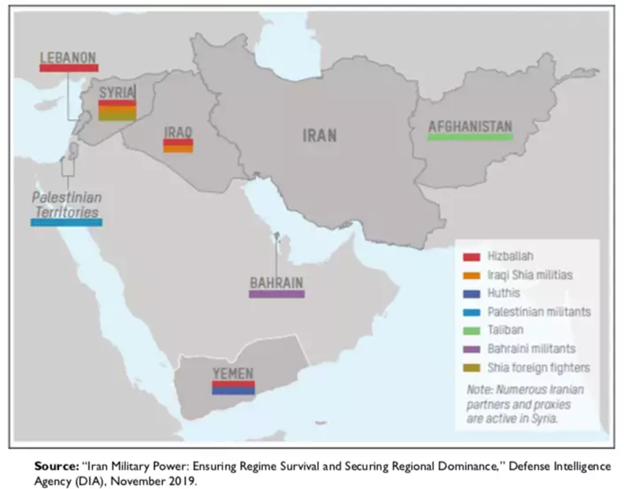
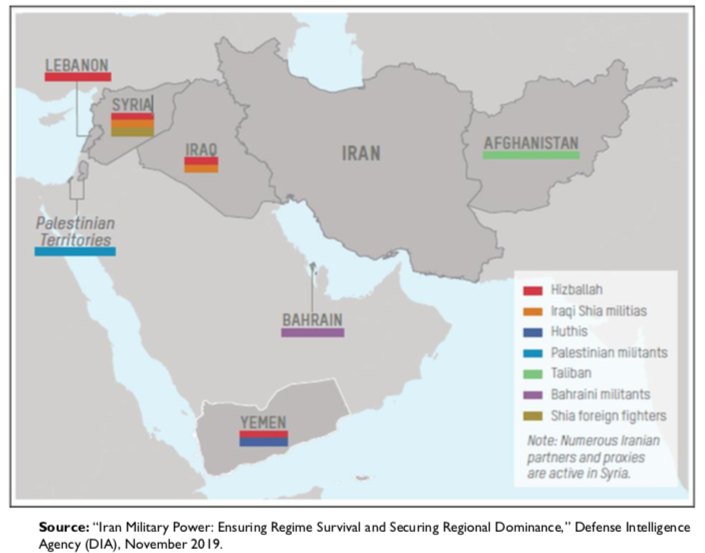
In addition to direct Iranian action, Iran’s allies in the region have been conducting attacks that might be linked to U.S.-Iran tensions, although it is not known definitively whether Iran directed or encouraged such attacks (see Figure 1 for a map of Iran-supported groups).
Figure 1. Selected Iran-supported Groups
Still, Trump Administration policy, as articulated by Secretary of State Pompeo, has been to hold Tehran responsible for the actions of its regional allies.13
- On May 19, 2019, a rocket was fired into the secure “Green Zone” in Baghdad but it caused no injuries or damage.14 Iran-backed Iraqi militias were widely suspected of the firing and U.S. Defense Department officials attributed it to Iran.15 The incident came four days after the State Department ordered “nonemergency U.S. government employees” to leave U.S. diplomatic facilities in Iraq, claiming a heightened threat that Iranian allies may act against the United States there. In mid-June, there were several other rocket attacks in Iraq, including one that landed near a housing compound for employees of an Exxon- Mobil energy project in the southern Iraqi province of Basra, wounding several persons.16 A May 2019 attack on Saudi pipeline infrastructure in Saudi Arabia with an unmanned aerial aircraft, first considered to have been launched from Yemen, was later determined to have been initiated from Iraq.17
- In June 2019 and subsequently, the Houthis, who have been fighting against a Saudi-led Arab coalition that intervened in Yemen against the Houthis in March 2015, claimed responsibility for attacks on an airport in Abha, in southern Saudi Arabia,18 and on Saudi energy installations and targets. The Houthis claimed responsibility for the large-scale attack on Saudi energy infrastructure on September 14, 2019, but, as discussed below, U.S. and Saudi officials have concluded that the attack did not originate from Yemen.
- In a June 13, 2019, statement, Secretary of State Pompeo asserted Iranian responsibility for a May 31, 2019, car bombing in Afghanistan that wounded four U.S. military personnel. Administration reports have asserted that Iran is providing materiel support to some Taliban militants, but outside experts asserted that the Iranian role in that attack is unlikely.19
Iran and U.S. Downing of Drones
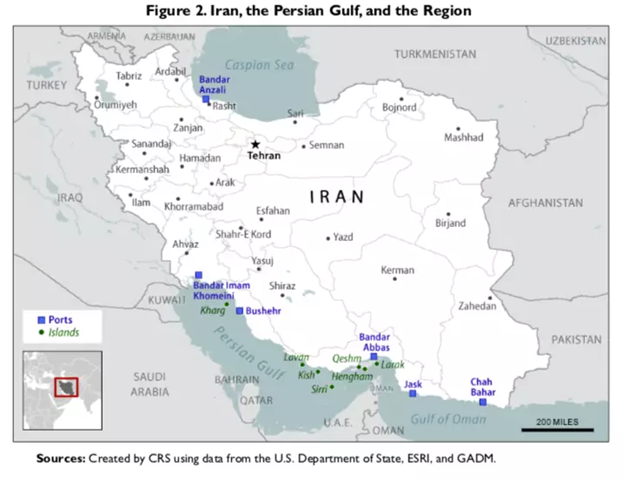
On June 20, 2019, Iran shot down an unmanned aerial surveillance aircraft (RQ-4A Global Hawk Unmanned Aerial Vehicle) near the Strait of Hormuz, claiming it had entered Iranian airspace over the Gulf of Oman. U.S. Central Command officials stated that the drone was over international waters. 20 IRGC commander-in-chief Major General Hossein Salami stated “The downing of the American drone is an open, clear and categorical message, which is: the defenders of the borders of Iran will decisively deal with any foreign aggression…. This is the way the Iranian nation deals with its enemies.”
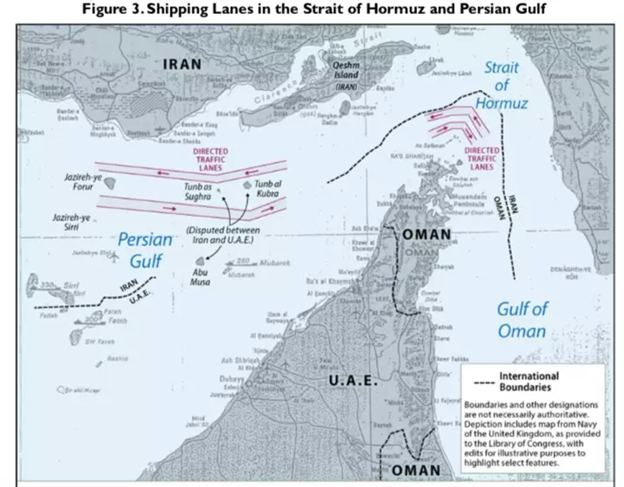
On June 20, 2019, according to his posts on the Twitter social media site, President Trump ordered a strike on three Iranian sites related to the Global Hawk downing, but called off the strike on the grounds that it would have caused Iranian casualties and therefore been “disproportionate” to the Iranian shootdown.21 The United States did reportedly launch a cyberattack against Iranian equipment used to track commercial ships.22 On July 18, 2019, President Trump announced that U.S. forces in the Gulf had downed an Iranian drone via electronic jamming in “defensive action” over the Strait of Hormuz (see Figure 3). Iran denied that any of its drones were shot down.
UK-Iran Tensions and Iran Tanker Seizures
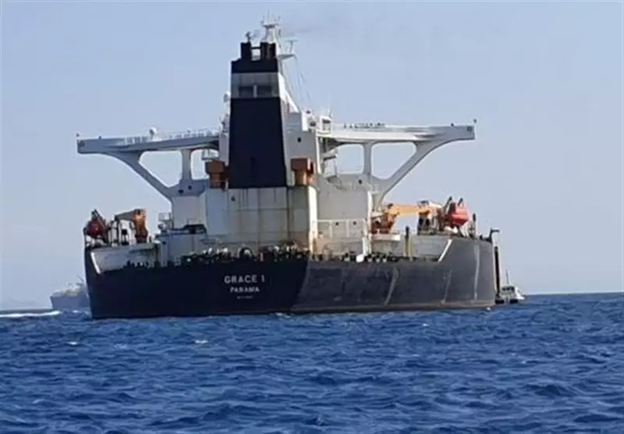
An effort by the United Kingdom (UK) to enforce EU sanctions against Syria opened up a dispute between Iran and the UK.23 On July 4, authorities from the British Overseas Territory Gibraltar, backed by British marines, impounded an Iranian tanker, the Grace I, off the coast of Gibraltar on the grounds that it was allegedly violating an EU embargo on the provision of oil to Syria. Iranian officials termed the seizure an act of piracy, and in subsequent days, the IRGC Navy sought to intercept a UK-owned tanker in the Gulf, the British Heritage, but the force was reportedly driven off by a British warship. On July 19, the IRGC Navy seized a British-flagged tanker near the Strait of Hormuz, the Stena Impero, claiming variously that it violated Iranian waters, was polluting the Gulf, collided with an Iranian vessel, or that the seizure was retribution for the seizure of the Grace I.
On July 22, the UK’s then-Foreign Secretary Jeremy Hunt explained the government’s reaction to the Stena Impero seizure as pursuing diplomacy with Iran to peacefully resolve the dispute, while at the same time sending additional naval vessels to the Gulf to help secure UK commercial shipping. Secretary Hunt stated that the UK had “made clear in public that [it] would be content with the release of Grace I if there were sufficient guarantees the oil would not go to any entities sanctioned by the EU.”24 President Donald Trump and other senior U.S. officials publicly supported the UK position. Secretary of State Pompeo said that “the responsibility … falls to the United Kingdom to take care of their ships.”25 At the same time, UK officials stated that they remained committed to the JCPOA and would not join the Trump Administration campaign of maximum pressure on Iran.
On August 15, following a reported pledge by Iran not to deliver the oil cargo to Syria, a Gibraltar court ordered the ship (renamed the Adrian Darya 1) released. Gibraltar courts turned down a U.S. Justice Department request to impound the ship as a violator of U.S. sanctions on Syria and on the IRGC, which the U.S. filing said was financially involved in the tanker and its cargo.26 The ship apparently delivered its oil to Syria despite the pledge27 and, as a consequence, the United States imposed new sanctions on individuals and entities linked to the ship and to the IRGC- linked network that the Department of the Treasury identified as assisting that and other Iranian oil shipments. On September 22, 2019, Iran released the Stena Impero.
Separate from the UK-Iran dispute over the Grace I and the Stena Impero, Iran seized an Iraqi tanker on August 5, 2019, for allegedly smuggling Iranian diesel fuel to “Persian Gulf Arab states.”28
Parallels to Past Incidents in the Gulf29
Iran’s apparent attacks on tankers in May and June share some characteristics with events in the mid-to-late 1980s during the 1980-1988 Iran-Iraq war. 1987-1988 represented the height of the “tanker war,” in which both Iran and Iraq were attacking ships in the Gulf. The United States backed Iraq during that war, and sought to limit and deter Iranian attacks on shipping, but there were several U.S.-Iran skirmishes in the Gulf. To protect commercial shipping, the United States launched “Operation Earnest Will” in July 1987, in which the United States reflagged 11 of Kuwait’s oil tankers and the U.S. Navy escorted them through the Gulf. Almost immediately after the operation began, one of the tankers, the Bridgeton, was damaged by a large contact mine laid by Iran. In August 1987, U.S. forces captured the Iran Ajr, an Iranian landing craft being used for covert minelaying. However, Iran continued attacking, including with missiles; on October 16, 1987, an Iranian Silkworm missile struck on a U.S.-flagged Kuwaiti tanker, Sea Isle City, 10 miles off Kuwait’s Al Ahmadi port. In response to that attack, U.S. destroyers and Special Operations forces blew up an Iranian oil platform east of Bahrain. On April 14, 1988, an Iranian-laid mine struck the U.S. frigate Samuel B. Roberts on patrol in the central Gulf, an attack that led to an April 16, 1988, naval confrontation in which the United States, in Operation Praying Mantis, put a large part of Iran’s naval force out of action, including sinking one of Iran’s two frigates and rendering the other inoperable. On July 3, 1988, mistaking it for an attacking Iranian aircraft, the guided missile cruiser USS Vincennes shot down Iran Air commercial passenger flight 655, killing all aboard.
Attack on Saudi Energy Infrastructure in September 201930
On September 14, 2019, an attack was conducted on multiple locations within critical Saudi energy infrastructure sites at Khurais and Abqaiq. The Houthi movement in Yemen, which receives arms and other support from Iran, claimed responsibility but Secretary of State Pompeo stated: “Amid all the calls for de-escalation, Iran has now launched an unprecedented attack on the world’s energy supply. There is no evidence the attacks came from Yemen.”31 Saudi officials said on September 16, 2019, that the attacks did not originate in Yemen and that the weapons used in the attack were of Iranian origin, but they did not name Iran as the perpetrator, instead inviting “U.N. and international experts … to participate in the investigations.”32 Press reports stated that U.S. intelligence indicates that Iran itself was the staging ground for the attacks, in which cruise missiles, possibly assisted by unmanned aerial vehicles, struck nearly 20 targets at those Saudi sites.33 Iranian officials have denied responsibility for the attack.
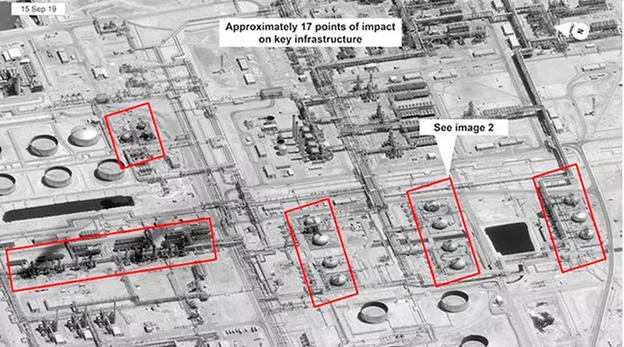
The attack shut down a significant portion of Saudi oil production and, whether conducted by Iran itself or by one of its regional allies, escalated U.S.-Iran and Iran-Saudi tensions and demonstrated a significant capability to threaten U.S. allies and interests. President Trump stated on September 16 that he would “like to avoid” conflict with Iran and the Administration did not retaliate militarily. U.S. officials did announce modest increases in U.S. forces in the region and some new U.S. sanctions on Iran. Secretary of State Pompeo visited Saudi Arabia and the UAE during September 18-19 to discuss responses to the attack, and in his press conferences in the region he stated an intent to use diplomacy to try to resolve the crisis.
The attacks on the Saudi infrastructure raised broader questions, including:
- What is the extent and durability of the long-standing implicit and explicit U.S. security guarantees to the Gulf states?
- Have Iran’s military technology capabilities advanced further than has been estimated by U.S. officials and the U.S. intelligence community?
- What additional U.S. deployments of forces or equipment, if any, might prevent or deter a similar attack in the future?
- What additional U.S. steps might be required to deter Iran from future attacks?
Iraq: Rocket Attacks, U.S. Retaliatory Airstrikes, and U.S. Embassy Blockade
In early December 2019, press reports and U.S. officials provided details on the signs of Iranian activity of concern in Iraq, including the reported Iranian supply of short range missiles to allied forces inside Iraq.34 Additionally, a series of indirect fire attacks in mid-December 2019 targeted Iraqi military facilities where U.S. forces are co-located.35 In response, Secretary Pompeo issued a statement saying, “We must also use this as an opportunity to remind Iran’s leaders that any attacks by them, or their proxies of any kind, that harm Americans, our allies, or our interests will be answered with a decisive U.S. response.”36 Secretary of Defense Mark Esper stated that he urged Iraqi Prime Minister Adel Abd Al Mahdi to “take proactive actions…to get that under control.”37
On December 27, a rocket attack on a base near Kirkuk in northern Iraq killed a U.S. contractor and wounded four U.S. service members and two Iraqi service members. Two days later, the U.S. launched retaliatory airstrikes on five facilities (three in Iraq, two in Syria) used by the Iran- backed Iraqi armed group Kata’ib Hezbollah, a U.S.-designated Foreign Terrorist Organization to which the U.S. attributed the December 27 and other attacks. A Pentagon statement described the locations as “weapon storage facilities and command and control locations” and said the strikes “will degrade KH’s ability to conduct future attacks.”38 KH leader and leading figure in the Iraqi- state affiliated Popular Mobilization Forces Abu Mahdi al Muhandis said dozens of fighters were killed and injured and promised a “very tough response” on U.S. forces in Iraq.39
Iraqi leaders, including Prime Minister Abd Al Mahdi, who in recent years has sought to maintain good relations with both the United States and Iran, criticized the strikes as a “violation of Iraqi sovereignty.”40 Abd Al Mahdi resigned in December 2019, but continues to serve in a caretaker role while Iraqi political leaders negotiate transition arrangements. U.S. forces remain in Iraq at the invitation of the Iraqi government, but Iran-aligned Iraqis have renewed calls for the expulsion of U.S. forces. Further escalation in Iraq between the U.S. and Iran and its proxies would likely pose a serious challenge for the Iraqi government and could complicate Iraqi transition negotiations and the United States’ pursuit of a long-term security partnership with Iraq.
The attacks came as Iran has sought to preserve its political influence amidst large-scale demonstrations in which hundreds of protestors have been killed by security forces.41 The U.S. government designated Iran-linked Iraqi groups and individuals in 2019 for involvement in human rights abuses and attacks on Iraqi protesters. In a December 6, 2019 press briefing announcing those designations, Assistant Secretary of State for Near Eastern Affairs David Schenker said,
the United States Government will work with anyone in the Iraqi Government who is willing to put Iraqi interests first….This is a sine qua non. But we see in the process of establishing a new government or determining who the next prime minister will be that Qasem Soleimani is in Baghdad working this issue. It seems to us that foreign terrorist leaders, or military leaders, should not be meeting with Iraqi political leaders to determine the next premier of Iraq, and this is exactly what the Secretary says about being perhaps the textbook example of why Iran does not behave and is not a normal state. This is not normal. This is not reasonable. This is unorthodox and it is incredibly problematic, and it is a huge violation of Iraqi sovereignty.42
On December 31, 2019, two days after the U.S. airstrikes against KH targets in Iraq and Syria, supporters of Kata’ib Hezbollah and other Iran-backed Iraqi militias surrounded the U.S. Embassy in Baghdad, forcing their way into the compound and setting some outer buildings on fire. Demonstrators (who differed in both profile and motivation from those protesting elsewhere in Baghdad since October) withdrew after their leaders said they obtained acting Prime Minister Abdul Mahdi’s promise for “serious work” on a parliamentary vote to expel U.S. forces from the country, a long-sought goal of Iranian-backed militias in Iraq.43
No U.S. personnel were harmed at the Embassy, but Secretary Esper announced the deployment of an additional infantry battalion “in response to increased threat levels against U.S. personnel and facilities, such as we witnessed in Baghdad.”44 President Trump tweeted that Iran, which “orchestrat[ed the] attack,” would “be held fully responsible for lives lost, or damage incurred, at any of our facilities. They will pay a very BIG PRICE!”45
U.S. Drone Strike Kills Qassem Soleimani
Two days later, on January 2, 2020, the Department of Defense announced in a statement that the U.S. military had killed IRGC-QF Commander Major General Qasem Soleimani in a “defensive action.” The statement cited Soleimani’s responsibility for “the deaths of hundreds of Americans and coalition service members” and his approval of the Embassy blockade, and stated that he was “actively developing plans to attack American diplomats and service members in Iraq and throughout the region.”46
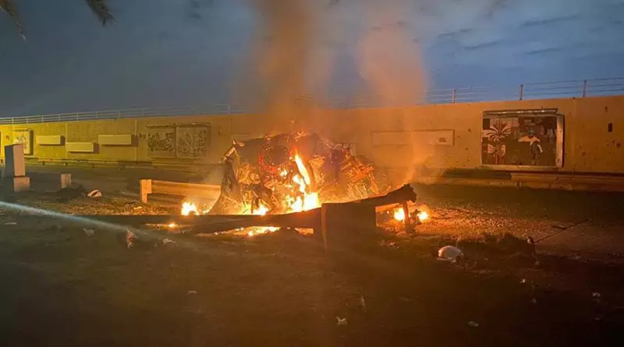
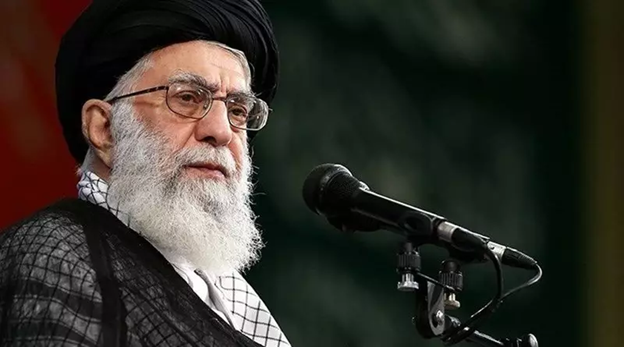
According to subsequent media reports, Soleimani was killed in a U.S. drone strike while leaving Baghdad International Airport early on the morning of January 3 local time; KH/PMF leader Al Muhandis and other Iranian and Iraqi figures also were killed in the strike. Iranian Supreme Leader Khamene’i declared three days of national mourning and vowed revenge for Soleimani’s killing. Iraqi Prime Minister Abd al Mahdi requested that the Iraqi parliament hold “an emergency session to take the appropriate legislative measures in a manner that preserves the dignity, security and sovereignty of Iraq.”47
Soleimani was widely regarded as one of the most powerful and influential figures in Iran, perhaps second only to Khamene’i, to whom Soleimani had a direct channel (see textbox below).48 Some analysts argue that his death is likely to have a dramatic impact on Iran’s capabilities, with one expert describing him as “the military center of gravity of Iran’s regional hegemonic efforts” and “an operational and organization genius who likely has no peer in the upper ranks of the Islamic Revolutionary Guard Corps.”49 Others contend that while Soleimani was undoubtedly important, “he was only the agent of a government policy that preceded him and will continue without him.”50
IRGC-QF Commander Qasem Soleimani
Qassem Soleimani was born in March 1957 in Kerman Province (southeast Iran). He joined the IRGC at its inception in 1979, serving in his home province. He participated in post- revolution suppression of Kurdish insurgents in northwestern Iran. He commanded an IRGC unit and then its 41st Sarollah Division during the Iran-Iraq war. The division was deployed back to Soleimani’s home province of Kerman after that war and was tasked with combating drug smugglers. He was still in that position when he was appointed as commander of the IRGC-QF in 1998. His main priority after taking command of the IRGC-QF was to work with Afghans of Tajik origin (“Northern Alliance”) against the Taliban regime, which at the time was a strategic adversary of Iran. After 2001, when the Taliban was ousted by the U.S.-led military engagement in Afghanistan in the aftermath of the September 11, 2001, attacks on the United States, the IRGC-QF turned its attention to the broader Middle East region. Soleimani’s success in expanding Iran’s regional influence through the IRGC-QF’s formation of pro-Iranian militias in several countries has made him a national hero in Iran. The regime afforded him wide publicity inside Iran as an able strategist who combatted Iran’s adversaries from the front lines of regional conflicts.
Secretary of State Pompeo underscored that the United States is not seeking further escalation. An Iranian response, which many observers see as likely, could take several forms.51 Possible Iranian retaliatory measures could include mobilizing militias it supports to attack U.S. forces deployed in Iraq, Syria, and/or Afghanistan; conducting strikes on oil production facilities or tankers, U.S. military installations, or other targets in the Gulf; activating proxies and operatives to execute “more asymmetric or unconventional-style hits” through Europe, South America, or elsewhere; or other responses.52 The confrontation also could heighten the prospect of additional Iranian steps in breach of the JCPOA (see below), perhaps dealing a “fatal blow” to the accord and European attempts to preserve it.53
CPOA-Related Iranian Responses54
Since the Trump Administration’s May 2018 announcement that the United States would no longer participate in the JCPOA, Iranian officials repeatedly have rejected renegotiating the agreement or discussing a new agreement. Tehran also has conditioned its ongoing adherence to the JCPOA on receiving the agreement’s benefits from the remaining JCPOA parties, collectively known as the “P4+1.” On May 10, 2018, Iranian Foreign Minister Mohammad Javad Zarif wrote that, in order for the agreement to survive, “the remaining JCPOA Participants and the international community need to fully ensure that Iran is compensated unconditionally through appropriate national, regional and global measures.” He added that
Iran has decided to resort to the JCPOA mechanism [the Joint Commission established by the agreement] in good faith to find solutions in order to rectify the United States’ multiple cases of significant non-performance and its unlawful withdrawal, and to determine whether and how the remaining JCPOA Participants and other economic partners can ensure the full benefits that the Iranian people are entitled to derive from this global diplomatic achievement.55
Tehran also threatened to reconstitute and resume the country’s pre-JCPOA nuclear activities.
Several meetings of the JCPOA-established Joint Commission since the U.S. withdrawal have not produced a firm Iranian commitment to the agreement.56 Tehran has argued that the remaining JCPOA participants’ efforts have been inadequate to sustain the agreement’s benefits for Iran. In May 8 letters to the other JCPOA participant governments, Iran announced that, as of that day, Tehran had stopped “some of its measures under the JCPOA,” though the government emphasized that it was not withdrawing from the agreement. Specifically, Iranian officials said that the government will not transfer low enriched uranium (LEU) or heavy water out of the country in order to maintain those stockpiles below the JCPOA-mandated limits. A May 8 statement from Iran’s Supreme National Security Council explained that Iran “does not anymore see itself committed to respecting” the JCPOA-mandated limits on LEU and heavy water stockpiles.57
Beginning in July 2019, the International Atomic Energy Agency (IAEA) verified that some of Iran’s nuclear activities were exceeding JCPOA-mandated limits; the Iranian government has since increased the number of such activities.58 Specifically, according to IAEA reports, Iran has exceeded JCPOA-mandated limits on its heavy water stockpile, the number of installed centrifuges, its LEU stockpile, and the LEU’s concentration of the relevant fissile isotope uranium-235. Tehran is also reportedly conducting JCPOA-prohibited research and development activities, as well as centrifuge manufacturing, and has also begun to enrich uranium at its Fordow enrichment facility.59 60
Iranian President Hassan Rouhani, in a November 5 speech, explained that Tehran still supports negotiations with the P4+1:
In the next two months, we still have a chance for negotiations. We will negotiate and talk with each other, and if we find the right solution, and the solution is in lifting of the sanctions, and that we will be able to sell our oil easily, we will be able to use our money in banks easily, and other issues that they have imposed sanctions on, such as metals and insurance, and if they lift sanctions fully, we will also return to the previous conditions fully.61
U.S. and other Responses to Iran’s Measures
U.S. partner countries have generally backed U.S. charges of Iranian responsibility for the Iranian attacks discussed above. However, U.S. partner countries have consistently called for the de- escalation of tensions and the avoidance of war. The EU countries have said they will not join the U.S. maximum pressure campaign as a consequence of Iran’s provocative acts, although the UK, France, and Germany have urged Iran to negotiate a new JCPOA that includes limits on Iran’s missile development.62 Some U.S. allies have joined a U.S. effort to deter Iran from further attacks on shipping in the Gulf, discussed further below.
U.S. Responses
As tensions have increased with Iran, the Trump Administration has undertaken a number of steps to try to deter further attacks, weaken Iran strategically, and compel Iran to negotiate a broader resolution of U.S.-Iran differences.
Additional Sanctions63
- On May 8, 2019, the President issued Executive Order 13871, blocking U.S.- based property of persons and entities determined to have conducted significant transactions with Iran’s iron, steel, aluminum, or copper sectors.64
- On June 24, 2019, President Trump issued Executive Order 13876, blocking the U.S.-based property of Supreme Leader Ali Khamene’i and his top associates. Sanctions on several officials, including Iran’s Foreign Minister Mohammad Javad Zarif, have since been imposed under that Order.
- On September 4, 2019, the State Department Special Representative for Iran and Senior Advisor to the Secretary of State Brian Hook said the United States would offer up to $15 million to any person who helps the United States disrupt the financial operations of the IRGC and its Qods Force—the IRGC unit that assists Iran-linked forces and factions in the region. The funds are to be drawn from the long-standing “Rewards for Justice Program” that provides incentives for persons to help prevent acts of terrorism.
- On September 20, 2019, the Trump Administration imposed additional sanctions on Iran’s Central Bank by designating it a terrorism supporting entity under Executive Order 13224. The Central Bank is already subject to a number of U.S. sanctions, rendering unclear whether any new effect on the Bank’s ability to operate would result. Also sanctioned was an Iranian sovereign wealth fund, the National Development Fund of Iran.
U.S. Military Deployments and Possible new Threats
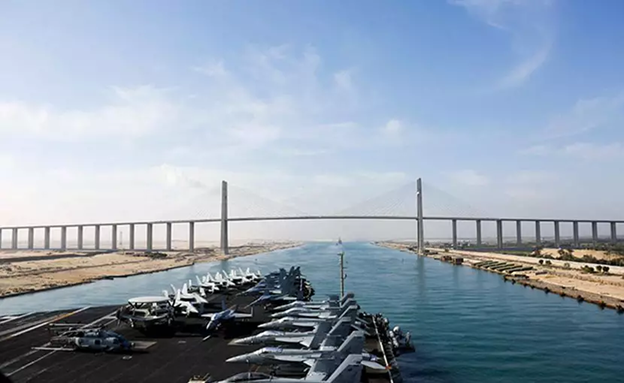
To try to deter further Iranian attacks, the United States has added forces and military capabilities in the region, beyond the accelerated deployment of the USS Abraham Lincoln and associated forces, discussed above. The additional deployments as of October 2019 had added 14,000 thousand U.S. military personnel to a baseline of more than 60,000 U.S. forces in and around the Persian Gulf, which include those stationed at military facilities in the Arab states of the Gulf Cooperation Council (GCC: Saudi Arabia, Kuwait, UAE, Qatar, Oman, and Bahrain), and those in Iraq and Afghanistan.65 Defense Department officials indicated that the additional deployments have mostly restored forces who were redeployed from the region a few years ago, and do not represent preparation for any U.S. offensive against Iran.66
- On May 24, 2019, the Defense Department announced deployment of an additional 900 military personnel, extension of the deployment of another 600 that were sent earlier to operate Patriot missile defense equipment, and the sending of additional combat and reconnaissance aircraft.67
- On June 17, 2019, then-Acting Defense Secretary Patrick Shanahan announced that the United States was sending an additional 1,000 military personnel to the Gulf “for defensive purposes.”68
- On July 18, 2019, U.S. defense officials said that an additional 500 U.S. troops, fighter aircraft and air defense equipment, would deploy to Prince Sultan Air Base in Saudi Arabia, which is south of Riyadh. 69 U.S. forces used the base to enforce a no-fly zone over southern Iraq during the 1990s, but left there after Saddam Hussein was ousted by Operation Iraqi Freedom in 2003.
- On September 26, 2019, DOD announced deployment to Saudi Arabia of 200 U.S. personnel supporting an additional Patriot missile defense battery and four An/MPQ-64 Sentinel Radars.70
- On October 11, 2019, DOD announced deployment to Saudi Arabia of additional forces (reportedly about 1,800) that, together with other announced deployments, brought to 3,000 the number of U.S, military personnel “extended or authorized” to deploy there in the prior few months. Also deployed were two Patriot systems and one Terminal High Altitude Area Defense (THAAD) system that were ordered in September to “prepare to deploy,” as well as two fighter squadrons and one air expeditionary wing.71
- On December 31, 2019, DOD announced deployment to the region of an infantry battalion from the Immediate Response Force (IRF) of the 82nd Airborne Division, with 750 soldiers to deploy immediately and additional forces from the IRF to deploy thereafter.72
After several months in which tensions seemed stable or even declining, in late November 2019, the commander of U.S. Central Command, General Kenneth McKenzie, stated that the U.S. deployments during May—October might have deterred Iran from attacking U.S. targets, but that “I wouldn’t rule [another Iranian attack like the September 14 attack on Saudi oil infrastructure] out going forward.”73 Referring to recent rioting in Iran in response to a reduction in fuel subsidies, General McKenzie added that “Iran is under extreme pressure” and is trying to “crack the [maximum pressure] campaign” with attacks to provoke an American military response. In early December, press reports and U.S. officials provided details on the signs of Iranian activity of concern, including an Iranian shipment of sophisticated components for cruise and other short- range missiles bound for the Houthis but intercepted by U.S. naval forces on November 2574, and the reported Iranian supply of short range missiles to allied forces inside Iraq (see above). The identification of new Iranian threats—coupled with the CENTCOM assessment that the additional U.S. deployments were not sufficient to deter Iran—seems to have prompted consideration of deploying additional U.S. forces to the region.
One report, denied by the Administration, said the Administration might send dozens more warships and as many as 14,000 more U.S. military personnel to the region75 At a Senate Armed Services Committee hearing on December 5, 2019, Undersecretary of Defense for Policy John Rood said that “as necessary, the secretary of Defense has told me he intends to make changes to our force posture there.” But Rood did not say how large a potentially additional force the Pentagon may be considering. Cable News Network reported on December 5, 2019, citing conversations with unnamed DOD officials, that a more likely additional figure ranges from 4,000 to 7,000 personnel focused on air and missile defense.
Gulf Maritime Security Operation
In addition to deploying more U.S. forces, the Trump Administration has sought to assemble a coalition that would use military assets to try to protect commercial shipping in the Gulf. In June, Secretary Pompeo visited Saudi Arabia, UAE, and several Asian states to recruit allies to contribute funds and military resources to a new maritime security and monitoring initiative (termed “Operation Sentinel”) for the Gulf, the Bab el-Mandeb Strait, and the Suez Canal. Defense Secretary Mark Esper told reporters on August 28, 2019, “I am pleased to report that Operation Sentinel is up and running,” but the coalition, termed the International Maritime Security Construct (IMSC), was formally inaugurated in Bahrain in November 2019. It consists of seven nations (United States, UK, UAE, Saudi Arabia, Bahrain, Albania, and Australia) operating four sentry ships at crucial points in the Gulf.76 Qatar and Kuwait have pledged to join the mission in the near future, and Canada and “some European countries” are described as having “expressed interest in the effort.”77 The IMSC appears to supplement longstanding multilateral Gulf naval operations that have targeted smuggling, piracy, the movement of terrorists and weaponry, and other potential threats in the Gulf.
Additionally, Israeli Foreign Minister Yisrael Katz said Israel would join the coalition, although it is likely that Israel would remain in a supporting role in light of the stated opposition of Iran, Iraq, and other regional governments to a direct Israeli military role in the Gulf.78 Defense Department officials have not listed Israel as a participant in IMSC to date. China’s ambassador to the UAE said in early August that China is considering joining the mission, although no announcement of China’s participation has since been made.
France reportedly intends to lead a separate maritime security mission (headquartered in Abu Dhabi) in the Gulf starting in early 2020; the Netherlands and several other European countries have expressed interest. India has sent some naval vessels to the Gulf to protect Indian commercial ships.
U.S. Military Action: Options and Considerations
The military is a tool of national power that the United States can use to advance its objectives, and the design of a military campaign and effective military options depend on the policy goals that U.S. leaders seek to accomplish. The Trump Administration has stated that its “core objective … is the systemic change in the Islamic Republic’s hostile and destabilizing actions, including blocking all paths to a nuclear weapon and exporting terrorism.”79 As such, the military could be used in a variety of ways to try to contain and dissuade Iran from prosecuting its “hostile and destabilizing actions.” These ways range from increasing presence and posture in the region to use of force to change Iran’s regime. As with any use of the military instrument of national power, any employment of U.S. forces in this scenario could result in retaliatory Iranian action and/or the escalation of a crisis.
U.S. military action may not be the appropriate tool to achieve systemic change within the Iranian regime, and may in fact set back the political prospects of Iranians sympathetic to a change of regime. Employing overt military force is likely to strengthen anti-American elements within the Iranian government. Some observers question the utility of military power against Iran due to global strategic considerations. The 2017 National Security Strategy and 2018 National Defense Strategy both note that China and Russia represent the key strategic challenges to the United States today and into the future. As such, shifting military assets into the United States Central Command (CENTCOM) area of responsibility requires diverting them from use in other theaters such as Europe and the Pacific, thereby sacrificing other long-term U.S. strategic priorities.
0 Comments
LEAVE A COMMENT
Your email address will not be published