

By Aung Marm Oo
A new administrative directive in Lawngtlai District in India’s Mizoram State has sent shockwaves through neighboring Arakan (Rakhine) State in Myanmar. The directive from Sept. 3 imposes draconian restrictions on refugees and foreigners living and working there. From now on, local businesses must obtain work permits for any refugees they employ, and refugees and foreigners are prohibited from renting houses in Lawngtlai town from September. On top of that, foreigners are now subject to an 8 p.m. curfew.
Fragile lifeline
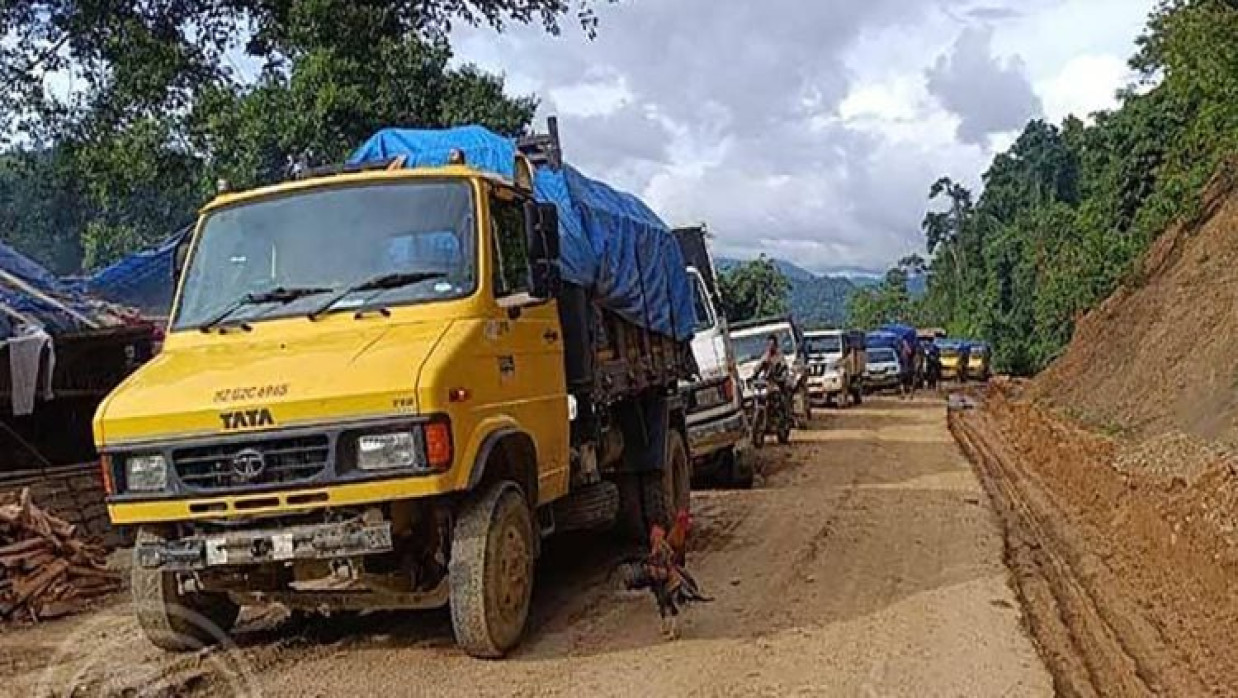
The restrictions are devastating news for Arakan, which is now overwhelmingly ruled by the revolutionary Arakan Army (AA). Since fighting resumed in late 2023, Myanmar’s central military regime has imposed a blockade on the state, meaning few goods get through from the heartland. But the AA has also conquered Paletwa in neighboring Chin State, which borders Mizoram, and that corridor has become one of Arakan’s most important economic lifelines. Hundreds of Arakan traders have been buying medicines, fuel, food and other commodities in Mizoram, while others seek access for their agricultural and fisheries products to the Indian markets.
In February, trade through Lawngtlai was temporarily disrupted following the death of an Indian truck driver near Paletwa. It took some negotiating before it reopened. Then came fuel restrictions in Mizoram, creating more difficulties for traders, before monsoon landslides near Lunglei stranded hundreds of trucks carrying essential commodities toward Arakan.
The worst followed in late August, when Myanmar military aircraft repeatedly attacked Paletwa Township. The military’s territorial losses have not eliminated its ability to impose economic costs on Arakan. Its air power can still threaten roads, towns and commercial networks far beyond its remaining ground positions.
With each disruption of this kind, goods move more slowly, transportation becomes more expensive, and consumers eventually pay more.
Trade, security and regional interests
Nor does Arakan’s other economic gateway, Bangladesh, provide complete security.
Trade continues across that border, but high taxation and other constraints have complicated formal commerce. India has consequently become particularly important for food, medicine, fuel and other goods.
India’s dilemma
The issue matters to India because the Mizoram–Paletwa corridor overlaps with its planned Kaladan Multi-Modal Transit Transport Project, designed to connect India’s eastern seaboard through Arakan’s Sittwe and Chin State’s Paletwa to Mizoram.
The political landscape in which the Kaladan project was conceived has fundamentally changed: the regime only holds on to Sittwe with its India-backed port, but the AA controls most of the surrounding territory.
New Delhi therefore has an interest in stability on both sides of this changing political geography: a functioning Mizoram–Paletwa corridor increasingly intersects with India’s own strategic and commercial interests.
Of course, Mizoram’s security concerns are legitimate. Local authorities have responsibilities involving documentation, public order and crime prevention, particularly in a district hosting thousands of refugees from Myanmar.
But their security policy should distinguish between criminal activity, refugee management and legitimate cross-border commerce.
Ways of making the corridor more transparent could include transparent work permits, documentation and predictable commercial regulations. But measures that make it prohibitively expensive for legitimate traders to operate are punitive and unfair.
Looking beyond wartime trade
Both sides also need to look to the future. For the AA, military control has opened new possibilities for economic relations with its neighbours, but wartime improvisation cannot become permanent trade policy.
If the AA intends to establish durable governance, it will need predictable customs procedures, transparent taxation, protection for merchants, mechanisms for resolving commercial disputes, and sustained engagement with neighboring authorities.
Arakan also needs diversified trade. Dependence on a single corridor leaves it vulnerable whenever that route is interrupted. India can become a larger economic partner, but Bangladesh remains important, and maritime commerce could eventually provide another avenue if political and security conditions permit.
The objective should be to develop an economic system resilient enough that disruption to one route does not threaten access to basic necessities across the region.
A warning from Lawngtlai
The Sept. 3 directive is not a blockade of Arakan and should not be portrayed as one. But it is a warning about the fragility of Arakan’s emerging economy.
The state remains dependent on neighbors whose policies it cannot dictate, transportation networks vulnerable to conflict and weather, and commercial routes operating under the threat of airstrikes.
For India, a stable and properly regulated Mizoram–Arakan trading relationship could strengthen border stability and support the long-term viability of the Kaladan project. For the AA, the challenge is to turn territorial control into an economic strategy capable of sustaining reliable relations with India and Bangladesh.
For ordinary people in Arakan, the stakes are more immediate: food must reach markets, medicine must reach clinics, and fuel and transportation must remain affordable.
The struggle is unfolding not only on the battlefields around Sittwe, Kyaukphyu and other frontlines. It is also taking place along the roads connecting Paletwa and Mizoram, at border checkpoints and marketplaces, and through the regional relationships that determine whether goods continue to move.
The article appeared in the irrawaddy

0 Comments
LEAVE A COMMENT
Your email address will not be published