

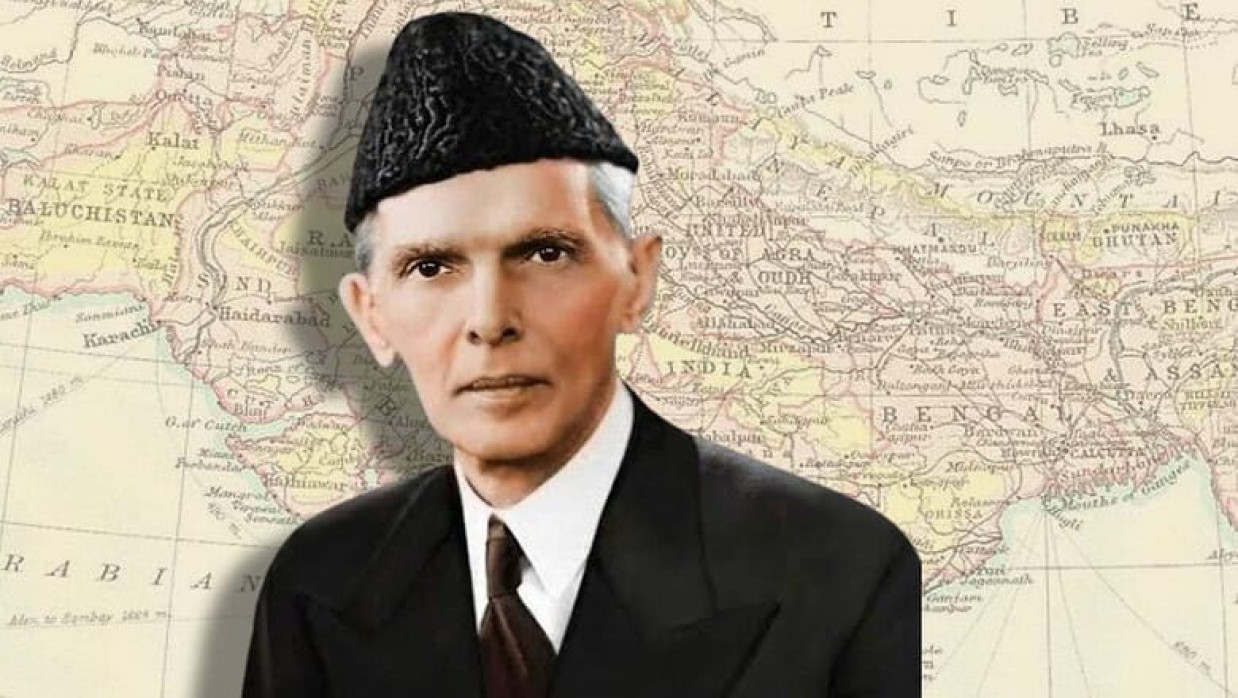
History is not a decorative ornament for nations; it is the spine that holds their identity upright. When nations forget their history, they do not merely lose memory — they lose moral direction. Bangladesh today stands at such a crossroads. The recent controversy at Dhaka University over the placement of Muhammad Ali Jinnah’s photograph — followed by its removal, defacement, and denunciation — is not merely a dispute over a portrait; it is a symptom of a deeper malaise: a nation increasingly estranged from the historical forces that made its very existence possible.
Bangladesh emerged in 1971, but its story does not begin in 1971. It begins in 1947, when Pakistan was born — a Pakistan that had two wings separated by nearly a thousand miles of hostile Indian territory. Without Pakistan, there would be no Bangladesh. Without Jinnah, there would be no Pakistan. And without the Muslim League’s political struggle, the Muslims of Bengal — my parents’ and grandparents’ generation — would have been condemned to the fate that today’s Indian Muslims suffer under Modi’s BJP: second-class citizenship, daily humiliation, mosque demolition, bulldozer justice, and the slow erosion of constitutional rights.
This is not a matter of sentiment. It is a matter of historical fact. Those interested in a deeper exploration of these dynamics will find extensive documentation and analysis in my book –‘Modi-fied’ India: The Transformation of a Nation (Peter Lang, 2026).
The Forgotten Debt: Jinnah and the Bengali Muslims
It is fashionable today in Bangladesh to vilify Jinnah, to erase his name from halls, avenues, and textbooks, and to replace him with figures whose historical roles were far more ambiguous. Jinnah Hall became Surya Sen Hall; Qaid-e-Azam Avenue became Bangabandhu Avenue. The irony is painful.
Forget, for a moment, that the Anushilon Samiti — the organization Surya Sen joined in 1916 — was a Hindutvadi outfit that explicitly excluded Muslims. Its members were required to take solemn vows while holding the Bhagavad Gita or standing before images of Hindu deities such as Durga or Kali. Forget that its ideological foundation rested heavily on Hindu revivalist literature, including Bankim Chandra Chattopadhyay’s anti‑Muslim, bigotry-laden and deeply offensive Anandamath, with its polytheistic anthem Vande Mataram. Forget even that the Samiti vehemently opposed the 1905 Partition of Bengal — a partition welcomed by the vast majority of Bengali Muslims because it freed them from the suffocating grip of absentee Hindu zamindars basking in Kolkata. And forget, too, that in the post‑1905 era the Samiti’s coercive “Swadeshi enforcement” routinely brought it into violent conflict with poor Muslim peasants and traders, who depended on inexpensive British salt and cloth; Samiti volunteers, drawn largely from upper-caste Hindu youths (Bhadralok), often used intimidation and force to destroy their livelihoods.
How many Bangladeshis today know any of this? How many understand what those violent revolutionary — or more accurately, terrorist — activities ever accomplished for Bengal, or for the Bangladesh of today?
The honest answer is: very few — and even then only superficially. While the general public today largely remembers these revolutionaries through a romanticized anti-colonial lens — unaware of the deep communal divisions they exacerbated — their actions fundamentally altered Bengal's history forever.
Yet today, this historical reality is entirely inverted: figures like Surya Sen are celebrated as heroes, while Jinnah — the man who secured political dignity for millions of Muslims against those very forces — is treated as an interloper.
This inversion of historical truth is not merely ingratitude; it is dangerous. It blinds Bangladeshis to the structural forces that shaped their destiny.
Jinnah’s Dhaka Speeches: A Window into His Mind
The two speeches Jinnah delivered in Dhaka on March 21 and March 24, 1948 — preserved in archives — are essential to understanding the present controversy. They reveal a man who was not a dictator imposing linguistic tyranny, but a statesman grappling with the existential threats facing a fragile new nation.
In the March 21 speech, Jinnah warned: “There are people financed by foreign enemies, intent on creating disruption… Their object is to disrupt and sabotage Pakistan.”
He understood — with astonishing clarity — that India would attempt to destabilize Pakistan from Day One. History has proven him right. The Indian establishment never accepted Pakistan’s stability. The creation of Bangladesh in 1971 was not merely a humanitarian intervention; it was a geopolitical strategy to amputate Pakistan.
Jinnah foresaw this decades earlier.
On the language question, at the Dacca University Convocation on March 24, 1948, he stated: “Whether Bengali should be the official language of this province is a matter for the elected representatives of the people of this province to decide.”
This sentence alone demolishes the myth that Jinnah sought to suppress Bengali. He explicitly affirmed Bengali’s place in East Pakistan.
But he also insisted: “The state language of Pakistan is going to be Urdu and no other language.”
This was not linguistic chauvinism. It was political realism. Pakistan needed a unifying state language — a true lingua franca — to prevent centrifugal forces, especially Indian interference, from tearing it apart. Urdu, already widely used among Muslims across North India, was the logical choice.
Jinnah’s stance must be understood in the context of the time, not through the lens of later nationalist narratives.
The Historical Context: Why Urdu? Why Unity?
Context matters a lot. On 23 February 1948, in the Pakistan Constituent Assembly in Karachi, Dhirendranath Datta — long known for his anti‑Muslim politics since 1905 and widely perceived as Nehru’s Trojan Horse within East Pakistan — rose to demand that Bengali be made one of the official languages of Pakistan. His proposal was not a neutral linguistic plea; it was widely interpreted by the government as a calculated attempt to inflame provincial sentiment at a moment when Pakistan was still struggling to stabilize itself after Partition. Datta’s deep political networks in independent India only heightened suspicions in Karachi that linguistic pride could be weaponized into a conduit for Indian destabilization.
Jinnah’s subsequent remarks in Dhaka cannot be divorced from this context. Speaking at the Dhaka University Convocation, he warned students that the language controversy was being deliberately stoked by external actors hostile to Pakistan’s very existence: “Does it not strike you rather odd that certain sections of the Indian press to whom the very name of Pakistan is anathema, should in the matter of language controversy set themselves up as the champion of what they call your just rights? … I must warn you to beware of these fifth columnists.”
For Jinnah, the sudden enthusiasm of Indian political circles for Bengali linguistic rights was not benevolence but subversion. The same forces that had opposed Pakistan’s creation were now exploiting linguistic sentiment to weaken it from within. He saw the language agitation not as a cultural debate, but as a geopolitical fault line.
Jinnah’s own approach to East Pakistan was shaped by an acute awareness of its structural vulnerabilities. He understood that Bengal was fractured by deep communal and economic fissures: a historically entrenched Hindu elite dominated education, administration, and the professions, while the vast Muslim agrarian population remained politically exposed and economically fragile. In such an environment, linguistic politics could easily become a proxy for separatist sentiment.
This is why Jinnah drew a clear distinction between provincial language and state language. For official use within East Pakistan, he affirmed that “the people of the province can choose any language they wish,” and that this decision must be made solely by the province’s elected representatives. But for inter‑provincial communication — the lingua franca of a state split by a thousand miles of hostile territory — he argued that only Urdu could serve.
His reasoning rested on several pillars.
First, Urdu was already the shared Muslim lingua franca of North India and Pakistan. It was not the native language of any region in West Pakistan, nor of Jinnah himself, a Gujarati; yet it functioned as a neutral administrative medium across Muslim political networks. As noted by Shafi J. Ahmed in Legacy of Jinnah: A Bangladeshi Perspective, most educated Bengali Muslims — from A.K. Fazlul Huq and the Khwaja family and H.S. Suhrawardy to Abul Hashim and A.H. Bhasani — were fluent in Urdu; it was also the court language of the last Muslim Nawabs. To Jinnah, this suggested that Urdu could serve as a unifying instrument without privileging any single provincial language.
Second, Urdu carried symbolic weight. Jinnah emphasized that it had been “nurtured by a hundred million Muslims of this sub-continent,” embodied Islamic cultural and literary traditions, and was “nearest to the language used in other Islamic countries.” In his view, Urdu provided Pakistan with a civilizational anchor that Bengali, Punjabi, Sindhi, or Pashto — each tied to specific regions — could not offer.
Third, Urdu was a defensive shield. Jinnah pointed out that Urdu had been “driven out of the Indian Union” and that even its script had been disallowed — a deliberate attempt, in his view, to erase Muslim cultural identity within India. The sudden embrace of Bengali linguistic rights by Indian political networks, therefore, appeared deeply suspect. To him, linguistic agitation was one of the “subtle ways whereby the poison of provincialism is being sedulously injected into this province.”
Thus, confronted with Datta’s maneuvering, the vulnerability of a geographically bifurcated state, and the specter of Indian interference, Jinnah advanced Urdu not as a cultural imposition but as an administrative shield — a strategic attempt to bind Pakistan against external destabilization and internal fragmentation.
And history ultimately vindicated him.
The very forces he warned about — provincialism, linguistic manipulation, external interference — eventually culminated in the breakup of Pakistan in 1971. Bangladesh emerged, but at a cost: the permanent hostility of India, the loss of geopolitical leverage, and the fragmentation of Muslim political unity in South Asia.
The Muslim League’s Struggle: A Bengali Story, Too
It is intellectually dishonest to treat Pakistan as a foreign imposition on Bengal. Bengal was central to the Pakistan movement. The Lahore Resolution of 1940 envisioned “independent states” in Muslim-majority regions — and Bengal was one of them.
The Muslim League’s 14-Point formula of 1929 was a blueprint for protecting Muslim minorities in a Hindu-majority India. Gandhi himself admitted to Abul Hashim on August 15, 1947: “Hashim, I shall jump at it.”
But Congress rejected it in 1929. Nehru rejected Jinnah’s proposals in 1928. Patel rejected federal safeguards. The Khaksars tried to assassinate Jinnah. Many Ulema opposed Pakistan. And yet, the Muslim masses — above all the Bengali Muslims — rallied behind Qaid-e-Azam Jinnah.
They saw what Jinnah saw: that Hindu majoritarianism would eventually crush Muslim rights.
Today’s India under Modi and the Sangh Parivar proves Jinnah right. Indian Muslims are called “Babur ki aulad” by “Godse ki aulad” hoodlums. They are lynched, marginalized, and treated as aliens. Their citizenship is conditional. Their loyalty is questioned. Their mosques are demolished. Their history is erased.
This is the India that Jinnah foresaw in the 1930s and 1940s.
Bangladesh’s Historical Amnesia: A Nation in Denial
Bangladesh’s political culture today is built on selective memory. It celebrates 1971 but ignores 1947. It venerates secularism but forgets that Jinnah was the most secular Muslim leader of his time. It glorifies anti-Muslim revolutionaries like Surya Sen but erases the man who secured political dignity for millions of Bengali Muslims.
This amnesia is not accidental. It is cultivated.
The post-1971 state narrative needed to delegitimize Pakistan to legitimize its own birth. In the process, it delegitimized Jinnah. But history cannot be rewritten without consequences.
A nation that forgets its origins becomes vulnerable to manipulation. Bangladesh today is increasingly susceptible to Indian cultural hegemony, political influence, and historical distortion. The erasure of Jinnah is part of this larger pattern.
Why Jinnah Matters to Bangladesh Today
Jinnah’s relevance to Bangladesh is not sentimental; it is structural.
- He secured Muslim political identity in South Asia.
Without Jinnah, Muslims would have been swallowed by Hindu majoritarianism — as they are today in India.
- He created Pakistan, which created the geopolitical space for Bangladesh.
East Pakistan was not a colony; it was a wing of a Muslim homeland. Bangladesh inherited that political identity.
- He envisioned a secular, democratic Pakistan.
His August 11, 1947 speech remains one of the most powerful declarations of minority rights in South Asian history. He said, “You are free; you are free to go to your temples, you are free to go to your mosques or to any other place or worship in this State of Pakistan. You may belong to any religion or caste or creed that has nothing to do with the business of the State… We are starting in the days where there is no discrimination, no distinction between one community and another, no discrimination between one caste or creed and another. We are starting with this fundamental principle that we are all citizens and equal citizens of one State… Now I think we should keep that in front of us as our ideal and you will find that in course of time Hindus would cease to be Hindus and Muslims would cease to be Muslims, not in the religious sense, because that is the personal faith of each individual, but in the political sense as citizens of the State.” Jinnah reminded people of the importance of character-building. As I have argued in my book – Bangladesh: a Polarized and Divided Nation? – had Pakistan lived up to the expectations of its great founder, its truncation might have been avoided, or at least delayed.
- He warned against provincialism and external interference.
Bangladesh’s political polarization and instability today reflect the very dangers Jinnah identified.
- He understood Bengal’s unique vulnerabilities.
His insistence on unity was not authoritarianism; it was foresight.
A Homage to Jinnah: The Man Behind the Myth
Jinnah was not perfect. No leader is. But he was the most secular, most principled, and most intellectually rigorous politician of his era. He defended Bal Gangadhar Tilak free of charge despite their differences on many matters. From the warmth of that relationship sprung the Lucknow Pact of 1916, which was the last hope for a united India. He rejected the much-coveted British knighthood, saying, “I prefer to be plain Mr. Jinnah.”
He was called the “Ambassador of Hindu-Muslim Unity” by Sarojini Naidu. Gokhale said: “He is the best ambassador of Hindu-Muslim unity.”
He fought for a united India longer than any Congress leader. He turned to Pakistan only when every door to Hindu-Muslim coexistence had been slammed shut by the chauvinist leadership of the Congress.
Francis Mudie, the last British Governor of Sindh, in Jinnah’s honor once said: “In judging Jinnah, we must remember what he was up against. He had against him not only the wealth and brains of the Hindus, but also nearly the whole of British officialdom, and most of the Home politicians, who made the great mistake of refusing to take Pakistan seriously. Never was his position really examined.”
Historian Stanley Wolpert summarizes the profound effect that Jinnah had on the world: “Few individuals significantly alter the course of history. Fewer still modify the map of the world. Hardly anyone can be credited with creating a nation-state. Mohammad Ali Jinnah did all three.”
To erase Jinnah from Bangladesh’s memory is to erase the very foundation of Bengali Muslim political consciousness.
Conclusion: Reclaiming Our History
Bangladesh must reclaim its history — not the sanitized version taught in textbooks, but the full, complex, honest history of its emergence. Jinnah is part of that history. Pakistan is part of that history. The Muslim League is part of that history. The fears, hopes, and struggles of millions of Bengali Muslims are part of that history.
To deny this is to deny ourselves.
The controversy over Jinnah’s photograph is not about a frame on a wall. It is about whether Bangladesh will continue to live in historical amnesia or finally embrace the truth of its origins.
Jinnah deserves respect — not because Pakistan reveres him, but because Bangladesh owes him its very possibility.
History is not a burden; it is a compass. And Jinnah is one of its true norths.


0 Comments
LEAVE A COMMENT
Your email address will not be published