

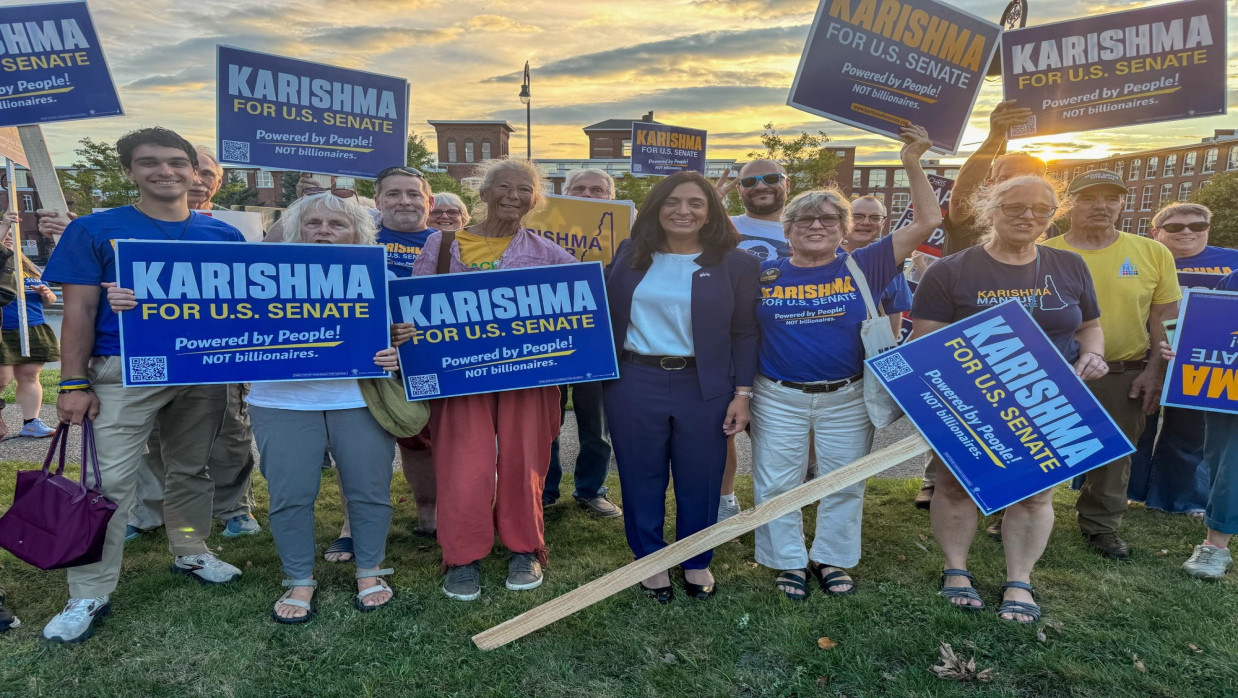
As New Hampshire Democrats prepare to choose their nominee for the U.S. Senate seat Jeanne Shaheen is vacating, the contest between Representative Chris Pappas and Dr. Karishma Manzur offers voters more than a choice between two candidates. It is also a choice between an experienced party figure and a first-time candidate who argues that the political system has become too dependent on wealthy donors, corporate interests, and entrenched leadership.
Manzur’s candidacy is especially noteworthy to South Asian audiences because her political identity is rooted partly in one of the most turbulent chapters of Bangladesh’s history. A biomedical scientist, immigrant, and grassroots activist, she is the daughter of Major General Muhammad Abul Manzur, Bir Uttom, a decorated sector commander in the 1971 Liberation War. Her campaign connects that inheritance of public service and her family’s experience of political violence with contemporary concerns about democracy, human rights, and government accountability.
A Family Shaped by Bangladesh’s Liberation War
General Manzur was one of the senior military officials who joined Bangladesh's insurgency against Pakistan in 1971. He served as sector commander during the Liberation War and was awarded Bir Uttom, Bangladesh's second-highest gallantry award. He is among the officers credited with transforming popular resistance into a cohesive force for independence.
Yet his life ended amid the instability that followed independence. President Ziaur Rahman was assassinated in Chattogram on May 30, 1981, during a failed military uprising. General Manzur, then commanding the army’s 24th Infantry Division in Chattogram, was accused of involvement. After the uprising collapsed, he was apprehended and transferred to military custody. He was killed inside Chattogram Cantonment on the night of June 1, according to later accounts. The precise responsibility for his death has remained disputed and the subject of a long-running murder case. It is therefore more accurate to say that he was killed in military custody following the failed uprising not simply that he “died in the coup.”
Karishma's father was killed when she was young. Her mother, Rana Yasmeen Manzur, along with four children, lived in fear and under political duress for years before starting over in America. A U.S. federal appeals ruling involving family members detailed accusations of imprisonment, monitoring, and persecution in Bangladesh. Democracy and political violence are therefore not abstract concepts for Karishma. They are part of her family's history from her earliest memory.
That background should not be used to romanticize a candidate or settle unresolved historical controversies. It does, however, help explain why Manzur speaks so insistently about accountable government, civil liberties and the dangers of concentrated power.
From Biomedical Research to Grassroots Politics
Manzur’s American story is one of education, scientific work and civic engagement. She earned a bachelor’s degree from the University of Rochester and a doctorate in biochemistry and molecular biology from the Mount Sinai School of Medicine, and she undertook further research training at the University of California, Berkeley. Her scientific career included work related to neurological illnesses such as Alzheimer’s disease and epilepsy.
She later became involved with progressive and democracy-reform organizations in New Hampshire, including groups concerned with peace, open government and electoral reform. Now based in Exeter, she is making her first run for elective office.
Her professional background gives her an unusual profile in a chamber dominated by lawyers, career politicians and business executives. Scientific training does not automatically make someone an effective legislator, but it can encourage habits that public life badly needs: respect for evidence, willingness to test assumptions and attention to the consequences of policy. Manzur presents those habits as relevant to healthcare, environmental protection, technology policy and public investment in research.
The Argument for Her Candidacy
Manzur certainly has her work cut out for her. Pappas has served New Hampshire's 1st Congressional District since 2019, is well known across the state, and has access to much more institutional support and campaign funding. His government experience and ballot-box success are genuine qualifications. Manzur, however, isn’t arguing that experience doesn’t matter. She’s arguing that being part of the status quo for long enough makes you part of it.
Her platform focuses on curtailing corporate campaign spending, repealing Citizens United, limiting dark-money organizations and super PACs, increasing donor transparency, and prohibiting members of Congress from purchasing individual stocks. While these policies likely find more support on the Democratic left, they speak to a concern many Americans share: Washington is more likely to listen to wealthy interests than regular people.
On domestic policy, Manzur supports universal healthcare, affordable housing and childcare, stronger wages, reproductive freedom and voting rights. Her scientific background also informs her emphasis on public health, medical research and environmental safeguards. She has raised concerns about the energy and water demands of large artificial-intelligence data centers, arguing that technological expansion must not be permitted to bypass community consent or environmental review.
Foreign policy provides the sharpest contrast with Pappas. Manzur calls for a less interventionist approach centered on human rights, diplomatic restraint, and American public interests rather than the priorities of defense contractors or outside lobbying organizations. She has strongly condemned Israel’s conduct in Gaza and U.S. military support for it. Because debate over Israel and Palestine can easily slide into collective blame, the most defensible formulation of her position is also the clearest: criticism should be directed at governments, military policies and political leaders, not at Jewish people or Judaism. The same moral standard should apply to every state and every civilian population.
What New Hampshire Voters Must Decide
Endorsements should be based on more than identity or biography, and Manzur’s Bangladeshi roots and her father’s story explain her motivations. New Hampshire voters should judge whether Manzur’s policies, her judgment, and her ability to work across party lines would be effective on behalf of the state. They should fact-check every claim made by any campaign, including claims about an opponent’s donors, responsiveness to constituents, or foreign-policy record.
But there is also a strong democratic case for voting for Manzur. A vote for Manzur is a vote for a scientist’s voice in the Senate. It’s a vote for serious campaign finance reform; for universal healthcare; and for a foreign policy focused more on diplomacy and civilian life. It’s a vote that proves candidates who aren’t favored by the party establishment deserve our consideration when they roll up their sleeves and organize locally to offer a real alternative vision.
Manzur’s story connects Bangladesh’s fight for independence to the democratic debates we’re having in the United States today. She carries with her the legacy of a decorated freedom fighter who died under mysterious circumstances. But she is not campaigning simply as her father’s daughter. Manzur is challenging voters to see her as a scientist, an immigrant, a New Hampshire activist, and a candidate who will fight to reduce the influence of money and the military in our public institutions.
On September 8, we’ll learn whether her message will overcome Pappas’ financial, organizational, and name-recognition advantages. Either way, she has already expanded the conversation. For voters looking to move the Democratic Party toward independent politics, reform, and a focus on human rights, Manzur is a clear choice.


0 Comments
LEAVE A COMMENT
Your email address will not be published