

South Asia has always been a region of profound asymmetry. India occupies nearly three-quarters of the region’s landmass, possesses by far its largest economy and military establishment, and geographically surrounds or borders most of its smaller neighbors. Geography has therefore given New Delhi enormous strategic advantages—but geography does not confer political ownership of a region.
That distinction lies at the heart of Bangladesh’s emerging foreign-policy transformation.
For decades, one of the most persistent questions confronting smaller South Asian states has been how to maintain productive relations with India without allowing necessary interdependence to become strategic dependence. Nepal has struggled with the dilemma. Sri Lanka has repeatedly sought to balance India and other powers. The Maldives witnessed an “India Out” movement before subsequently recalibrating relations with New Delhi. Even Indian strategic analyses acknowledge that neighboring countries have sometimes viewed India as a “big brother,” interventionist power, or hegemon, despite New Delhi officially describing its “Neighborhood First” policy in the language of respect, dialogue, peace, prosperity, and non-reciprocity.
Bangladesh now faces that same essential question with even greater confidence: Can a smaller nation have a friendly relationship with a much larger neighbor without being politically subservient? Dhaka's emerging response seems clearer by the day: Yes.
An anti-Indian foreign policy is unnecessary for Bangladesh. All that Bangladesh needs is an independent foreign policy. It is the exact distinction. The developing philosophy can be stated in four propositions: friendship without subordination, cooperation without dependence, engagement without intervention, and sovereign equality without fear.
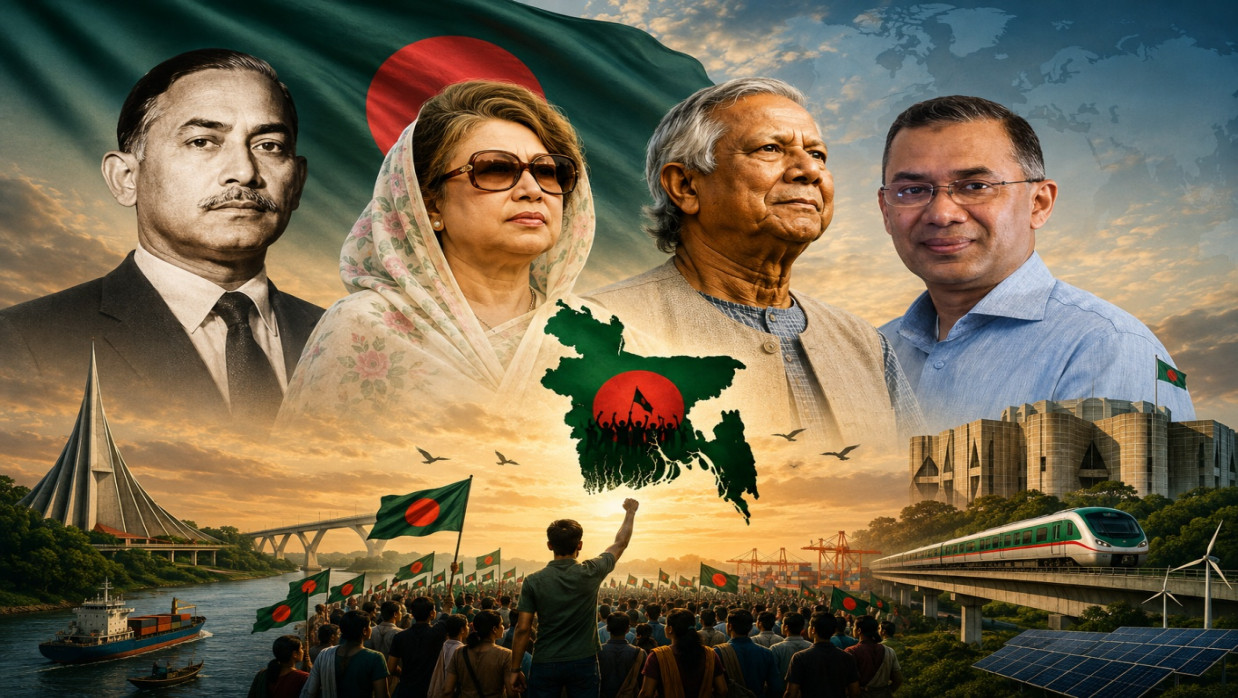
In different historical circumstances, President Ziaur Rahman, Prime Minister Khaleda Zia, Chief Adviser Professor Muhammad Yunus, and now Prime Minister Tarique Rahman have embodied important dimensions of this tradition. What distinguishes the present moment is that this philosophy appears increasingly aligned with a powerful grassroots demand for national dignity and strategic autonomy.
Understanding Hegemony in South Asia
However, hegemony cannot be equated to power. Major powers will, by definition, seek influence, protect their security interests, build alliances, and try to shape their strategic environment. India has legitimate security, economic, and geopolitical interests in South Asia, as do Bangladesh, Nepal, Sri Lanka, Bhutan, Pakistan,, and the Maldives. Hegemony begins when influence becomes an expectation of deference, meaning the dominant power starts to see its neighbors' domestic politics, diplomacy, security policy, and economics as following its wishes.
International Relations theory explains the tension that ensues.
Realist doctrine teaches that power imbalances necessarily influence state relations. However, the theory of strategic autonomy provides a way out for smaller states – to diversify alliances, to remain free to make decisions, to avoid dependence on any one power, and to cooperate with competing powers in line with national interests. This is especially true for modern South Asia, where China, the United States, Japan, the European Union, Turkey, Gulf states, ASEAN and many others have extended their economic and strategic presence.
The smaller South Asian states therefore possess more diplomatic options than they once did.
India faces a choice. It can respond to that diversification as a threat to an exclusive sphere of influence, or it can accept a genuinely multipolar South Asia in which sovereign countries maintain multiple partnerships.
Certainly, scholars from India and the region have become increasingly aware of the challenge themselves. Reviews of India’s “Neighborhood First” policy note that perceptions of interventionism still carry significant weight and cite controversies surrounding the blockade of Nepal in 2015, unresolved water issues, political alignment with friendly governments, and competition with China as reasons for mistrust. This means one thing: Regional leadership has to be earned, not demanded.
Ziaur Rahman and the Architecture of Strategic Autonomy
Bangladesh’s struggle against dependence is not new. President Ziaur Rahman knew a basic truth: Bangladesh could maintain its independence by broadening its diplomatic horizon beyond its immediate neighbors. Hence, its foreign policy aimed at diversification.
Bangladesh forged ties with China, the USA, Islamic countries, Southeast Asia, and the international community. Zia was instrumental in building regional cooperation that would later become SAARC. That vision carried considerable strategic wisdom.
Regional organizations can give small states diplomatic elbow room by shifting traditional bilateral power relations into multilateral ones. At the negotiating table, a small state has as much sovereign right as a big state. So, Zia’s approach to national security went beyond nationalism to include strategic pluralism. Bangladesh would deal with India, but India wasn’t Bangladesh's sole diplomatic focus. This is still true today.
Khaleda Zia: National Dignity as Foreign Policy
Another element of the Begum Khaleda Zia political tradition is that the relationship between Bangladesh and India must be one of equality and respect. Geography cannot be changed: India will always be Bangladesh's most important neighbor. Both Bangladesh and India share history, rivers, territory, culture, economic ties, security considerations, and connections between millions of people. Begum Khaleda Zia's political tradition includes the need for Bangladesh to treat India as an equal. Cooperation is essential and welcome, but not dependency. Friendliness is good, but not interference.
This became especially relevant amid growing apprehensions within Bangladesh regarding border killings, sharing of water resources, unequal trade, political interference, transit and connectivity issues, and the tendency of New Delhi to favor some of the political figures.
Whether all criticisms of India are justified is not really the question. Perceptions play an integral part in the dynamics of international politics, and when vast sectors of the neighboring population feel that a great power interferes in their internal affairs, this ultimately diminishes its influence.
India is discovering this lesson across South Asia.
The Hasina Era and the Problem of Asymmetrical Partnership
The India-Bangladesh relationship under Sheikh Hasina demonstrated both the possibilities and dangers of extremely close bilateral alignment. However, while there were achievements, many believe the cost-benefit ratio was tilted heavily in India's favor, and that security and security cooperation became possible primarily because India’s security problems, particularly in t the country, were solved. Connectivity has increased so much that India has gained a major advantage in transit and integration in the region. By concluding the Land Boundary Agreement on an issue that had remained unresolved for decades, Bangladesh was able to secure some of its interests. Trade increased, energy cooperation deepened, and infrastructure developed, giving India additional advantages. Thus, the time when India celebrated its exceptional cooperation turned out to be a highly asymmetric relationship for Bangladeshis.
It wasn’t just that India had more power, which is a physical fact of life in that region. Rather, New Delhi seemed more interested in the survival of a certain government than in maintaining good relations with the government of Bangladesh and its people. It’s worth noting that even Indian foreign policy analysis has concluded that New Delhi's support for governments friendly to India in places such as Bangladesh has helped feed the image of interventionism in the region.
While a great power may have an excellent relationship with a government, if that relationship creates animosity with a large segment of the population, diplomatic success can ultimately prove a weakness.
Muhammad Yunus and the Restoration of Strategic Balance
After the July uprising and Sheikh Hasina’s departure for India, Professor Muhammad Yunus inherited an extraordinarily delicate diplomatic environment.
Bangladesh could easily have moved toward either extreme: confrontation with India or continued deference. Instead, the Yunus administration attempted something more consequential strategic rebalancing. Its message was that Bangladesh remained willing to cooperate with India, but the relationship had to respect Bangladesh’s sovereignty and changing political reality.
The Hasina question became particularly significant. Bangladesh formally sought her extradition, while India acknowledged the requests and subjected them to its legal and judicial processes. The matter remains a major source of bilateral tension. But the significance of the Yunus period extends beyond any individual dispute.
Dr. Yunus, Nobel Laureate and Chief Advisor Professor, helped popularize the idea that Bangladesh could expand its relationships with China, Pakistan, the US, ASEAN, the EU, and others without asking permission from any regional capital. This is not anti-Indianism. It is sovereignty.
Tarique Rahman and the Emergence of a New Confidence
Prime Minister Tarique Rahman has now taken this evolution into a potentially more consequential phase. The original article from which this analysis develops rightly emphasizes the importance of his decision not to rush into an India visit and instead to establish his own diplomatic sequence and priorities. That decision carries symbolism far beyond diplomatic protocol.
The Prime Minister's choice of first destinations reflects his priorities. By not making Delhi an inevitable first stop, Tarique Rahman has shown that Bangladesh's elected government will make its diplomatic appointments based on its own priorities. Recent developments have reinforced the point. Reuters reported on August 16 that Dhaka believes a more conducive diplomatic environment is necessary before a prime-ministerial visit to India, amid continuing tensions over Sheikh Hasina and other bilateral issues. This is extraordinary not because Bangladesh is confronting India, but because it is redefining the relationship's psychological foundation. For too long, a damaging assumption has circulated in Bangladeshi political culture: that no government can survive in Dhaka without Delhi’s approval. The July uprising profoundly weakened that mythology.
Circumstances now exist in which Tarique Rahman can bury the hatchet. It seems his attitude is well received by a general public sentiment that Bangladesh should remain friendly to all while making decisions on its own. This sentiment matters because foreign policy must be sustainable at home. Here's the new message:
Not Delhi first. Not Beijing first. Not Washington first. Bangladesh first.
Why India Faces Pushback Across South Asia
Bangladesh’s experience is not isolated. Nepal has historically alternated between cooperation with India and attempts to establish greater strategic space through relations with China. Even Indian strategic analysis notes that Nepal has viewed India simultaneously as partner, protector, and hegemon.
The Maldives also saw a particular “India Out” political campaign. Though President Mohamed Muizzu eventually shifted the Maldives’ foreign policy away from India, the case showed how excessive Indian domination could create a powerful domestic political issue.
Sri Lanka has similarly practiced strategic balancing between India and China, shaped by historical sensitivities, Tamil politics, economic necessities, and Indian Ocean geopolitics.
These cases should not be simplistically interpreted as evidence that South Asia has become “anti-India.” They reveal something more important. South Asia is becoming post-hegemonic.
Smaller states increasingly want multiple partnerships rather than exclusive alignment.
Bangladesh’s Unresolved Agenda with India
For Dhaka, sovereign equality must inevitably translate into substance in its diplomacy. The relationship cannot remain bogged down in rhetoric. Water will be a crucial topic for discussion. The Ganges accord needs to be revisited, and the Teesta problem still hangs in limbo. Water-sharing is not just an environmental matter, but in Bangladesh’ case, also one related to agriculture, livelihoods, ecology, regional disparities, and sovereignty. Border management is yet another sore point. Every civilian casualty along the border hurts the popular perception irrespective of the overall diplomatic relationship. Other topics of discussion include trade restrictions, connectivity, transit facilities, migration, narcotics and smuggling, energy cooperation, visa policy, minority issues, disinformation, and border security. This is followed by geopolitical considerations.
India, of course, has concerns about China’s growing economic and strategic presence in the region. Chinese investment, infrastructure development, port facilities, military relationships, and the Belt and Road Initiative have dramatically altered the regional equation. India's strategic analysis has acknowledged that China is a factor in its neighborhood policy. However, Bangladesh cannot accept the fact that India’s rivalry with China should guide its relations with China.
Bangladesh must be free to cooperate with China where cooperation serves Bangladesh, with India where India serves its interests, with the United States where American partnership is beneficial, and similarly with Japan, Europe, Türkiye, Malaysia, the Gulf states, Pakistan, and others. That is precisely what strategic autonomy means.
From Hegemony to Partnership
India therefore faces an historic opportunity.
It can continue seeking predominance through political leverage, security pressure, preferred political partners, and expectations of strategic deference. Or it can become the architect of a different South Asia one based upon sovereign equality. The second approach would ultimately serve India better.
A Bangladesh that cooperates voluntarily with India will be a far more dependable partner than a Bangladesh that cooperates because it feels it has no alternative. The same principle applies to Nepal, Sri Lanka, Bhutan, and the Maldives. India possesses everything necessary for constructive regional leadership: economic scale, technology, universities, culture, markets, infrastructure capacity, military strength, and extraordinary civilizational connections throughout South Asia. But leadership and hegemony are fundamentally different.
Hegemony demands obedience. Leadership earns confidence.
Bangladesh Must Neither Bow Nor Become Hostile
Bangladesh must also exercise maturity.
Standing up to hegemony must never degenerate into reflexive anti-Indianism. India is not merely a geopolitical abstraction; it is Bangladesh’s neighbor of more than 1.4 billion people. Geography has condemned—or blessed—the two countries to coexist permanently.
However, no responsible Bangladeshi government will pursue a policy of continual confrontation with India. Rather, the goal would be to reach an equilibrium. Bangladesh should work together where interests coincide, negotiate toughly where they do not, protest encroachments on sovereignty, and remain open to reconciliation where compromise is feasible.
Therefore, a visit to Delhi by Tarique Rahman will eventually happen. However, it should be a well-prepared bilateral visit, not just a ceremonial one during an international conference. Dhaka should come to Delhi with a substantive agenda: Teesta, Ganges, killings at the borders, extradition, trade, transit, connectivity, visas, security cooperation, energy, migration, and the larger issues of non-interference. Moreover, the meeting should carry symbolic meaning. The Prime Minister of Bangladesh should come to Delhi not as the head of a small country that seeks blessing from a regional power, but rather as the elected leader of a sovereign country with a population of about 170 million.
A New Bangladesh Doctrine
From Ziaur Rahman’s diversification of foreign policy to Khaleda Zia’s stress on national pride, from Muhammad Yunus’ readjustment of policies following the insurgency to Tarique Rahman’s strong diplomatic initiatives, it is possible to discern the outlines of a new Bangladesh doctrine. This is not an anti-Indian or pro-Chinese doctrine. Nor a pro-American or anti-American doctrine. It is a pro-Bangladeshi doctrine. And its principles are quite straightforward:
Sovereignty without isolation.
Friendship without subservience.
Connectivity without dependency.
Cooperation without political interference.
Strategic partnership without strategic surrender.
This may explain why Tarique Rahman’s present stance has the potential to generate such powerful grassroots resonance. After years of political polarization and contested sovereignty, many Bangladeshis appear eager to see their country treated and to see their leaders behave—as representatives of a genuinely independent nation. The ultimate test, however, will not be whether Bangladesh can defeat India in a diplomatic contest. That should never be the objective.
The real victory will come when India itself concludes that a sovereign, confident, democratic, and friendly Bangladesh serves Indian interests better than a dependent Bangladesh.
President Ziaur Rahman realized the importance of strategic diversification. Begum Khaleda Zia supported the politics of national dignity. Professor Muhammad Yunus restored his country's confidence in a time of unprecedented political change. Prime Minister Tarique Rahman has the chance to put all those principles into action for the next generation.
If he succeeds, Bangladesh will have achieved something far more important than winning a diplomatic argument with Delhi.
It has demonstrated that size does not determine sovereignty, geography does not require obedience, and friendship between unequal powers can endure only when they meet as equals.
That could become not merely Bangladesh’s foreign-policy doctrine, but a lesson for South Asia itself.


0 Comments
LEAVE A COMMENT
Your email address will not be published