

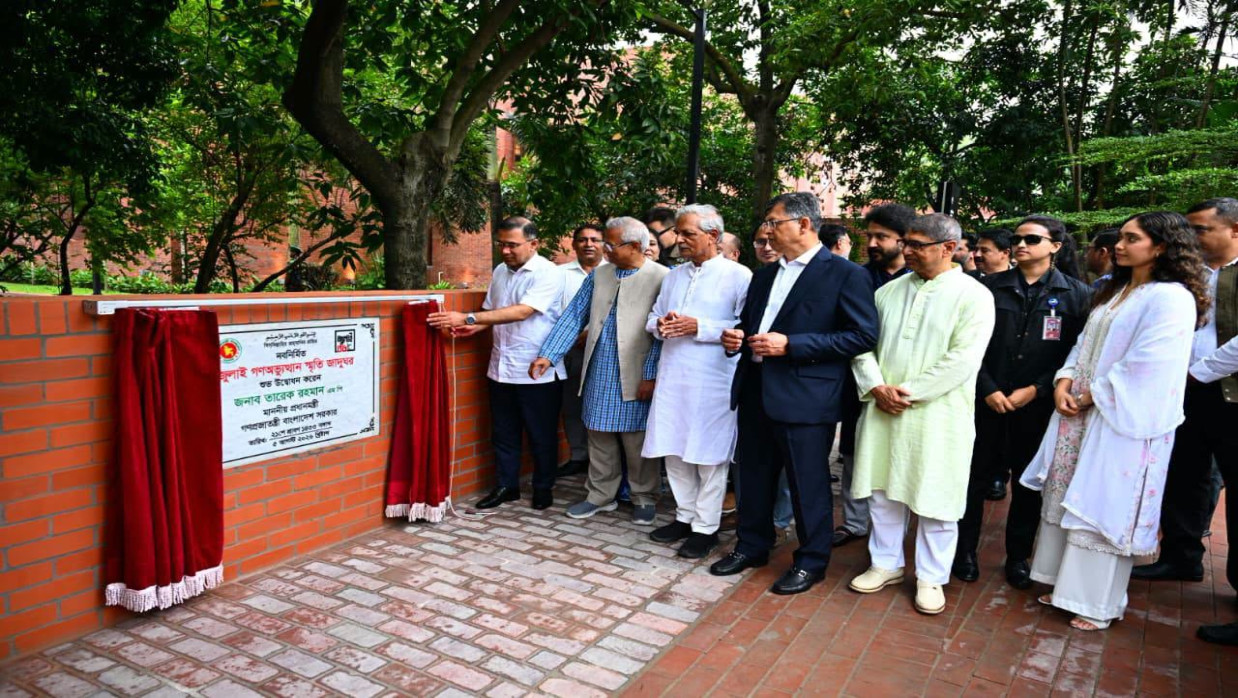
In the political arena, important events in history are usually associated with historic speeches, policies, or reforms. However, just as important are events in which small acts of humanity reflect the personalities of the politicians and the values that they would like to incorporate in their rule. Such gestures may include offering a handshake, inviting someone to join you, offering a seat, or publicly acknowledging someone.
An instance in which such a gesture was witnessed occurred during the inauguration ceremony for the July 36 Museum at Gonobhaban, when the Prime Minister noticed the presence of the Nobel Peace Prize laureate and former chief advisor, Professor Muhammad Yunus, who was seated in the audience. It was then that the Prime Minister invited him to join him on the stage, walked towards him with his hand, and personally offered him a seat next to him. Whether spontaneous or carefully considered, the symbolism of that gesture resonated far beyond the ceremony itself.
Respect as the Language of Statesmanship
Leadership is not measured solely by authority or constitutional power. It is equally measured by how leaders treat others, especially those who have occupied positions of influence before them or whose contributions transcend politics. By personally inviting Professor Yunus to the stage rather than leaving him in the audience, Tarique Zia appeared to communicate several important messages simultaneously.
First, respect should transcend political transitions.
Secondly, national service deserves public recognition independent of one’s position within the institution.
Thirdly, leadership is strengthened by acknowledging individuals who have contributed to their country.
Symbolic gestures become political communication in democratic nations. Instead of struggling for reputation, well-developed leaders are open to sharing public space. It gives the impression of confidence rather than insecurity.
Symbolic Politics and Political Communication
It is well known among political communication theorists that symbolism often conveys meaning more effectively than words themselves. According to Murray Edelman’s concept of “Symbolic Politics,” political actions usually have meanings that go beyond the direct practical function of the act. The citizens understand symbolic acts as indicators of the leader's intentions, value system, and governing philosophy. So, the invitation issued to Professor Yunus can also be considered as a symbolic manifestation of mutual respect and national unity.
In today's media environment, photographs often become historical documents. Images of political courtesy frequently survive longer in public memory than lengthy policy statements.
Practical Application of Transformational Leadership
According to James MacGregor Burns and Bernard Bass, transformational leaders transcend public affairs beyond any personal or partisan interests by emphasizing national values.
One characteristic of transformational leadership is idealized influence, in which the leader sets an example for followers to emulate.
When a national leader publicly demonstrates humility and respect, citizens often interpret such behavior as establishing new norms of political conduct. Transformational leaders not only value hierarchy but focus on collaboration, acknowledgment, and inclusion. In this view, Tarique Zia’s action was not just procedural; rather, he aimed to raise political culture.
Servant Leadership and Humility
Another theory that can provide insight is Robert Greenleaf's concept of Servant Leadership.
Servant leaders lead people through service, rather than control. Their leadership is defined by humility, empathy, and respect towards others. Approaching someone instead of demanding he approach you shows equality. Providing your own stage to someone else shows self-assurance instead of rivalry. Public recognition of another national leader speaks of generosity. All these traits are typical of mature democratic leadership.
Social Identity Theory and National Unity
The Social Identity Theory, as formulated by Henri Tajfel, states that society tends to polarize when its members identify with different political identities. Certain actions can help bridge those differences. Professor Yunus occupies a unique place in Bangladesh's national consciousness. He is internationally recognized for pioneering microcredit and social business while serving as Chief Adviser during a critical transitional period. An acknowledgment like this from a new prime minister can easily be read by citizens as conveying continuity rather than discontinuity in the stages of leadership. These gestures help broaden political identification from "our side against their side" to identification with the nation as a whole. An identification based on the nation itself.
Soft Power in Domestic Politics
Joseph Nye introduced the concept of soft power to explain how attraction, credibility, and moral authority often produce greater influence than coercion. While soft power is commonly discussed in international relations, it also applies to domestic leadership. Respect lends legitimacy. Courtesy creates trust. Humility creates credibility. Leaders who show confidence rather than arrogance are likely to gain more legitimacy than lose it. This exact kind of soft power was created through the visual image of Tarique Zia accompanying Professor Yunus to the podium.
Lessons Learned from Democratic Practices around the World
The history book is replete with instances where showing respect through symbolism helped strengthen democracy.
Nelson Mandela – South Africa
After apartheid ended in South Africa, Nelson Mandela respected his opponents at all times.
His public gestures toward political opponents reassured millions that reconciliation—not revenge would define the nation's future.
Abraham Lincoln – United States
Abraham Lincoln was known to have “a Team of Rivals,” according to historian Doris Kearns Goodwin.
Instead of alienating his political opponents, he embraced them in his administration.
His approach became one of history's greatest examples of confident leadership.
King Charles III and British Constitutional Tradition
British constitutional culture places great importance on publicly honoring former prime ministers, senior statesmen, and national leaders regardless of party affiliation.
Respect and ceremony emphasize continuity of institutions, not divisiveness of politics.
Emperor Akihito and Emperor Naruhito – Japan
Humility, Dignity, Respect – Japanese Leadership Tradition
The act of showing courtesy to citizens and national figures has boosted confidence in the nation’s institutions for centuries.
Angela Merkel – Germany
The former Chancellor, Angela Merkel, was respected globally not because of her eloquence but because of her composed nature, modesty, and courtesy toward fellow politicians and adversaries.
Her political manner exemplified how civility was an advantage for a leader.
Political Psychology and Public Perception
According to political psychologists, citizens judge politicians by both their policy performance and their emotional intelligence.
Research on impression management and nonverbal communication indicates that body language frequently shapes public perceptions more strongly than speeches.
Taking someone's hand...
Walking beside them...
Offering a seat of honor to…
They immediately speak volumes about warmth, confidence, and respect.
Audiences can understand these actions very differently based on their political views. For some people, they would mean magnanimity and inclusiveness in leadership; but to others, they could mean nothing more than politicking or protocol. Whatever the case, such actions will always invite public reflection as they speak of values beyond words.
Why These Instances Matter to Bangladesh
Bangladesh has had decades of political contestation, in which gestures of mutual respect across political lines have been subsumed by the pressures of confrontation.
This is why such instances carry particular significance.
Maturity in politics does not require complete consensus on everything.
It requires realizing that institutions in the nation get strengthened by acknowledging one another's contributions with respect. Democracy thrives when politicians compete in ideas, not in mutual disdain. Public respect generates private respect.
Past Ceremonial Instances
Ceremonies eventually end. Speeches will eventually cease. Debates in politics will eventually shift. But some pictures stay forever in national memories. The Prime Minister entering the public audience.
The Nobel Laureate rising to stand with humility. Both of them taking a walk together.
One inviting.
The other accepting.
These are the kinds of images that often become part of a nation's democratic narrative.
No matter whether it was seen primarily as a ritual protocol, courtesy, or a form of political symbolism, the gesture exemplified a key democratic value: truly strong leadership does not make anyone else weaker simply because it needs to assert itself. On the contrary, a true leader becomes stronger by acknowledging merit, respect and confidence in showing generosity.
Conclusion
The foundation of political civilization rests not only on constitutions and elections but also on culture, etiquette, and respect. The great leaders know that symbolism has a greater impact on people than a political speech.
No matter why the inauguration of the July 36 Museum will be remembered, the moment when Prime Minister Tarique Zia personally invited Professor Muhammad Yunus, the Nobel Peace Prize Laureate, from the audience to take his place next to him on the stage, will certainly be one of the best moments of the day.
As the ancient Chinese philosopher Confucius once wisely said:
"The superior man is modest in his speech, but surpasses in his deeds."
In a democratic society, acts of politeness are always more than just an act. It becomes a statement of political character—indeed, at its finest, it reminds us that leadership is not just about power, but about dignity.


0 Comments
LEAVE A COMMENT
Your email address will not be published