

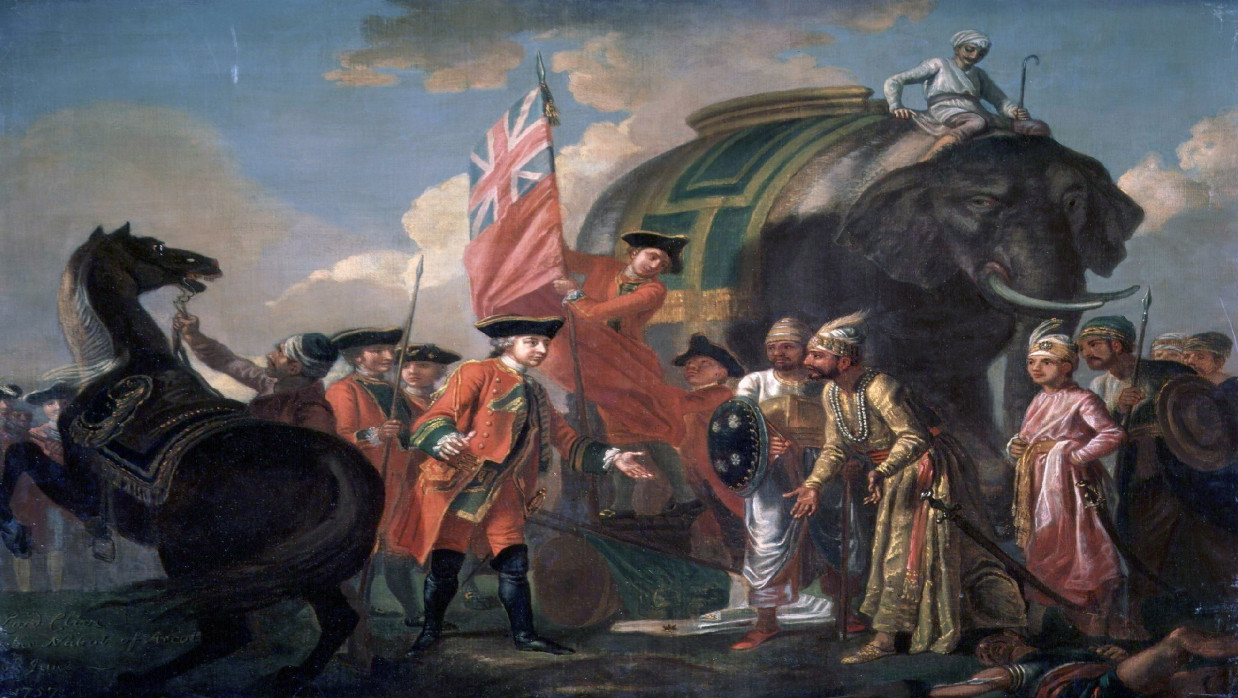
The Battle of Plassey in 1757 is commonly remembered as the moment when Mir Jafar betrayed Nawab Siraj-ud-Daulah and enabled the British East India Company to establish political dominance in Bengal. Yet Plassey was not merely a military confrontation or an isolated act of personal treachery. It was the culmination of a far-reaching struggle over money, taxation, credit and political authority. At the center of that struggle stood the Jagat Seths, Bengal’s most powerful banking family.
The family’s remarkable rise began during the seventeenth century with Hiranand Sahu, a Marwari merchant who migrated from Rajasthan to Patna. Bihar was then an important center of the saltpeter trade. Saltpeter, or potassium nitrate, was essential for manufacturing gunpowder and was therefore highly sought after by European trading companies, including the British, Dutch and French.
Hiranand made his fortune as a trader and money-lender through a wide Marwari business network based on community trustworthiness, kinship, and ledger-book credit discipline. The family is said to have used the dadan system, where traders advance capital to producers and workers in exchange for a promise to deliver goods later. This provided assurance of commodities and allowed lenders to control production costs, commodity prices, and distribution.
Hiranand’s successors expanded the family’s operations into Bengal. Manikchand established close relations with Murshid Quli Khan, Bengal’s powerful Diwan and later Nawab. When the provincial capital was transferred from Dhaka to Murshidabad, the family followed the emerging center of political and financial power.
Their relationship with the Murshidabad mint allowed the family to control coin exchange, revenue transfer, and trade agreements. The Jagat Seths were able to send vast amounts of money to distant places without physically sending silver through the use of hundis. These were financial instruments similar to bills of exchange. They established a banking system with networks that linked merchants, zamindars, revenue officials, provincial nobility, and the Mughal Empire.
Manikchand's son Fatehchand was honored with the title "Jagat Seth", which literally means "Banker to the World," by Mughal emperor Muhammad Shah. Their powerful position allowed them to lend money to governments, collect taxes on behalf of the government, trade in currencies, and give loans to the ruling class. Their fortunes were described as unfathomable at the time.
They have sometimes been described as richer and more influential than the great European banking dynasties. Comparisons with the Rothschild family, however, should be treated cautiously because the Rothschild financial empire rose later, during the nineteenth century. Nevertheless, the comparison conveys the scale of the Jagat Seths’ reputation. At their height, few private banking houses anywhere exercised such direct influence over the finances and political succession of a wealthy province.
Financial power inevitably drew the family into Bengal’s political struggles. The Jagat Seths helped finance the overthrow of Nawab Sarfaraz Khan in 1740 and supported Alivardi Khan’s accession. Their most consequential intervention came in 1757, when they joined disaffected courtiers, military commanders and East India Company officials in the conspiracy against Siraj-ud-Daulah.
Financial power inevitably drew the family into Bengal’s political struggles. The Jagat Seths helped finance the overthrow of Nawab Sarfaraz Khan in 1740 and supported Alivardi Khan’s accession. Their most consequential intervention came in 1757, when they joined an anti-Siraj coalition that included the court official and military commander Rai Durlabh, the commander-in-chief Mir Jafar, the military officer Yar Lutuf Khan, the merchant-intermediary Omichand and officials of the British East India Company. Siraj also faced opposition from within the ruling family, particularly from his influential aunt, Ghaseti Begum.
Siraj-ud-Daulah's bankers are said to have viewed him as arbitrary and dangerous to their financial interests. They were willing to place Mir Jafar on the throne in hopes that the new Nawab would safeguard their riches and re-establish commercial normalcy. Robert Clive and the British East India Company manipulated these alliances with great success. Thus Plassey was less the result of a great battle than of meticulously planned and funded intrigue. The Company won primarily because factions of Siraj's army, led by generals who were already party to the plot, refused to fight hard. The Jagat Seths thought they could oust an unfriendly Nawab and keep Bengal's existing political structure intact. They badly miscalculated the ambitions of the British East India Company. The British wanted more than simply lucrative trade. They sought armies, land, and rights to revenue. The Company's leadership planned to convert commercial advantage into political dominion.
The family thus found itself trapped by the forces it had helped unleash. Having contributed to Siraj’s removal, the Jagat Seths expected to remain indispensable financiers behind Bengal’s throne. Instead, the Company progressively reduced the Nawab to a dependent figure and brought Bengal’s revenues under its own control. Indigenous bankers who had once decided political succession became unnecessary and potentially troublesome to an expanding colonial state.
The family suffered a devastating blow in 1763, when Jagat Seth Mahtab Rai and his relative Maharaj Swaroop Chand were killed on the orders of Nawab Mir Qasim during his conflict with the Company. The British victory at Buxar in 1764 further transformed the balance of power. In 1765, the Mughal emperor granted the Company the Diwani, or right to collect revenue from Bengal, Bihar and Orissa. The Company no longer needed powerful intermediaries controlling credit, currency and revenue transfers.
The history of the Jagat Seths illustrates both the power and vulnerability of indigenous finance. Their wealth helped make and unmake Nawabs, but it could not withstand a corporate empire determined to monopolize taxation, military force and political authority. Their alliance with the Company may have been motivated by fear, self-preservation and commercial calculation, but it produced consequences far beyond their intentions.
Their ascendancy showed how bankers could serve as tools of political power. Their decline signified Bengal’s transition from Mughal provincial administration to British colonial rule. By seeking to defend their financial realm through backing the victors at Plassey, the Jagat Seths became architects of a new system in which there was no place for them to exist independently.


0 Comments
LEAVE A COMMENT
Your email address will not be published