

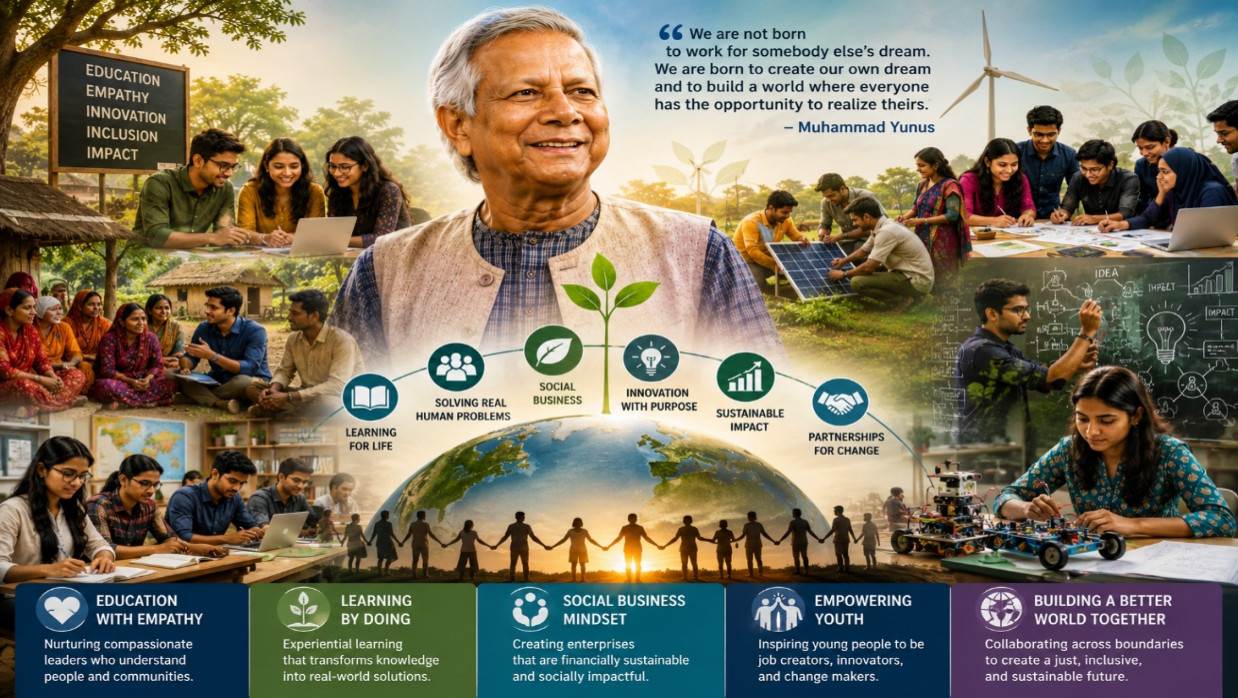
“The purpose of education is not merely to prepare people for jobs; it is to prepare them to solve the problems of humanity.” — Inspired by the educational philosophy of Nobel Laureate Muhammad Yunus
A New Vision for Education
For centuries, education has been considered one of man’s greatest inventions. Universities throughout time have been known as hubs of research, knowledge, science, culture, and professionalism that have trained generations of doctors, engineers, teachers, lawyers, scientists, economists, journalists, artists, and politicians, whose inventions and discoveries have helped form civilizations and contributed greatly to the development of mankind.
However, the twenty-first century marks a paradoxical reality.
Even though there have been great scientific and technological advances, man is still struggling with poverty, inequality, climate change, food insecurity, environmental degradation, youth unemployment, mass migration, public health crises, societal disunity, and ethical issues due to rapid technological development.
Never before has humanity possessed so much knowledge. Never before have so many complex human problems remained unresolved. This contradiction invites a fundamental question: Has education become too successful at producing professionals while falling short of preparing problem solvers? Few contemporary thinkers have challenged this conventional understanding of education more profoundly than Nobel Peace Prize laureate Muhammad Yunus. Best known internationally as the founder of the Grameen movement and the pioneer of microcredit and social business, Yunus has also developed a compelling educational philosophy that redefines the very purpose of learning.
His vision for education encourages institutions of higher learning to transcend the conventional role of disseminating knowledge and preparing students for work. Instead, education should focus on fostering creativity, moral leadership, social responsibility, and innovation to solve problems facing humanity. Muhammad Yunus’ philosophy on education is very simple but profound: Education must not produce successful people. It should produce people who can make society successful.
Education Beyond Employment
Higher education has always been associated with employment. Parents are willing to invest in education because they expect good career prospects for their children. Students pursue degrees to secure stable jobs. Universities measure graduate success through employment statistics and salary levels. Governments view education as an investment in economic productivity.
While these objectives remain important, Yunus argues that they are incomplete.
Education certainly prepares individuals to earn a livelihood, but its higher purpose extends beyond economic survival.
- Education should cultivate imagination.
- It should encourage curiosity.
- It should strengthen moral responsibility.
- It should inspire innovation.
Above all, it should empower individuals to improve the lives of others.
From this perspective, employment becomes one outcome of education rather than its ultimate purpose. The highest achievement of education is not finding one’s place within the existing world but helping create a better one.
Every Human Being Is Born Creative
One of Muhammad Yunus’ most influential beliefs is that every human being possesses enormous untapped creative potential. Society often assumes that entrepreneurship, innovation, and leadership belong only to exceptionally gifted individuals. Yunus rejects this assumption.
He argues that creativity is universal. Every person possesses ideas. Everyone is able to solve problems. Each and every one of us has the potential to be innovative because of our education systems. The problem is that many traditional education systems work to undermine creativity.
Many students learn to accept facts rather than be critical of them. They learn the right answers instead of exploring all options. Fear of failure often replaces the willingness to experiment.
Yunus envisions an educational environment where questioning becomes more important than memorization, experimentation more valuable than perfection, and innovation more meaningful than repetition.
Learning Through Human Problems
Perhaps the defining characteristic of Muhammad Yunus’ educational philosophy is that learning begins with human problems rather than academic disciplines. Traditional universities organize knowledge according to departments such as under Economics, Engineering, Medicine, Business, Journalism, Agriculture, Law, Computer science. Each subject becomes increasingly specialized. Although specialization has brought many breakthroughs in science, the problems that arise are often multidisciplinary. Poverty involves economics, education, healthcare, agriculture, technology, governance, gender equality, and environmental sustainability simultaneously. Climate change affects engineering, business, public policy, communication, agriculture, and international relations. Public health depends upon medicine, psychology, economics, sociology, data science, and community engagement. Yunus therefore proposes an educational model organized around problem-solving rather than the protection of disciplinary boundaries. Students from diverse academic backgrounds collaborate to design practical solutions. Knowledge is synthesized. Education is interdisciplinary. Learning is purpose-driven.
The Classroom Without Walls: Learning Through Communities and Social Business
The hallmark of education, according to Muhammad Yunus, is that true learning transcends the four walls of the classroom. In his opinion, communities should be seen as living experiments in knowledge, in which the village becomes the classroom, the entrepreneur becomes the mentor, the farmer becomes the researcher, the patient becomes the partner, and the child becomes the innovator. This means that the educational process goes beyond just using textbooks and involves the learner interacting with real-life situations.
In the heart of Yunus's educational theory is the idea of social business, which can be considered one of the most significant intellectual contributions of the author. Through social business in higher education, students are taught to learn through a multidisciplinary approach, with a clear focus on solving concrete problems people face. They are asked to evaluate the effectiveness of their work not only in financial terms but also in terms of its positive influence on people’s lives, the community, the environment, and inclusive development. It is still necessary to ensure financial sustainability, but now profit serves the purpose of sustainability of social impact.
Social Business as an Educational Framework
At the heart of Yunus's educational theory is the idea of social business, which is considered one of the author's most significant intellectual contributions. Through social business in higher education, students are taught to learn through a multidisciplinary approach, with a clear focus on solving concrete problems people face. They are asked to evaluate the effectiveness of their work not only in financial terms but also in terms of its positive influence on people’s lives, the community, the environment, and inclusive development. It is still necessary to ensure financial sustainability, but now profit serves the purpose of sustaining social impact.
The University as a Social Innovation Laboratory
Muhammad Yunus’ educational philosophy envisions universities as engines of continuous social innovation. Instead of existing primarily as institutions that transmit established knowledge, universities become laboratories where new ideas are developed, tested, refined, and implemented. Students work alongside faculty, entrepreneurs, policymakers, scientists, local governments, non-governmental organizations, and community leaders. Research becomes directly connected to societal challenges. Innovation addresses practical needs. Knowledge creates measurable impact. Universities become active participants in national development rather than passive observers. Every research project asks an essential question: How will this improve human life?
Ethical Leadership for a Complex World
Technological advancement alone cannot solve humanity’s challenges. Artificial intelligence, robotics, biotechnology, digital platforms, and automation possess extraordinary potential.
Yet technology without ethics can deepen inequality, threaten privacy, accelerate misinformation, and widen social divisions. Yunus therefore argues that education must cultivate ethical leadership alongside technical competence. Students should understand not only what technology can accomplish but also what it ought to accomplish. Ethics becomes inseparable from innovation. Compassion becomes inseparable from leadership. Responsibility becomes inseparable from entrepreneurship. Graduates leave universities prepared not only to lead organizations but to serve humanity.
Failure as a Teacher
Traditional educational systems often treat failure as something to be avoided. Grades reward correct answers. There are consequences for mistakes. The students are discouraged from making experiments. But entrepreneurship instills something different. Innovation is all about experiments. Each failed attempt adds up to experience. Yunus’s philosophy encourages universities to accept intelligent risk-taking. Students should not hesitate to try out ideas, change hypotheses, overcome failures, and keep improving their proposals. Mistakes prove one’s engagement in the process instead of incompetence. Innovation occurs where fear is absent.
From Competition to Cooperation
The educational system often focuses on individual success. Students compete for grades.
Universities compete for ratings. Researchers compete for grants. Companies compete for markets. Although healthy competition motivates individuals to achieve better results, Dr. Yunus believes that cooperation yields greater social benefits. Challenges of the modern world demand collective intelligence. Students from different areas work together. Universities cooperate across the globe. Communities join universities in their educational mission. Governments, companies, NGOs, researchers unite their efforts. Knowledge evolves in cooperation, not isolation.
Global Citizenship Through Local Engagement
The educational philosophy of Muhammad Yunus combines the local and the global.
The students start from knowing their community. They identify local challenges.
However, these experiences help them tackle problems that affect the whole world.
The creation of a new health system in a rural area of Bangladesh may influence Africa in the same way. The climate change adaptation strategies devised by a village community can work globally as well. Local knowledge contributes to global progress. Students therefore become global citizens not merely through international travel but through meaningful engagement with universal human challenges.
The Future University
The implications of Yunus’ educational philosophy for higher education are profound.
The university of the future will no longer use only journals, rankings, or graduate income to define its success. It will also assess: How many communities have benefitted? How many social enterprises have been created? How many lives have been transformed? How many innovations have decreased inequities? How many graduates became ethical leaders? What is the level of environmental sustainability? Societal impact will be the yardstick for measuring educational excellence. Universities become institutions that create hope as well as knowledge.
Grameen University: Bringing the Philosophy to Life
Among the most significant opportunities arising from Muhammad Yunus’ educational philosophy is the development of Grameen University as a living embodiment of these principles. The institution has the potential to integrate social business throughout its curriculum, research agenda, student life, community partnerships, and entrepreneurial ecosystem. Rather than simply teaching about development, Grameen University can actively contribute to development. Rather than studying social innovation, it can produce social innovation.
Rather than preparing graduates for existing careers alone, it can prepare graduates to create entirely new opportunities that improve society. Through this, the university would establish itself as an international model for how higher education contributes to sustainable development, poverty alleviation, climate resilience, gender equality, ethical entrepreneurship, and inclusive economic growth.
Bangladesh’s Contribution to Global Educational Thought
Bangladesh has already transformed global development thinking through the Grameen movement, microcredit, and social business. Muhammad Yunus’ educational philosophy offers another significant contribution. Instead of importing educational models developed elsewhere, Bangladesh now possesses the opportunity to export an original vision of higher education rooted in its own developmental experience. Universities across Asia, Africa, Latin America, Europe, and North America increasingly seek educational models emphasizing experiential learning, interdisciplinary collaboration, entrepreneurship, sustainability, and social responsibility. The Yunus philosophy provides an integrated framework capable of addressing all these priorities simultaneously. Its influence could extend well beyond Bangladesh.
Conclusion: Educating Problem Solvers for Humanity
The defining challenge of higher education in the twenty-first century is no longer simply producing more graduates. It is producing graduates capable of improving the human condition.
Muhammad Yunus’ educational philosophy offers an inspiring roadmap toward that future.
It asks universities to replace passive learning with active problem-solving. To replace isolated disciplines with interdisciplinary collaboration. To replace profit-centered thinking with human-centered innovation. To replace narrow career preparation with lifelong social responsibility.
Its ultimate aspiration is beautifully simple. Every graduate should leave the university asking not merely, “What career will I pursue?” But rather, “What human problem will I help solve?”
If our institutions follow such an ideology, then education in itself shall become one of mankind’s most innovative social inventions. The future success of education shall depend not only on the amount of knowledge it produces, but also on how much it changes people’s lives, strengthens communities, and gives hope to future generations. As Muhammad Yunus has eloquently pointed out to us all: “Human beings are born to solve problems. Education should help them discover that extraordinary capacity within themselves.”


0 Comments
LEAVE A COMMENT
Your email address will not be published