

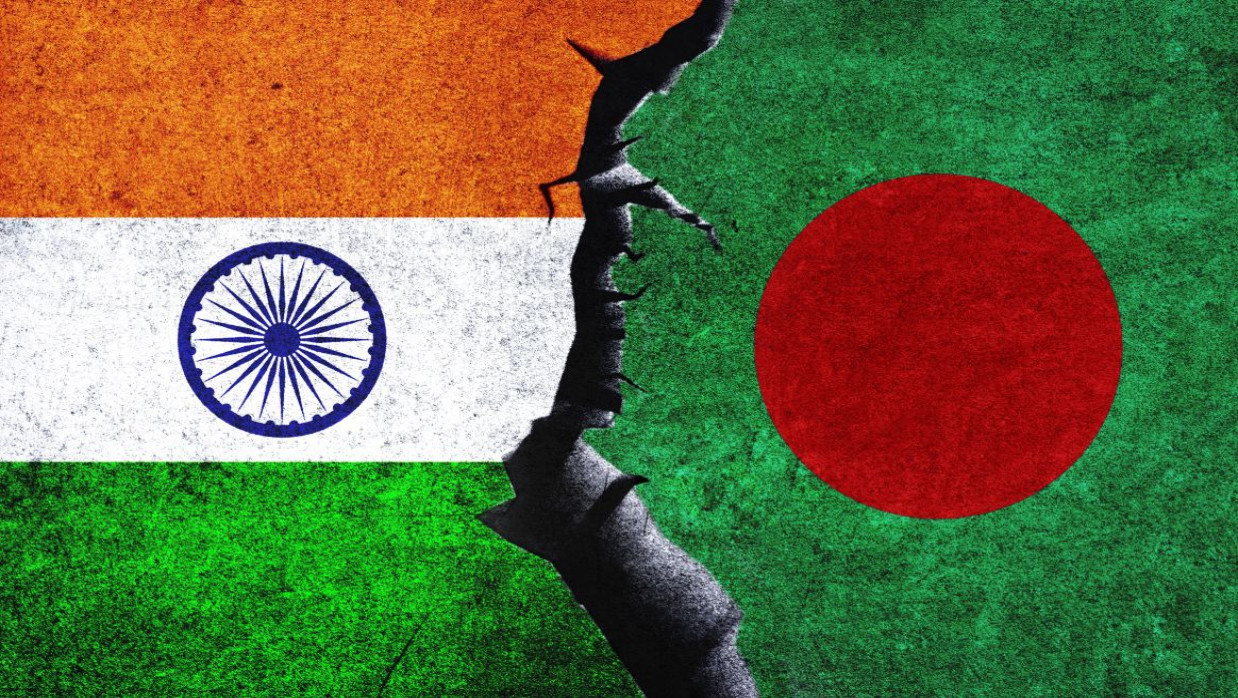
The history of Bangladesh's independence is inseparable from India's military, diplomatic, and humanitarian support during the Liberation War of 1971. Yet the relationship that emerged after independence remains one of the most contested subjects in Bangladesh's political discourse. The focal point of this controversy is the Treaty of Friendship, Cooperation and Peace (popularly known as the Bangladesh–India Friendship (Maitri) Treaty), signed by Prime Minister Sheik Mujibur Rahman of Bangladesh and Indian Prime Minister Indira Gandhi on 19 March 1972. Supporters of the Treaty argue that it was necessary to maintain good relations with the neighbors, while opponents have argued since its inception that it sacrificed Bangladesh's sovereignty to India.
History must not be confused with politics. The "1971 Maitri Agreement" didn't exist. The Friendship Treaty was signed between India and Bangladesh in March 1972 after Bangladesh gained independence.
The Critics' Perspective
Critics of the Treaty described it as a one-sided treaty signed when Bangladesh was weak politically and still reeling from the war. According to them, since India had a major role in liberating Bangladesh, it exploited its influential position over Bangladesh by striking a treaty that would allow India political domination over Bangladesh in the long run.
Points of criticism
Indian military presence in Bangladesh
One of the major points of criticism concerns the Indian military presence in Bangladesh after the Pakistani surrender of 16 December 1971. Opponents claim that India was hesitant to withdraw its troops, reasoning that having Indian troops stationed in Bangladesh till late March 1972 implied Indian supremacy over Bangladesh rather than two equal nations cooperating. While India did eventually pull out its troops after around three months, dissenters believe that Indian forces meddled in the politics of the newly formed country during its early stages.
Government structure of Bangladesh
Similar criticisms have been raised about Bangladesh's government structure. Some critics argue that, due to the political government's wartime mistrust of numerous civil servants, Bangladesh allowed Indian authorities to control the rebuilding of its governmental structure, leaving little room for growth without Indian input. However, historians differ on this point, and documentary evidence does not indicate Indian officials formally replaced Bangladesh's civil government.
Alignment with India
Another major criticism is the alignment of Bangladesh's foreign and defense policies with India's. Detractors of the Treaty argue that Bangladesh was bound to coordinate its policies with India for twenty-five years, and thus was left with little room for independent foreign policy decisions in its initial years of independence.
Supporters' Interpretation
Adherents of the Friendship Treaty disagree sharply. From their point of view, Bangladesh had inherited a shattered economy with millions of internally displaced people and fragile state institutions at the end of the Liberation War. Friendly collaboration with India was considered rational and necessary given the exceptional situation. India had hosted nearly ten million refugees, trained Mukti Bahini, and lost thousands of soldiers in the Liberation struggle. Seen from this angle, the Treaty simply made cooperation on trade, reconstruction, security, science, education, and regional development institutional rather than political domination by India. Advocates of the Treaty also argue that India withdrew troops within months of the Treaty being signed (in March 1972), implying that New Delhi had no intention of militarily occupying Bangladesh. They state that the Treaty did not include any clause ceding Bangladesh's sovereignty to India, nor did it grant India control over Bangladesh's foreign policy and defense. Instead, they maintain that the Treaty was no different from other friendship treaties concluded between countries sharing borders at the time.
A Debate That Continues
Years after the Treaty's signing, Bangladesh continues to grapple with divergent views on the spirit and intent of the Friendship Treaty. Bangladesh politicians and historians tend to frame their interpretations of past events within polarizing narratives. While some may argue that Bangladesh owes a debt of gratitude to its neighbor for helping it emerge as an independent state, others point to Bangladesh's tilted bilateral relationship with India, which has defined much of its political-strategic journey since independence.
The debate serves as an example of how historical realities are often colored by political leanings, nationalism and evolving geopolitical environments. As Bangladesh works to recalibrate its foreign policy stance within a shifting power dynamic in Asia, conversations around the lessons learned from the 1972 Treaty of Friendship remain important. Rather than taking staunch political stances when analyzing this sensitive topic, examining the full context of the historical events leading up to the Treaty, public records, and the language of the Treaty itself can help shed light on these competing historical arguments.


0 Comments
LEAVE A COMMENT
Your email address will not be published