

The Anatomy of a Contested Commons
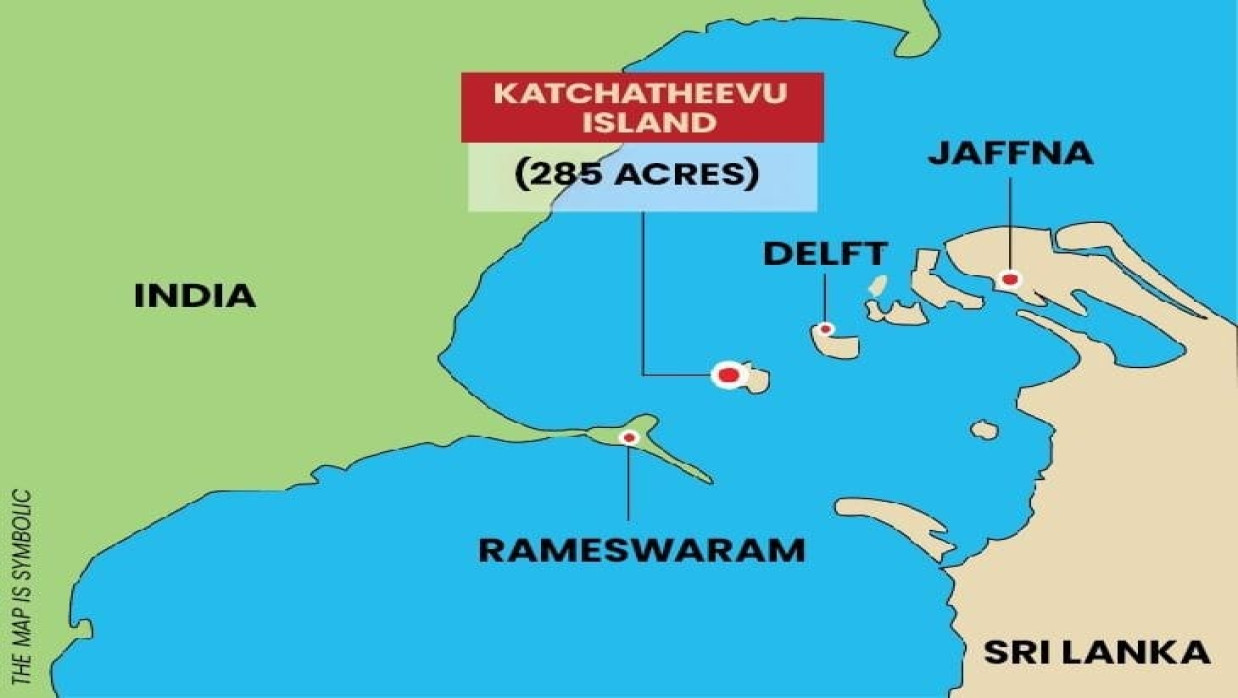
The sixty-four-kilometre stretch of shallow water separating Tamil Nadu from Sri Lanka's Northern Province has never behaved like an ordinary international boundary. Long before independence, the Palk Bay functioned as a single ecological and cultural unit, carrying Tamil migrant labour to Ceylon's tea estates and later ferrying refugees fleeing civil war, long before either nation formalised its maritime claims. That informality collided with modern statecraft when the two governments demarcated the International Maritime Boundary Line through agreements signed in 1974 and 1976, a settlement that also resolved sovereignty over the contested islet of Katchatheevu in Sri Lanka's favour. Half a century later, that line remains a paper abstraction to communities who consider the shoals ancestral fishing ground, and the friction it generates has metastasised from a bilateral irritant into a governance failure with measurable human and ecological cost.
The scale of that failure is no longer contestable. Arrests of Tamil Nadu fishermen crossing the boundary line exceeded five hundred in a single recent year, and as of late 2024 more than 128 Indian fishermen remained in Sri Lankan custody with their vessels impounded, a pattern of detention and seizure that recurs almost seasonally regardless of which government holds office in Colombo or New Delhi. The proximate trigger is rarely territorial ambition; it is the search for catch in waters that Tamil Nadu's own overcapitalised trawler fleet has progressively exhausted.
Bottom Trawling as the Fault Line
At the technical core of the dispute sits a single, banned fishing method. Sri Lanka outlawed bottom trawling decades ago precisely because dragging weighted nets across the seabed devastates coral formations, juvenile fish nurseries, and benthic habitat, yet a substantial share of Tamil Nadu's mechanised fleet continues the practice, drawn by the Bay's comparatively richer stocks. Northern Province fishing communities, still rebuilding livelihoods after decades of conflict, experience this asymmetry as a double injury: excluded from full economic recovery by history, and now watching the resource base itself erode under a technique their own law forbids. Analysts at institutions such as the Institute of South Asian Studies have framed the dispute explicitly as a fisheries-management problem masquerading as a border conflict, arguing that a permit regime, an enforceable trawling ban, and a dedicated bay-wide management authority would do more to reduce violence than any renegotiation of the boundary itself.
Periodic diplomatic mechanisms exist on paper. A Joint Working Group on Fisheries convened in Colombo in October 2024 specifically to address arrests and sustainable practice, following informal fishermen-to-fishermen talks earlier that year that produced sentiment but no binding outcome. India has periodically floated a transition programme, first initiated around 2017, to move Tamil Nadu's mechanised boats toward deep-sea fishing so that pressure on the shallow, shared Palk Bay shelf eases over time. Proposals have also surfaced for a joint Palk Bay research station to monitor ecosystem health and pilot alternative gear, alongside calls to revisit a 2010 understanding between fishermen's associations on phased trawling reduction. None of these initiatives, however, has been backed by the kind of treaty-level enforcement architecture, budget commitment, or political continuity that durable resource governance requires, and the Janatha Vimukthi Peramuna-led administration in Colombo has shown limited urgency in reopening formal negotiations.
Climate Change as a Force Multiplier
What makes 2026 a genuinely different moment from the stalemate of the past two decades is the accelerating climate signal layered atop an already stressed fishery. The Bay of Bengal occupies a disproportionate share of global protein supply relative to its size, contributing nearly eight percent of world fishery production despite covering under one percent of the ocean's surface area, which makes any productivity shock in these waters a food-security event rather than a purely regional inconvenience. Recent oceanographic research led by Rutgers University, drawing on paleoclimate records, found that both unusually strong and unusually weak monsoon seasons choke off nutrient mixing between deep and surface waters, and that such extremes have historically driven roughly a fifty percent reduction in the surface food available to marine life. As monsoon variability intensifies under warming, that mechanism is expected to recur with greater frequency across the entire Bay, Palk Bay included.
The consequences are already visible in the water. Warming sea-surface temperatures and reduced rainfall have been linked to a documented surge in jellyfish populations displacing conventional catch off the Bay's deep-sea fishing grounds, with researchers noting that warming of just 1.5 to 3 degrees Celsius meaningfully accelerates jellyfish proliferation while pushing commercially valuable species toward cooler waters. Regional stock assessments elsewhere in the Bay reinforce the trend: a joint government-UN survey recently found that fish stocks in Bangladesh's zone of the Bay of Bengal had collapsed by nearly seventy-eight percent over seven years, a figure attributed jointly to overfishing, warming, and deoxygenation. There is no credible reason to assume the Palk Bay's shallower, more enclosed waters are insulated from the same pressures; if anything, its constrained geography likely makes thermal and salinity swings more acute. Longer-term assessments of the wider Bay of Bengal Large Marine Ecosystem have separately projected that, absent adaptation, warming will suppress the value and volume of coastal fisheries even as underlying food-security dependence on fish protein remains unchanged, a diagnosis that converts the Palk Bay dispute from a bilateral irritant into a shared climate-adaptation emergency.
Toward a Re-Architected Governance Framework
The economic stakes for India alone justify urgency: fisheries contribute roughly one percent of national GDP and five percent of agricultural GDP, and Tamil Nadu accounts for around a fifth of the country's entire marine fisherfolk population, a coastal workforce whose livelihoods are staked entirely on a shrinking and increasingly volatile resource base, as documented in analysis compiled by the Socio-Legal Policy Research Foundation. Treating this purely as a law-enforcement problem, through naval patrols and boat seizures, addresses symptoms while the underlying stock continues to collapse under combined trawling pressure and thermal stress.
A re-architected framework would need three interlocking components operating simultaneously rather than sequentially. First, an enforceable, jointly monitored phase-out of bottom trawling within a defined transition window, paired with financed conversion to deep-sea and pot-and-line gear for Tamil Nadu's fleet, would remove the ecological trigger that fuels almost every arrest. Second, a standing bilateral Palk Bay Authority, distinct from the periodic and largely ceremonial Joint Working Group, could hold budgetary authority to fund the long-proposed joint research station, standardise stock assessments across both coastlines, and issue reciprocal, revocable fishing permits that formalise limited cross-boundary access without conceding sovereignty. Third, climate adaptation financing, channelled through mechanisms akin to the Bay of Bengal Large Marine Ecosystem project, would need to be explicitly folded into this bilateral architecture rather than treated as a separate multilateral track, since monsoon-driven productivity collapse will erode any trawling settlement that ignores warming and salinity trends. Absent this integration, India and Sri Lanka risk negotiating a twentieth-century fisheries treaty for a twenty-first-century ocean that is already changing beneath their boats.


0 Comments
LEAVE A COMMENT
Your email address will not be published