

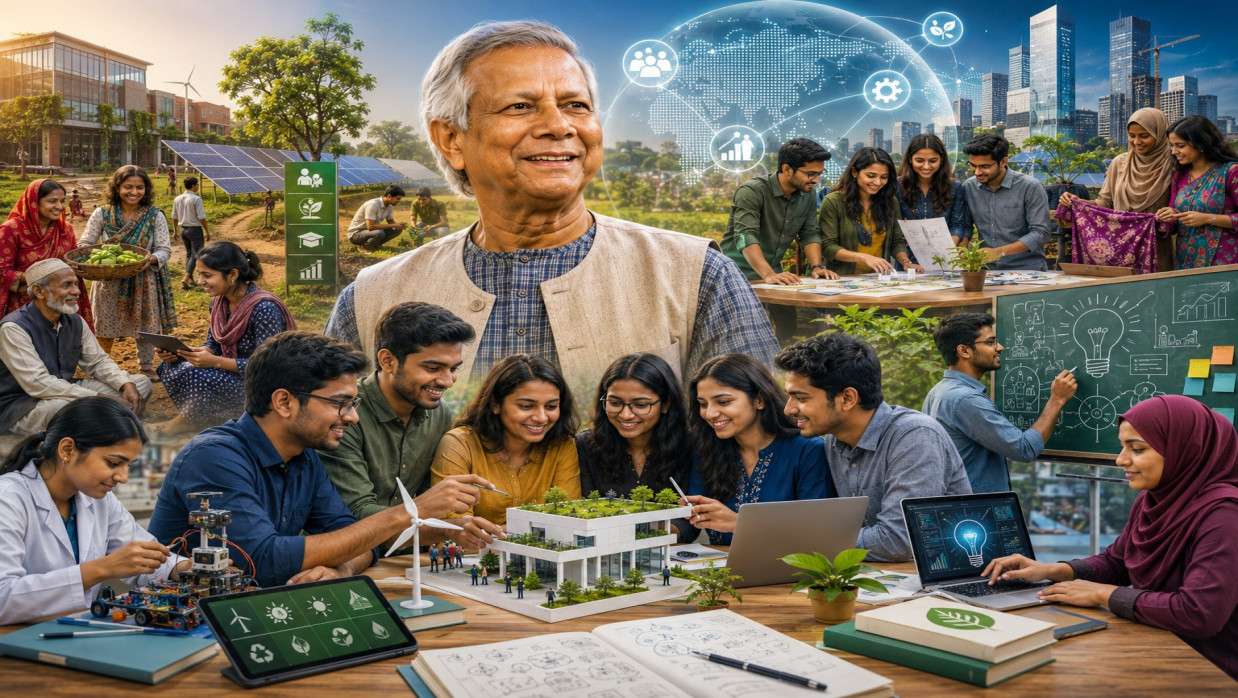
"Young people are not job seekers; they are natural entrepreneurs. If we redesign education to unleash their creativity, they can become the architects of a new economy." — Muhammad Yunus
The Changing Landscape of Employment
It can be observed that one of the biggest transformations in terms of employment is taking place in the 21st century. The developments in artificial intelligence, automation, robotics, biotechnology, and information technology have brought changes in industries in record time. Jobs that were considered the best source of livelihood until now are gradually vanishing, and entirely new jobs are being created very rapidly. The concept of education leading to secure employment is in doubt.
Millions of young graduates across the globe find themselves in a situation where their education does not guarantee employment. Developing countries like Bangladesh have been facing this problem on an alarming level. Every year, universities churn out thousands of bright graduates who are unable to be employed to their full potential due to a lack of employment opportunities.
These realities require a fundamental rethinking of higher education.
Universities can no longer define success solely by the number of graduates they produce. Increasingly, they must also consider how effectively they prepare students to create opportunities—not only for themselves but for others.
This shift from producing job seekers to cultivating job creators represents one of the most significant educational transformations of our time.
It is precisely within this context that Grameen University offers an inspiring and forward-looking vision.
A New Educational Philosophy
For many years now, colleges and universities have primarily helped students gain entry to existing organizations. The curriculum has been designed to prepare graduates with the skills and knowledge required to land a job in an organization. While this model has served societies well, today's rapidly changing economy demands something more. Grameen University seeks to cultivate entrepreneurial mindsets capable of identifying opportunities where others see obstacles, designing innovative solutions to complex social challenges, and creating sustainable enterprises that generate both economic and social value. Inspired by the philosophy of Nobel Peace Prize laureate Muhammad Yunus, the university views entrepreneurship not merely as a business activity but as a powerful instrument for human development. In this model, entrepreneurship becomes an act of service. Business becomes a means of solving problems.
Innovation becomes a pathway toward inclusive prosperity.
Every Student Has Entrepreneurial Potential
One of the most revolutionary ideas introduced by Muhammad Yunus is that entrepreneurship is not limited to a privileged few. Each individual is creative. Each one of us has the ability to be innovative. Each student has the potential to be a problem solver. The issue does not lie in identifying the gifted, but in establishing a learning environment where they can flourish.
Education traditionally encourages rote learning, standard tests, and conformity. On the other hand, entrepreneurship needs curiosity, experimentation, perseverance, teamwork, and a spirit of rebellion.
Grameen University's educational philosophy embraces these qualities. Students are encouraged to ask difficult questions. Why does poverty persist? How can healthcare become more accessible? Can clean energy become affordable for rural communities? How can technology improve agricultural productivity? How might artificial intelligence enhance financial inclusion?
Every question becomes a potential entrepreneurial opportunity.
Innovation Rooted in Community Needs
Perhaps the most distinctive characteristic of Grameen University's approach is that innovation begins not only in laboratories but also within communities. Rather than asking students to invent products solely for commercial markets, the university encourages them to engage directly with villages, urban neighborhoods, marginalized populations, farmers, women entrepreneurs, small businesses, healthcare providers, schools, and local governments.
Through observation, dialogue, participatory research, and field immersion, students learn to identify genuine human needs. These experiences become the foundation for entrepreneurial innovation. Instead of inventing technologies in search of customers, students begin with real societal challenges and develop practical solutions that improve lives.
This community-centered approach increases both the relevance and sustainability of entrepreneurial initiatives.
Social Business as the Foundation of Entrepreneurship
Conventional entrepreneurship education frequently emphasizes maximizing profits, attracting investors, expanding markets, and increasing shareholder returns. Grameen University's educational model broadens this perspective through the principles of social business.
Students learn that enterprises can pursue financial sustainability while simultaneously addressing pressing social challenges.
Possible ideas that could be worked on by students would include:
- Affordable health technology.
- Renewable energy to meet the needs of the rural population.
- Agriculture resilient to climate change.
- Digital education systems.
- Inclusive finance.
- Recycling and circular economy.
- Women’s empowerment economically.
- Affordable housing.
- Nutrition and food security.
- Mental health.
Profitability is important. However, profitability takes a back seat, becoming an instrument for achieving social good. Entrepreneurship thus evolves from wealth creation alone to value creation for society.
Learning by Building
Entrepreneurship cannot be mastered through lectures alone. It must be experienced.
Grameen University has the opportunity to embed experiential entrepreneurship throughout the student journey. Students could establish interdisciplinary innovation teams, participate in social enterprise competitions, develop business prototypes, conduct market research, test pilot projects, and refine their ideas in response to continuous community feedback. Instead of writing hypothetical business plans solely for classroom evaluation, students would launch real ventures capable of generating measurable social impact. Successes become learning opportunities.
Failures become equally valuable lessons. Graduation becomes not the beginning of entrepreneurial thinking but the culmination of years of practical experience.
The Social Business Incubator
An essential pillar of this educational model would be a comprehensive Social Business Innovation and Entrepreneurship Center. A center like that would be able to offer students mentoring, seed capital, technical assistance, legal advice, research assistance, networking, and access to potential investors interested in socially responsible businesses. These groups would work together to see the students' projects through from conception to implementation.
Importantly, success would not be measured solely by the number of businesses launched but by the measurable improvements these enterprises generate in people's lives.
Interdisciplinary Entrepreneurship
Today's challenges rarely fall within a single academic discipline. Consequently, Grameen University has the opportunity to cultivate interdisciplinary entrepreneurship, unlike most traditional universities. Consider engineers joining hands with businesspeople to develop more affordable medical technology. Agricultural experts collaborating with economists for better food chain management. Computer engineers and healthcare professionals coming together to increase telemedicine facilities. Journalists partnering with environmental experts to enhance climate change communication. Architects working together with sociologists to develop cheaper and sustainable homes. Such partnerships reflect the complexities of development issues in the modern era and encourage students to learn about diverse perspectives. Innovation thrives at the intersection of disciplines.
Entrepreneurship in the Digital Age
Digital transformation has greatly reduced barriers to entrepreneurial entry. With artificial intelligence, cloud computing, mobile technologies, e-commerce, blockchain technology, digital finance, and big data analytics, it has become easier than ever for entrepreneurs to target global markets. Grameen University can prepare students to harness these technologies responsibly. Digital innovation should not merely create convenience for affluent consumers. It should also expand access to education, healthcare, finance, government services, agricultural information, and employment opportunities for underserved populations. Technology becomes an enabler of inclusion rather than exclusion. This human-centered approach distinguishes social entrepreneurship from purely commercial technological innovation.
Women as Leaders of Entrepreneurial Transformation
No discussion of the Grameen philosophy would be complete without recognizing the central role of women. The Grameen movement demonstrated that investing in women produces transformative outcomes for families, communities, and national economies. Grameen University can extend this legacy by ensuring that women are not only participants but leaders in entrepreneurial innovation. Through mentorship, leadership development, financial literacy, networking opportunities, research collaboration, and dedicated incubation programs, female students can become founders of enterprises that address challenges affecting women and society more broadly. Gender equality thus becomes both an educational objective and an entrepreneurial strategy.
Entrepreneurship with Ethics
Recent corporate scandals, environmental crises, financial misconduct, and technological abuses have highlighted the dangers of separating innovation from ethics. Grameen University's educational philosophy recognizes that entrepreneurship without ethical responsibility cannot produce sustainable development. Students must therefore learn to balance innovation with integrity. Business decisions should be evaluated not only for economic efficiency but also for their impact on communities, workers, consumers, and future generations. Ethics becomes embedded within entrepreneurial decision-making rather than treated as an afterthought.
Building Entrepreneurial Ecosystems
Universities cannot cultivate entrepreneurship in isolation. Strong partnerships with industry, government, financial institutions, non-governmental organizations, international development agencies, and local communities are essential. Grameen University can serve as a catalyst connecting these diverse stakeholders. Its campus can become an ecosystem where ideas, research, investment, mentorship, technology, and community needs converge. Such ecosystems encourage continuous innovation while strengthening regional economic development.
Measuring Success Beyond Employment
Traditional graduate outcomes typically emphasize employment rates and average salaries.
Grameen University has the opportunity to adopt broader indicators of educational success.
These might include:
- Student enterprises established.
- Jobs created by graduates.
- Communities served.
- Women economically empowered.
- Carbon emissions reduced through innovative ventures.
- Farmers benefiting from agricultural innovations.
- Healthcare accessibility improved.
- Students continuing social enterprises after graduation.
- Sustainable Development Goals advanced through university initiatives.
These indicators reflect a broader understanding of educational excellence one rooted in societal contribution rather than individual advancement alone.
Bangladesh's Opportunity to Lead
Bangladesh has already contributed one of the world's most influential development innovations through microcredit and social business. Grameen University now has the opportunity to contribute another transformative model entrepreneurship education centered on human development. Rather than replicating business schools focused exclusively on corporate careers, the university can demonstrate how higher education prepares students to become architects of inclusive economies. Its graduates may eventually establish enterprises that address challenges not only in Bangladesh but also throughout Asia, Africa, Latin America, and other regions facing similar developmental issues. In doing so, Bangladesh can once again influence global thinking about development, education, and entrepreneurship.
The Road Ahead
Transforming students into job creators requires more than adding entrepreneurship courses to existing curricula. It demands institutional transformation. Faculty members must embrace interdisciplinary teaching. Research must become increasingly applied. Assessment methods should reward creativity, collaboration, and social impact. Students must be encouraged to experiment, innovate, and occasionally fail. Most importantly, universities must redefine their own purpose. Education should not merely prepare individuals to adapt to the future.
It should empower them to create it.
Conclusion: Educating Builders of Tomorrow
What the future holds is not for the countries with the largest economies or the best technology, but rather for those that can produce entrepreneurs who are innovative, ethical, and socially responsible. This is precisely what Grameen University strives to accomplish. Their vision is not limited to graduating students seeking work opportunities. They aim to develop students who innovate, build communities, promote inclusivity, support sustainability, and ultimately improve people’s lives. In a world where machines may be doing jobs traditionally held by human beings, one of the most useful skills humans can possess is the ability to innovate socially responsible businesses. By integrating entrepreneurship with social business, community engagement, ethical leadership, and interdisciplinary learning, Grameen University has the potential to become a global model for the university of the future. Its greatest achievement will not be measured by the number of diplomas awarded but by the number of lives transformed through the vision, creativity, and leadership of its graduates.
As Muhammad Yunus has wisely observed:
"We are not born to work for somebody else's dream. We are born to create our own dream—and to build a world where everyone has the opportunity to realize theirs."
If Grameen University succeeds in inspiring that spirit among its students, it will not simply educate entrepreneurs. It will cultivate a generation of compassionate innovators who view business as a force for human dignity, shared prosperity, and lasting social transformation.


0 Comments
LEAVE A COMMENT
Your email address will not be published