

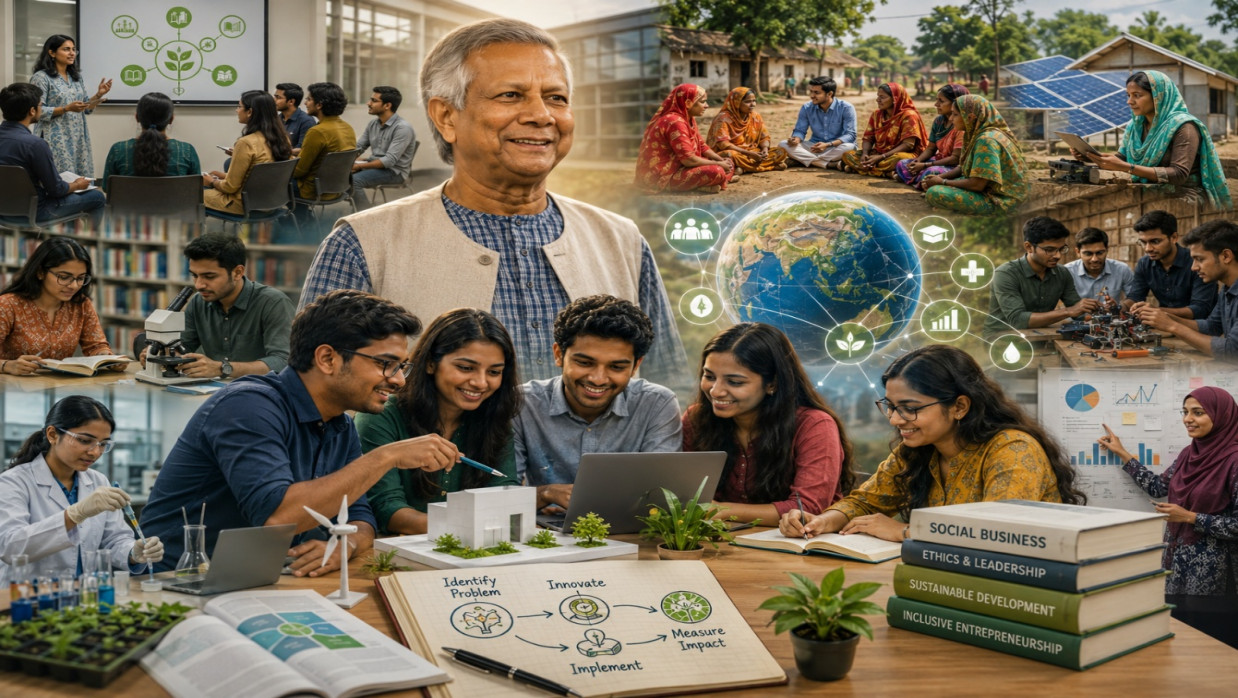
"The purpose of business should not be only to make money. Business should be a powerful force for solving human problems." — Muhammad Yunus
Rethinking the Purpose of Higher Education
Traditionally, universities are recognized as drivers of intellectual inquiry, scientific progress, and career growth. Universities educate future doctors, engineers, entrepreneurs, economists, scientists, journalists, lawyers, educators, and policymakers who collectively determine the course for countries. However, despite their tremendous success, many institutions of higher learning operate within the framework of an educational paradigm that only makes graduates ready for employment while failing to prepare them to address humanity's most daunting problems.
The twenty-first century marks the emergence of a new context. Ongoing poverty, inequality, unemployment among youth, climate change, hunger, disruptive technology, forced migration, and healthcare emergencies have demonstrated the inadequacy of existing development approaches. These multidimensional problems call for a generation of leaders who can combine academic expertise with moral values and innovative thinking.
Against this background, the educational paradigm at Grameen University represents a completely new approach to higher learning that is distinct from anything traditional education offers. Based on the breakthrough idea of social business put forward by Muhammad Yunus, the Nobel Peace Prize laureate, the university has a great opportunity not just to change what students learn but also why they do that and for whose benefit.
Instead of limiting the role of education to one of preparing individuals for career success, Grameen University can use higher education as an engine for problem solving, inclusive prosperity, and sustainable human development.
From Profit Maximization to Problem Solving
In recent years, business education has been focused on maximization of shareholder value, profit making, market competitiveness, and organizational efficiency. Even though these goals still matter, there is one more question that has been forgotten: Is it possible to use business as a tool to solve social problems rather than making money from them?
The idea of social business is the answer to this question.
Unlike traditional companies, social businesses aim to solve problems while remaining financially sustainable. They cover costs, plow back the profits, and make social impact.
This rather basic change in mission essentially redefines the character of business.
It is no longer enough to be profitable; rather, success lies in improving people’s lives, enhancing communities, preserving the environment, and giving those left out of the economic equation an opportunity.
Grameen University's educational philosophy offers the possibility of embedding this mindset across every academic discipline.
Students would no longer study business simply to understand markets. They would study business to redesign markets in ways that advance human dignity.
A University Built Around Social Impact
Most universities organize their curricula according to academic disciplines. Departments often function independently, each pursuing specialized knowledge within clearly defined boundaries.
Grameen University's educational model offers an opportunity to organize learning around societal challenges instead.
Imagine students from business, engineering, medicine, agriculture, computer science, journalism, environmental studies, architecture, law, economics, and public policy working together to address a single problem such as rural healthcare, clean drinking water, affordable housing, youth unemployment, or climate resilience.
Rather than asking, "What discipline does this belong to?" the university would ask, "What solution does society need?"
Such an interdisciplinary approach mirrors the complexity of contemporary global challenges, which rarely fit neatly within traditional academic categories.
Learning becomes collaborative, practical, and deeply connected to human needs.
Integrating Social Business Across the Curriculum
The integration of social business should extend far beyond a single elective course or specialized program. Instead, it can serve as the intellectual foundation for the university's curriculum. Future business students could be taught how to develop sustainable businesses that solve social problems. Engineering students could develop affordable technological solutions for underprivileged communities. Medicine and public health students could develop creative healthcare delivery systems for rural communities. Agricultural students could consider climate-proof farming models that would contribute to food security and the conservation of natural resources.
Students majoring in computer science could work on digital solutions that would advance financial, educational, health care, and community development services.
Future journalism and communications students could explore the roles of storytelling, media innovation, and strategic communication in fostering social awareness, behavior change, and engagement. Education students could develop innovative learning models that expand educational access to marginalized populations.
In every discipline, academic knowledge becomes connected to practical social transformation.
Experiential Learning Beyond the Classroom
One of the defining characteristics of Grameen University's educational philosophy is the integration of experiential learning into every stage of the student journey.
Knowledge acquired in classrooms reaches its fullest value only when applied to real communities facing real challenges.
Students would regularly engage with villages, urban neighborhoods, cooperatives, social enterprises, non-governmental organizations, healthcare facilities, schools, environmental initiatives, and community development projects. Field immersion will cease to be an intermittent internship experience and become an integral part of academics.
Students could engage in the process of need assessment, research, intervention design, outcome measurement, and problem-solving in collaboration with the community during semesters.
Communities themselves turn into learning institutions. Education changes from observation to involvement. Learning becomes interactive instead of unidirectional.
Social Business Laboratories
As engineering colleges have laboratories where technological experiments take place, Grameen University could create Social Business Innovation Laboratories to develop practical solutions to social problems. These laboratories would function as interdisciplinary innovation hubs where students transform ideas into implementable ventures.
Each lab could focus on developmental challenges including:
- Alleviation of poverty and financial inclusion;
- Sustainability of agriculture;
- Production of renewable energy;
- Making healthcare affordable;
- Digital inclusion;
- Economic empowerment of women;
- Adaptation to climate change;
- Affordable housing;
- Circular economy initiatives;
- Entrepreneurship of youth.
The students would stop preparing business plans and begin piloting, prototyping, and perfecting their ideas. The element of failure would be seen as a natural part of the learning process.
Entrepreneurship with a Human Face
Traditional entrepreneurship education frequently emphasizes venture capital, market expansion, profitability, and rapid business growth. Grameen University's approach would broaden these objectives. The students will be motivated to ask very different types of questions:
How many lives will this venture make better? Whom do the current markets leave out? Is environmental sustainability possible along with economic growth? How can innovation empower those with the fewest resources? What measurable social value will this organization create? This shift represents more than an alternative business model. It reflects an alternative philosophy of economic development itself. Graduates would leave the university prepared not only to launch successful enterprises but also to create organizations that contribute meaningfully to societal well-being.
Research that Solves Problems
Research universities often evaluate scholarly success through publications, citations, grant funding, and international rankings. While these indicators remain important, Grameen University has the opportunity to introduce an additional measure of academic excellence: measurable societal impact. Research issues might also be identified based on problems facing the community. The academic faculty and students could undertake research into affordable healthcare technologies, financial inclusion models, sustainable agriculture, educational technologies, renewable energy sources, urban resilience mechanisms, and poverty alleviation.
Research issues might also be identified based on problems facing the community.
The academic faculty and students could undertake research into affordable healthcare technologies, financial inclusion models, sustainable agriculture, educational technologies, renewable energy sources, urban resilience mechanisms, and poverty alleviation. Community members become research partners rather than research subjects. Knowledge production becomes democratized. Academic inquiry becomes directly connected to improving human lives. Such an approach does not diminish scholarly rigor; instead, it enhances the social relevance of academic research.
The Student Experience: Learning Through Purpose
The most unique aspect of the Grameen University concept may very well be the student experience itself.
Not only would students be graduating from university not just with transcripts and degrees but with portfolios that demonstrated social change.
They would have started businesses, gotten involved with community development projects, undertaken applied research, worked interdisciplinarity, worked with foreign collaborators, and even gained leadership experience. University life would revolve around empathy, cooperation, ethics, and service along with academics. Leadership would be more about helping others than about power. Competition would increasingly give way to collaboration. It would be a shared achievement, not one that is solely personal.
Global Cooperation to Address Transnational Problems
The issues facing humankind are transnational. Climate change, migrations, pandemics, technological disruptions, food insecurity, and inequality need global cooperation. Grameen University therefore has the opportunity to become an important global hub for social business education. Collaborations with universities, research institutions, international organizations, charitable foundations, development organizations, and social enterprises could help conduct research, exchange students, innovate, and gain practical experience in the international arena.
This would enable Bangladesh to be not only a recipient of the global educational paradigm but also a maker of the future of higher education. Grameen's philosophy could be an inspiration for universities in Africa, Asia, Latin America, and elsewhere.
Measuring Education's Effect on Society in a New Way
University rankings often place heavy weight on research productivity, faculty reputation, citations, financial status, and alumni salaries. These factors tell us much about institutions, but seldom anything about their impact on society. Grameen University offers an opportunity to develop complementary measures of institutional success.
These might include:
- Social enterprises created by graduates.
- Communities served through academic programs.
- Empowering women through entrepreneurship programs.
- Creating jobs through projects done by the students.
- Reducing carbon footprints through sustainable developments.
- Improving the livelihoods of people in rural communities through university-community partnerships.
- Improved public health through community intervention programs.
- Successful implementation of poverty alleviation programs.
- Such indicators would redefine educational excellence by focusing on meeting humanity's immediate requirements.
- Fostering a New Breed of Ethical Leaders
- The modern era requires leaders who can integrate technology with humanistic values.
- Technologies such as artificial intelligence, automation, biotechnology, and digital technology are revolutionizing societies at an unprecedented pace.
- However, technological ability alone does not guarantee social development.
- Ethics, empathy, compassion, and responsibility become critical.
- Grameen University's philosophy of education aims to foster exactly such leadership qualities.
Its graduates would possess technical competence, entrepreneurial confidence, global awareness, and a profound commitment to serving humanity.
Such leadership is increasingly essential in an interconnected world characterized by complexity, uncertainty, and rapid change.
Bangladesh's Contribution to Global Higher Education
Bangladesh has already transformed international thinking through microcredit and social business. Grameen University presents an opportunity to make an equally significant contribution to global higher education. It will be possible to present an entirely new model based on the country’s own experience rather than copying models used elsewhere. This is a striking turnaround in the dissemination of knowledge. Ideas born in rural Bangladesh could once again influence universities across continents. Just as the Grameen Bank challenged assumptions about finance, Grameen University can challenge assumptions about the very purpose of higher education.
Challenges on the Path Forward
Realizing this ambitious vision will require sustained leadership, institutional commitment, international collaboration, adequate resources, and continuous innovation. Faculty development is vital for fostering interdisciplinary teaching and research. The curricula need to remain academically challenging while adapting to changing social requirements. Collaborations with government agencies, private industry, civil organizations, and global organizations will help the university achieve its potential to translate ideas into tangible impact. The delicate balance will determine whether the university succeeds.
Education as the Most Important Social Institution for Humanity
The future of the higher education system cannot be measured solely by larger campuses, advanced technologies, and improved international rankings. Its real value lies in its ability to change people's lives for the better. Grameen University is a university with an amazing vision: to create an educational organization that would become the most powerful social enterprise of all, serving society by solving problems rather than educating people. The integration of social business into teaching, research, entrepreneurial activities, and community work will give rise to a new generation of innovators who view every social problem as an opportunity to use creativity. If this university succeeds in its mission, it will be much more than a mere learning establishment. This will be an organization that serves humanity as a laboratory of knowledge, promotes inclusiveness through innovation, and pursues the highest goal of higher education—improving life and helping to create a better world.
As Muhammad Yunus wisely observed:
"Every human being is born as an entrepreneur. Some get the opportunity to discover that. Some never do."
Grameen University has the opportunity to ensure that future generations not only discover that entrepreneurial spirit but also learn to direct it toward humanity's greatest needs, proving that the highest purpose of education is not merely to create successful careers, but to create a better civilization.

0 Comments
LEAVE A COMMENT
Your email address will not be published