

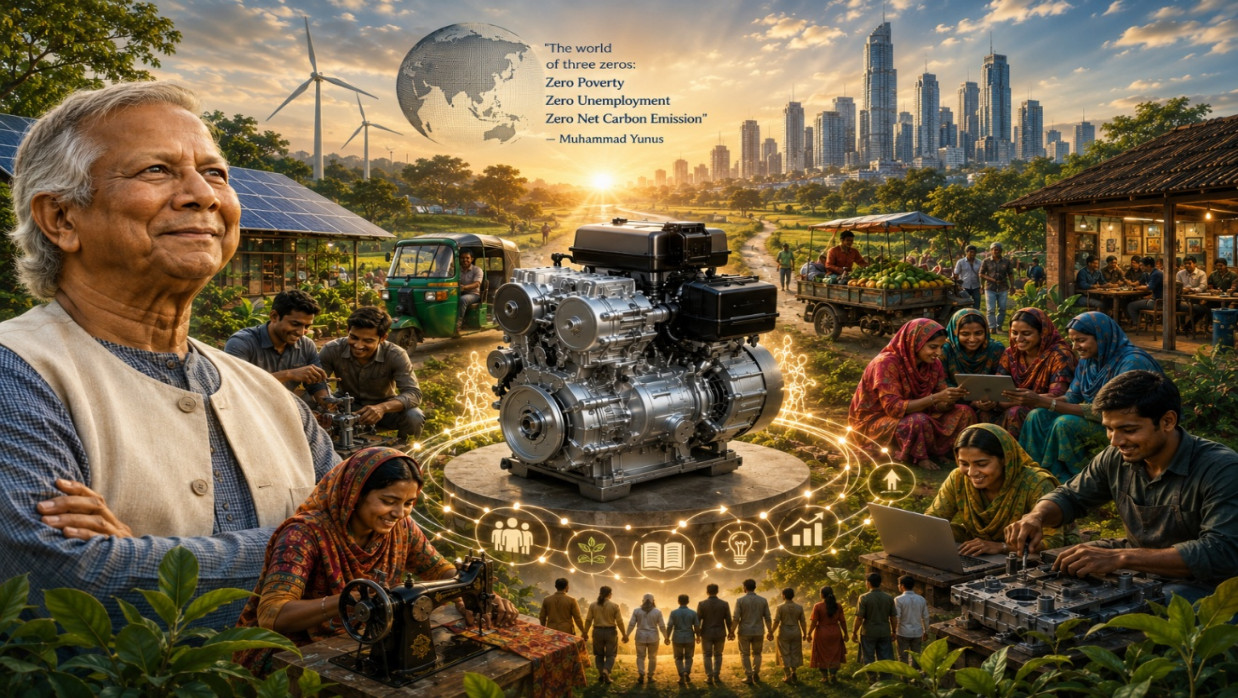
Historically, disruptive innovations have been strong drivers for human development. The steam engine powered the Industrial Revolution, electricity transformed modern civilization, and the invention of the internal combustion engine transformed transport, commerce, and industry. In addition to transforming economies, innovations changed lifestyles, employment, and social interactions. Despite the significant role of innovative technology in the development of societies and improving the general welfare, the distribution of its advantages has been far from even. People who owned capital, resources, and market power were the primary beneficiaries, while billions of people struggling with poverty were left on the fringes of technology.
Today, a groundbreaking innovation emerging from Germany seeks to challenge that longstanding reality.
Inspired by the vision of Nobel Peace Prize laureate Muhammad Yunus and his lifelong commitment to empowering the poor through entrepreneurship, Dr. Sabet Consulting GmbH has developed a remarkable new technology known as the Sabet Advanced Motor (SAM). The result of years of intensive research, experimentation, and engineering innovation, SAM represents far more than a new generation of engine technology. It embodies a bold reimagining of how technological progress can be harnessed to serve those historically excluded from its benefits.
Fundamentally, SAM was conceived on the premise that engineering can transform society, with engineering innovation leading to affordable, flexible, and accessible energy technologies that will open economic opportunities for poor entrepreneurs around the world. This new technology aims to redefine the concept of engineering by empowering people and addressing poverty in the developing world.
By virtue of its unique innovation, if the Sabet Advanced Motor is implemented through a creative social business model, it has the potential to become a means of triggering grassroots entrepreneurship and sustainable development. In essence, this technology can be viewed as having potential beyond mere innovation, since innovation itself should lead to expanded human possibilities in society.
A Different Kind of Innovation
The vision behind the Sabet Advanced Motor is both ambitious and profoundly humanitarian.
Unlike conventional engines designed primarily for commercial markets, SAM was conceived with a specific social mission: to create a technology that helps poor people improve their productivity, increase their income, and ultimately escape poverty.
The technology hinges upon the following three basic tenets.
First, the engine needs to be inexpensive. The creators of the engine hoped that their creation would become a source of income for those individuals who could not afford new machinery.
Second, it has to be flexible. In other words, this engine has to work with various types of fuel; hence, consumers living in isolated or economically disadvantaged regions can use whatever fuel is available to them instead of expensive or hard-to-get fuel.
Third, the engine must be reliable and easy to maintain. Poor people often have difficulty finding someone to repair their engine or provide spare parts. The problem is solved by developing an engine with far fewer parts than traditional engines.
The result is an engine that is smaller, more efficient, more adaptable, and potentially far more affordable than many existing technologies.
One highly respected technical observer has gone so far as to describe SAM as “the invention of the century.”
While such praise will ultimately be tested through practical application and large-scale deployment, the enthusiasm surrounding the technology reflects its potentially transformative nature.
Inspired by the Vision of Muhammad Yunus
The history of SAM would be incomplete without the philosophy of Nobel Peace Prize winner Professor Muhammad Yunus, who has been at the forefront of developing the concepts of microfinance and social business.
It would also be appropriate to trace the genesis of this partnership back to 1997, when Houshmand Sabet first met Professor Yunus upon receiving the Planetary Consciousness Award at Frankfurt's famous Paulskirche Church.
At that event, distinguished German leader Dr. Lothar Späth made a striking observation. He suggested that the combined ideas and work of the award recipients had the potential to contribute to the emergence of a genuinely global eco-social market economy.
For Houshmand Sabet, the encounter proved deeply influential.
For years, he had followed Professor Yunus's work through German media and had been particularly inspired by one of Yunus's central observations: technology often serves the interests of the wealthy while bypassing the needs of the poor.
Yunus’ argument was consistent in his belief that poverty cannot exist because of the poor themselves but because they are marginalized by the systems, institutions, and structures of exclusion. Hence, technology must not just be designed to increase profit but to enhance human capabilities.
This philosophy became the intellectual foundation of the SAM project.
The Sabet family spent years consulting with Professor Yunus, seeking to understand how technology could be designed specifically to serve the needs of poor communities and aspiring entrepreneurs.
In 2008, Houshmand Sabet and his son, Hafez Sabet, presented the first prototype of the Sabet Advanced Motor to Professor Yunus in Berlin.
What began as an engineering project gradually evolved into a social innovation initiative to address one of humanity's most enduring challenges: poverty.
Perseverance Through Adversity
The journey toward developing SAM has not been without obstacles.
Following Houshmand Sabet's illness and passing in 2016, progress on the project slowed considerably. However, the vision did not disappear.
From 2020 onwards, a new wave of innovations spearheaded by Hafez Sabet revived the venture through further technological advancements and enhancements to the initial idea.
This new push led to major milestones, which were publicly marked on Social Business Day in 2025 in Dhaka, where Hafez Sabet appeared as a guest of honor.
This milestone was not just another technological success, but rather the culmination of a long journey pursued by a family over many years toward socially impactful innovation.
Technology Meets Social Business
Perhaps the most exciting dimension of the project lies not in the engine itself but in how it may be deployed.
Recognizing that technology alone cannot solve poverty, Dr. Sabet Consulting and Professor Muhammad Yunus have agreed to establish the Sabet–Yunus Foundation in Germany.
The foundation will oversee patent licensing rights for SAM technology and support the establishment of social businesses to manufacture and distribute the engines.
This model reflects Professor Yunus's broader philosophy of social business enterprises designed not to maximize profits for investors but to solve social problems while remaining financially sustainable.
Through this process, the community will not be seen as passive beneficiaries but will take an active role in development.
Rather than relying entirely on external aid, the project aims to develop sustainable ecosystems that create jobs, income, and social benefits.
The foundation is expected to serve as an international platform promoting social innovation, entrepreneurship, research, education, and development cooperation.
A New Opportunity for Bangladesh
Bangladesh is expected to play a central role in the next phase of the SAM initiative.
A Memorandum of Understanding among Dr. Sabet Consulting GmbH, Grameen Healthcare Trust, and WeQ Institute GmbH will enable us to initiate a social business project to generate energy using SAM technology.
The initiative aligns closely with Bangladesh's growing need for affordable, decentralized, and environmentally sustainable energy solutions.
Partners have examined not only the SAM engine itself but also the CELINE concept—Clean Ethanol Logistics Improving Natural Environment—which seeks to integrate cleaner fuel systems into local energy ecosystems.
From technical feasibility to commercial viability, from regulations to environmental impact, supply chains, and sustainability, their deliberations covered many aspects.
The next crucial step for these partners is to develop a pilot project in Bangladesh with at least 200 SAM units.
The pilot will provide valuable data regarding performance, economic viability, environmental impact, and social benefits.
Addressing Global Energy Challenges
One of the most significant advantages of SAM is its fuel-agnostic design.
The system can produce mechanical, electrical, and refrigeration energy, among other outputs, from various fuel sources.
This engine will be very useful in developing countries, where access to energy is often difficult.
Around the world, millions of small farmers, fishermen, shop owners, and rural entrepreneurs struggle with limited access to affordable power.
A low-cost, durable, and versatile engine could dramatically improve productivity, reduce operational costs, and create new economic opportunities.
In this sense, SAM has implications that extend far beyond Bangladesh.
Its successful deployment could provide a scalable model for addressing energy poverty across Asia, Africa, and Latin America.
Reimagining Technology for Human Progress
The story of the Sabet Advanced Motor offers an important reminder that innovation is ultimately about people.
Technology achieves its highest purpose not when it simply generates profit but when it expands human freedom, dignity, and opportunity.
For decades, Professor Muhammad Yunus has challenged the world to rethink poverty, arguing that human beings possess unlimited potential when given access to appropriate opportunities and resources. The SAM initiative embodies that philosophy in practical form.
Given the blend of excellent engineering, socially responsible enterprise, innovative use of renewable energy sources, and a determination to foster economic empowerment, the concept becomes a powerful statement regarding the potential for technology to serve as a catalyst for social change.
The future success of such an invention would rely on successful testing and implementation, but the very concept holds great promise. In a world where new technologies increasingly contribute to inequality rather than alleviate it, the creation of the Sabet Advanced Motor offers an alternative – one of technology designed to empower not the select elite but those millions of people left behind by conventional approaches. If successful, the SAM could be far more than simply an engine; it could become the symbol of an approach in which technology, in conjunction with compassion and purposeful thinking, could result in a world free from the shackles of poverty.
“The world has three billion people who are trying to survive on less than two dollars a day. Imagine what would happen if we could unleash the energy and creativity in each of them.” — Muhammad Yunus


0 Comments
LEAVE A COMMENT
Your email address will not be published