

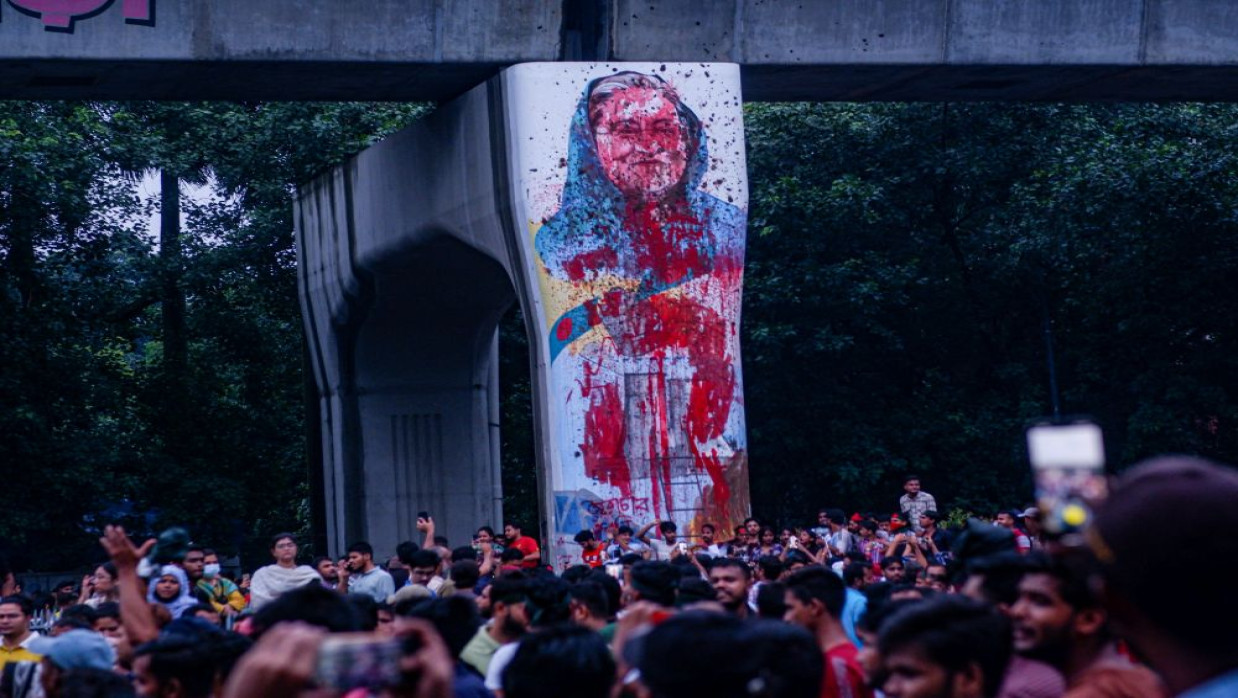
Twenty two months since Sheikh Hasina fled to India fearing repercussion to committing massacre and seven months since she was sentenced to death for crimes against humanity, New Delhi is yet to make public its actual decision on whether to extradite the deposed Bangladesh ruler as per the existing treaty despite repeated requests from Dhaka.
However, that Hasina has been there in secret shelter since 5 August 2024, proves to be India's decision, presumably a well-thought out politico-diplomatic stand. India was part of the process of her 'evacuation' from the then Prime Minister's official residence Ganabhaban in Dhaka to save her from the wrath of the surging masses.
Now, it requires a 180-degree shift in Delhi's position if it is to dump a ruler whom it patronised and who served it for years. Bangladesh's immediate past interim government of Professor Muhammad Yunus requested Delhi to hand over Hasina for prosecution and execution of conviction and the newly elected government of Prime Minister Tarique Rahman conveyed the same request to the Indian authorities.
The Indian external affairs ministry's recent statement that Dhaka's formal request was "being examined as part of ongoing judicial and internal legal processes", indicates no change in status quo and rather a tactic to buy time and keep others in a state of confusion. The Indian ministry spokesperson's comment that they would "continue to engage constructively on the issue with all the stateholders" can be seen as their policy position.
Hasina's conviction is an internal affair of Bangladesh while as a pawn in the Indian custody she has turned into Delhi's own strategic asset. Since the two neighbouring countries earlier signed extradition treaty, India's only domestic jurisdiction is whether the crimes such as killing of around 1400 people she committed in Bangladesh to quell people's uprising are also lawfully considered as crimes in India. If the Indian authorities abide by their own laws, there is no legal barrier to surrendering Hasina to the Bangladesh authorities.
Delhi may also outright reject the extradition request on two grounds: (a) 'We cannot put our friend (Hasina) into trouble including possibility of execution' and (b) 'Her crimes in Bangladesh are political in nature so we cannot extradite a political prisoner'.
The Indian leaders would not do this either in keeping with diplomacy they had pursued towards Bangladesh; otherwise no one will be so friendly to India unlike her in future. Delhi's interest in engaging more with the new elected government in Dhaka suggests India would love to use the issue of Hasina's extradition as a bargaining point which can diminish the importance of other issues of bilateral interests.
Conspicuously, the Bangladesh authorities -- no matter exactly who they are -- had on 5 August 2024 allowed Hasina to leave the country losing the opportunity to detain and try her, cerrtainly not in abstentia. However, the poetic justice in this episode is that she fled the country she had ruled with iron hand, like a fleeing thug. Delhi gave shelter to a tyrant who had been hated by millions at home for all repressive and anti-democratic acts, risking feeling of more anger among Bangladeshis for India.
Hasina's status in India is not also clear as her passport was cancelled and Delhi has not officially offered her political asylum. So, her questionable stay in that country has arisen and may remain as another irritant in Indo-Bangladesh relations.
The critical issues that have not been resolved for years, include unilateral withdrawal of waters of common rivers by upper riparian India depriving Bangladesh of its shares, tariff and non-tariff barriers to exports from Bangladesh and killing of Bangladeshis along the border. The need to reviewing agreements publicly criticised as unjust, including the one on powea trade signed during the Hasina regime has been added to the list.
A bitter point that cannot be ignored is: India's big brotherly attitude towards Bangladesh, was dealt with a devasting blow in Dhaka due to the fall of Sheikh Hasina who herself once bragged that Delhi would never forget her for "what I gave India... I give more than I receive". In exchange for Delhi's support to her, her regime deprived the Bangladeshis of their rights including the right to vote.
In its relations with post-Hasina Bangladesh, India cannot expect any one-sided affair and merely Delhi-centric foreign affairs policy of its neighbour.
Therefore, the Indian leaders need a new beginning in its overall relations with the Bangladesh people more than the popularly elected government of the Bangladesh Nationalist Party (BNP) does.
If or when Prime Minister Tarique Rahman would be visiting New Delhi some time soon, the Bangladeshi diplomats may utilise the occasion for raising the issue of reviving SAARC (South Asian Association for Regional Cooperation) initiad by Tarique Rahman's father Shaheed President Ziaur Rahman but made nonfunctional during the Hasina rule. However, instead of debating on Hasina, Dhaka has the scope to tell Delhi that SAARC can reduce hostilities in inter-state relations and increase cooperation for benefit of peoples of all the countries of the region.
Any excessive focus on the Hasina extradition issue may be just waste of time as that may derail the discussion on other important issues. In case, India agrees to extrade Hasina imposing certain conditions, it may have domestic political impications today and tomorrow.
Of course, Dhaka would strongly demand Hasina's extradition simply in accordance with the bilateral Extradition Treaty and as part of principles of international law, not as an issue of trade-off. If Delhi doest not bother to respect the treaty, Dhaka may have to shift the focus elsewhere, to other serious issues of national interests. Improving bilateral relations to widen areas of cooperation is the responsibilities of both the sides.
From its relations with other regional countries and also global powers in recent times, India might have learned that it has no reason to undermine Bangladesh as a country of 180 million people. Thus it can make the opening gambit to heal the injuries it caused to the Bangladeshi heart and signal that Delhi now believes in sovereign equality while maintaining relations with Bangladesh.

0 Comments
LEAVE A COMMENT
Your email address will not be published