

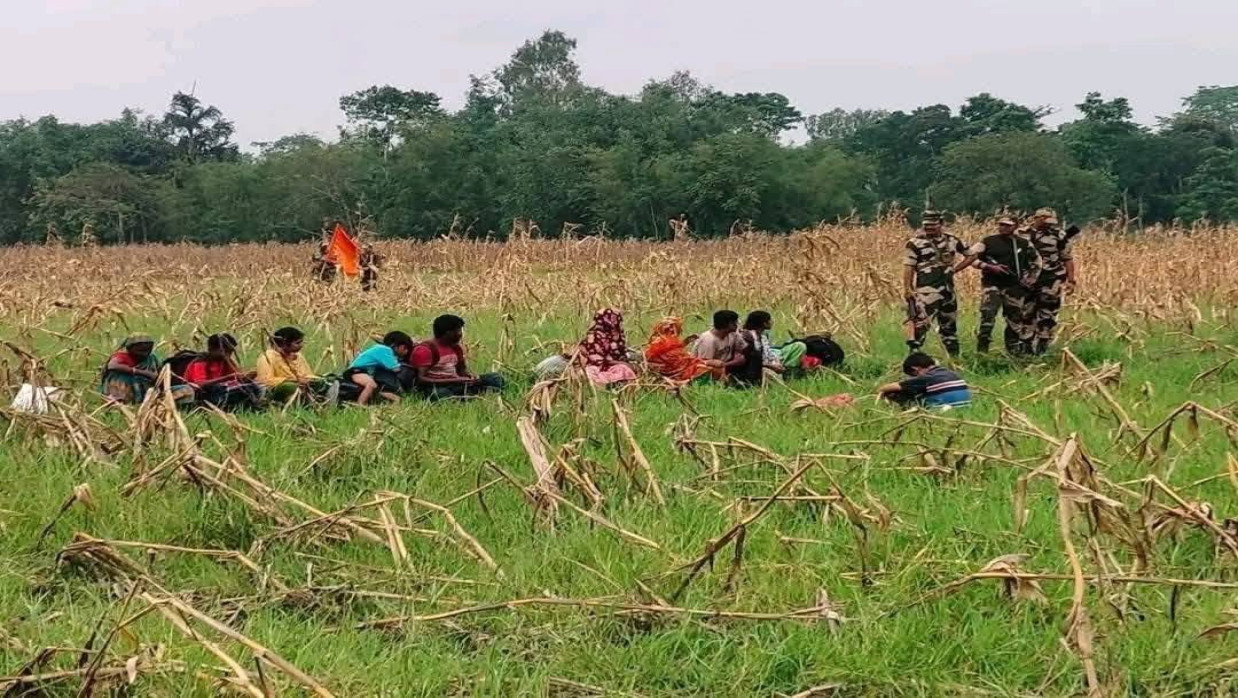
Bangladesh–India relations have been strained recently as talks of illegal migration from Bangladesh have once again come into discussion, with reports of forced push-ins emerging last month. Bangladesh and India are working to normalize relations following major developments in Bangladesh's political landscape in 2024. However, recent events on the Bangladesh-India border have raised issues of migration, border control, sovereignty, and trust between Bangladesh and India.
A Border That Defies Easy Control
Bangladesh and India share more than 4,000 kilometers (2,500 miles) of international land border crossing rivers, forests, croplands, villages, and populated areas. Because of its extensive length and varied terrain, Bangladesh's border with India is hard to manage. Bangladesh has long struggled to patrol this porous border.
Illegal immigration, smuggling, and the movement of humans across the border have been problems faced by both nations for many years. Generally speaking, relations between the Border Guard Bangladesh (BGB) and the Indian Border Security Force (BSF) have improved over the years. However, tensions have flared from time to time whenever the political rhetoric heats up over migration from Bangladesh.
Allegations of Forced Push-Ins
Bangladesh has accused Indian security forces of trying to push people into the neighboring country on multiple occasions recently, without following due process. Border Guards Bangladesh (BGB) said they recently spotted 10 attempts to push crowds into Bangladesh over a brief period, and have ordered intensified border patrols in several areas.
The southern border district of Jhenaidah was reportedly the scene of one of the largest incidents Bangladesh claimed to have occurred. BGB officials stated that recently, Border Security Force (BSF) officials tried to push between 30 and 35 people into Bangladesh in prison vehicles meant for transporting people across the border. "The Border Force drove them back after the perpetrators tried to take the vehicle into Bangladesh territory," a BGB statement read.
Hundreds of Bengali-speaking Muslims and Rohingyas were allegedly discovered trying to enter Bangladesh in crowds, according to recent reports. Bangladesh has also recently found hundreds of people stranded in both border areas and no-man's land.
India's Crackdown on Undocumented Migration
Migration has recently emerged as a prominent issue in Indian domestic politics. There are fears over migration across India's borders with Bangladesh in the states of Assam, West Bengal, and Tripura. India's BJP-led government has long spoken of illegal migration as a demographic, economic, and security threat.
Officials in some Indian states have stepped up efforts to detect and deport those believed to have illegally entered India. New Delhi says it has asked Bangladesh to conduct nationality checks on thousands of people it believes are living in India illegally as Bangladeshi nationals.
India is within its rights to be concerned about and take action to repatriate those who have entered illegally. Bangladesh objects to methods of determining who is believed to be an illegal immigrant and being sent back without due process, saying unilateral deportations disregard international standards and could lead to humanitarian and diplomatic problems.
Bangladesh's Sovereignty Concerns
Bangladesh framed the issue as one of both migration and infringement upon their sovereignty. Dhaka requested that those who were able to prove, through nationality verification, that they were Bangladeshi be returned through diplomatic channels, including repatriation verification through immigration channels.
Bangladesh has condemned these illegal crossings, which it has called informal "push-ins". It has protested the move as a violation of bilateral agreements and international protocols governing border management. Bangladesh has said it will not allow anyone or any community to enter the country illegally.
The BGB is stepping up vigilance, patrols, and border fencing along the border while increasing awareness among border communities. Bangladesh has been assuring its citizens that its borders will not be breached.
The Rohingya Dimension
A further complication is Bangladesh's Rohingya refugees. There are already over a million Rohingyas living as refugees in Bangladesh who have fled persecution from Myanmar. Allegations that Rohingyas have been among those groups being pushed toward Bangladesh have raised further alarm.
Bangladesh already shoulders an enormous humanitarian load as the host of the world's largest refugee settlement in Cox's Bazar. Pushing Rohingyas into Bangladesh without clearance would probably be considered extremely unfavorable by Dhaka and could damage relations further.
Impact on Bilateral Relations
The territorial conflict emerged at a time when Bangladesh-India bilateral relations are undergoing recalibration following the regime change that ended Sheikh Hasina's 15-year rule in 2024.
Water sharing of transboundary rivers, trade deficits, border killings, and "regional hegemony" are some of the other issues waiting to be resolved that have blemished public opinion about India in Bangladesh. The migration issue is yet another bone of contention between the two countries.
A segment of Bangladesh's society feels India's current foreign policy move towards Bangladesh has become unnecessarily abrasive and contrary to the spirit of mutual trust and good neighborly relations. On the other hand, Indian politicians continue to politicize border management and irregular migration.
The Need for Dialogue and Cooperation
Bangladesh and India have disputes and differences, no doubt. But they are close neighbors with common geography, history, culture, and economics. Strong linkages tie together both countries. A prolonged chill in diplomatic relations is good for no one.
Director-general-level talks between BGB and BSF next week can help express frustrations and find solutions towards well-defined guidelines for resolving pending cases. Genuine mechanisms need to be transparently devised to verify such cases under bilateral agreements and to facilitate the exchange of information between border-guarding forces, thereby reducing misunderstandings in the future.
Collaboration between the two sides is imperative. Irregular migration should not be allowed to become a unilateral decision through extrajudicial means. Border management should be based on respect for sovereignty, international responsibilities, and trust.
Conclusion
Border push-ins are turning into a double-edged sword for Dhaka-New Delhi ties. Although India regards illegal immigration as a grave internal problem, Bangladesh has made it clear time and again that any deportation must follow a dignified protocol. Bangladesh doesn't object to deportation as such, but Dhaka says that push-backs cannot be accepted.
The Bangladesh-India border is arguably the most complicated in the world. Unfortunately, push-ins along the borders threaten to undo the goodwill between Dhaka and New Delhi, which should otherwise remain committed to resolving border disputes through continuous dialogue. There is too much to gain from bilateral cooperation for both countries to let border issues damage their relations.

0 Comments
LEAVE A COMMENT
Your email address will not be published