

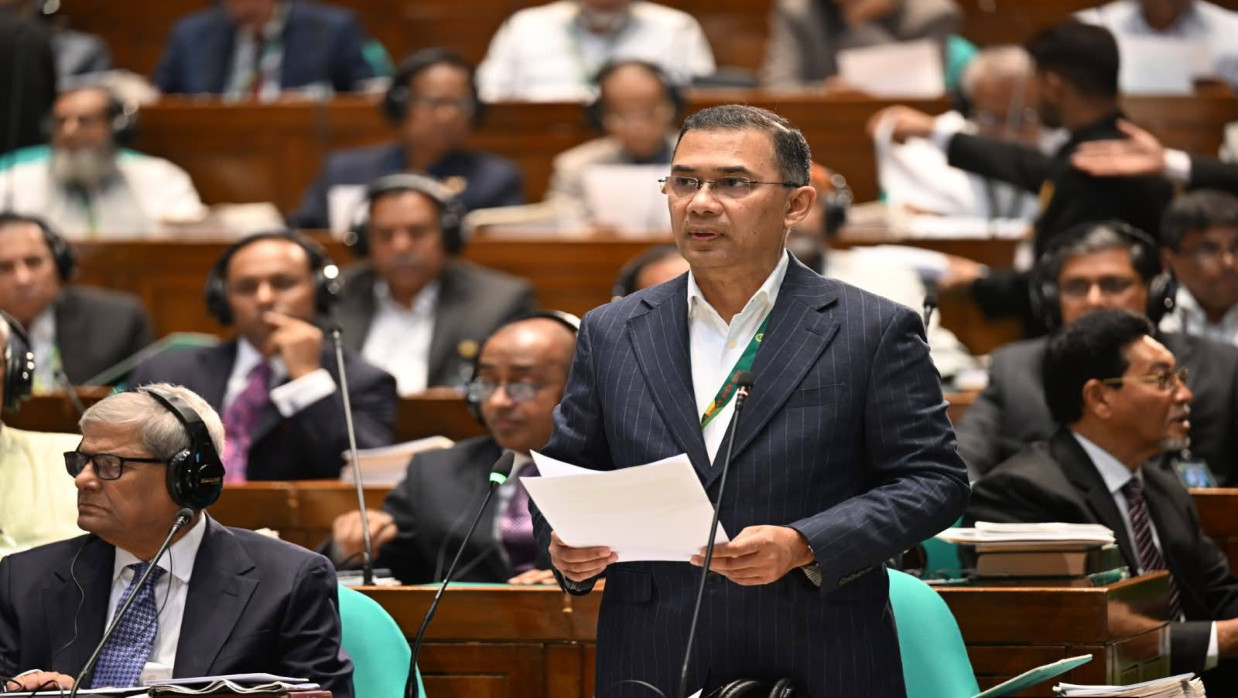
Bangladesh finds itself at one of the most pivotal political junctures in its history since its independence. Bangladesh was born out of sacrifice in 1971, but since its independence, it has swung back and forth between democratic ideals and military-authoritarian rule, reformist promises and political expediency. The political crisis that ensued after the stunning ouster of Sheikh Hasina’s regime in 2024, followed by the ascendance of a new regime under the leadership of Tarique Rahman’s Bangladesh Nationalist Party (BNP), has once again revealed the weakness and the lack of true democratic consolidation in Bangladesh’s state institutions. What seemed like a new day for Bangladeshis now looks bleak to many, fraught with uncertainty, suspicion, and resentment.
The interim government of Muhammad Yunus initially promised a comprehensive overhaul of the Bangladeshi state after years of authoritarian Awami League rule. Yunus faced a highly polarized political landscape, with severely politicized state institutions; a compromised judiciary in the eyes of the people; and rampant human- rights abuses, including enforced disappearances and politically-motivated abductions, which had tainted the trust Bangladeshi citizens had in their government. The July 2024 revolution was driven by students and young activists who had built up anger over unfair elections, censorship, corruption, and unchecked executive authority.
Although many viewed the movement that deposed Sheikh Hasina as an anti-government movement, it actually represented people’s frustration with how politics had slowly choked democracy in Bangladesh. U.N. sources report that up to 1,400 people died during the movement and thousands were injured. The loss of lives created high expectations for change, especially among Bangladesh’s youth and civil society. Bangladeshis wanted their country to transition to a state in which democracy ensured accountability and no political party or individual could seize power indefinitely.
Interim government’s Chief Advisor Yunus aimed to address these demands with wide-scale reforms. Over one hundred reformist ordinances were passed. These ordinances targeted the independence of the judiciary, the creation of a more effective anti-corruption system, the prevention of enforced disappearances, electoral reforms, referendum amendments allowing the public to vote on constitutional issues, and more. Eleven independent commissions were tasked with investigating deficiencies in the constitution, judiciary, and elections. What came to be known as the “July Charter” was an attempt to create a national consensus between Bangladesh’s two main parties on structural reforms.
Amongst these measures was a referendum held on the day of the February parliamentary elections. Over sixty percent of voters backed amendments regarding interim government-led free and fair elections, judicial independence, separation of powers, expansion of women's rights, and institutional reform to establish checks and balances. Prior to the election, the BNP itself led a campaign to advocate for the referendum. Many citizens of Bangladesh hoped that, rather than slowing reform, the decisive election would give new momentum to reform efforts.
The reality of Bangladesh's post-election politics has left many Bangladeshis disappointed. Far from speeding up implementation of the reforms agreed upon in January, the BNP-led government has instead postponed, weakened, or scrapped many reforms put into place by the interim government. The ordinances on judicial independence, the Human Rights Commission, and disappearances were not renewed. Bangladesh's new Parliament (which includes the BNP's supermajority) has swiftly acted to return powers over judicial appointments and governance to the executive branch. While the government claimed some ordinances needed "further scrutiny", many see these actions as backsliding on reform.
It is this widening gap between pre-polls rhetoric and post-polls performance that poses the principal political challenge facing Bangladesh today. Having presented itself during the election as the victim of authoritarian oppression at the hands of Sheikh Hasina, the BNP pledged to eradicate those very institutions that have allowed executive aggrandizement and politicization. But some in the party’s leadership now seem loath to give up the centralized power so characteristic of Bangladesh politics. Today, the opportunity to retain tight executive control appears to outweigh incentives for longer-term institutional building.
There are also divisions within the BNP. Reform-minded supporters, thinkers, and younger members who helped bring about the BNP’s electoral victory now feel disillusioned. At least some within the BNP high command privately admit to being uncomfortable with the direction things are headed. Commentators suggest that old-guard politicos within the party, those socialized by Bangladesh’s older patronage/populist political culture, are struggling to come to terms with limitations on executive authority or oversight bodies that aren’t ultimately subservient.
Simultaneously, vestiges of the AL machinery and remnants of the former regime retain footholds in elements of the bureaucracy, the judiciary, the business sector, and the media establishment. Reform represents an existential threat to these interests, which will resist change. They have played a role in political instability and provided fodder for anti-reformist propaganda. Bangladesh, therefore, faces opponents both from partisan sources and from regime interests that have grown reliant on four decades of politicization.
Adding to this is an increase in foreign-driven political ideologies and political polarization. Bangladesh has historically been vulnerable to foreign political influence, being both a South Asian middle power with a large population and significant geopolitical influence. Regional and international powers view Bangladesh as a key player. Within Bangladesh, political parties form transnational relationships to gain domestic political capital, projecting their internal conflicts internationally.
Many Bangladeshis fear that continued political uncertainty may open up room for extremist elements, sectarian organizing, and ideological violence. The resurgence of hate speech and inflammatory politics by secular-nationalist and Islamist extremists continues to further divide the country along ideological lines. Protests calling for reforms supported in last year's referendum have been organized by Jamaat-e-Islami and the National Citizen Party, both led by the opposition. Young activists tied to the 2024 movement have also begun issuing similar statements, saying another movement is possible should the government backtrack further on reforms.
Enforced disappearances have become emblematic of impunity. During the Awami League rule, several high-profile disappearances came to light targeting opposition activists, journalists, bloggers, and dissidents. Yunus' administration moved to criminalize enforced disappearance by passing the "Enforced Disappearance Prevention and Remedies Ordinance." The ordinance described enforced disappearance as a continuing offense, and criminals would be liable for prosecution and punishment until the individual is found. The BNP did not sign this into permanent law through parliament. In its absence, human-rights activists fear Bangladesh could return to old ways.
Equally troubling has been the emasculation of the National Human Rights Commission. Rolling back reforms that would have strengthened the commission's independence and investigatory power, particularly in matters relating to law-enforcement agencies, could allow this body to return to the politicized role it played under previous governments. Without independent institutions with real teeth, democracy is simply hollow talk, complain critics.
Suspending the Awami League under the guise of the amended Anti- Terrorism Act has only increased fears about the democratic direction of Bangladesh. Anti-Awami League sentiment still runs high among Bangladeshis who have grown weary of years of oppression and alleged misdeeds by the party. However, many are skeptical that silencing major political parties is ever a productive step towards enduring democratic norms. Bangladesh has a history of banning political rivals through legal maneuvering. The Awami League did it to Jamaat- e-Islami, and now the BNP-led parliament has done it to the Awami League.
The tragedy of Bangladesh’s situation is that it has had the opportunity, yet has failed to take advantage of it. Bangladesh’s moment came during the 20twenty-four revolution when there was finally a national consensus on the need for systemic change. People from across the political spectrum realized that Bangladesh could not continue to oscillate between phases of autocratization and democratic regression. People wanted change; they wanted strong institutions that could rise above political power games. The July Charter was one of the few moments in Bangladesh’s recent past when all significant political players seemed ready to subordinate political interests to institutional interests.
Bangladesh has long suffered from a political culture in which power is vested in individuals rather than institutions. Political parties have acted more like networks of patronage and personal loyalty than well-organized ideological entities.
It has become less acceptable among the Bangladesh Generation Z. They are better connected to the outside world than their predecessors. They are more politically aware than their parents. They have a lesser tolerance for patronage politics as we have known them for decades. Most protesters during the 2024 movement felt they were fighting against not just a government but an entire system fueled by impunity and centralized hegemony. Their anger now stems from a fear that all the sacrifices they made will be once again co-opted by the same ineffective system.
Don’t forget the economy either. Politics will influence investors’ confidence, industries’ growth, export performance, social unrest, and much more. Bangladesh has made tremendous economic progress in the last thirty years. It has become one of the fastest-growing economies in South Asia. But for the growth to remain consistent, there is a need for a credible democracy. We need the rule of law, we need judicial trust, and most importantly, we need predictable politics. Years of political bickering and questionability over our institutions will jeopardize all that we have achieved.
Bangladesh faces a litmus test: will it finally overcome the winner-takes-all culture that has plagued its politics since independence and lay the foundations for stronger democratic institutions that can outlive political parties and personalities? The fate of this government and that of the Bangladeshi state itself hangs in the balance.
More than anything, Bangladesh needs new ideas about what democracy should look like. People are crying out for a politics in which power can change hands without bloodshed, institutions are allowed to operate without fear or favor, dissent is permitted, and no government can seize the state. Will this government have what it takes to deliver on this expectation?
If all efforts to reform Bangladesh fail, the country risks slipping into more severe polarization, violence, and authoritarianism. But there is still time. The energy of the 2024 movement lives on. The calls for justice, institutional reform, and democratic dignity will not go silent until millions of Bangladeshis stop demanding it.

0 Comments
LEAVE A COMMENT
Your email address will not be published