

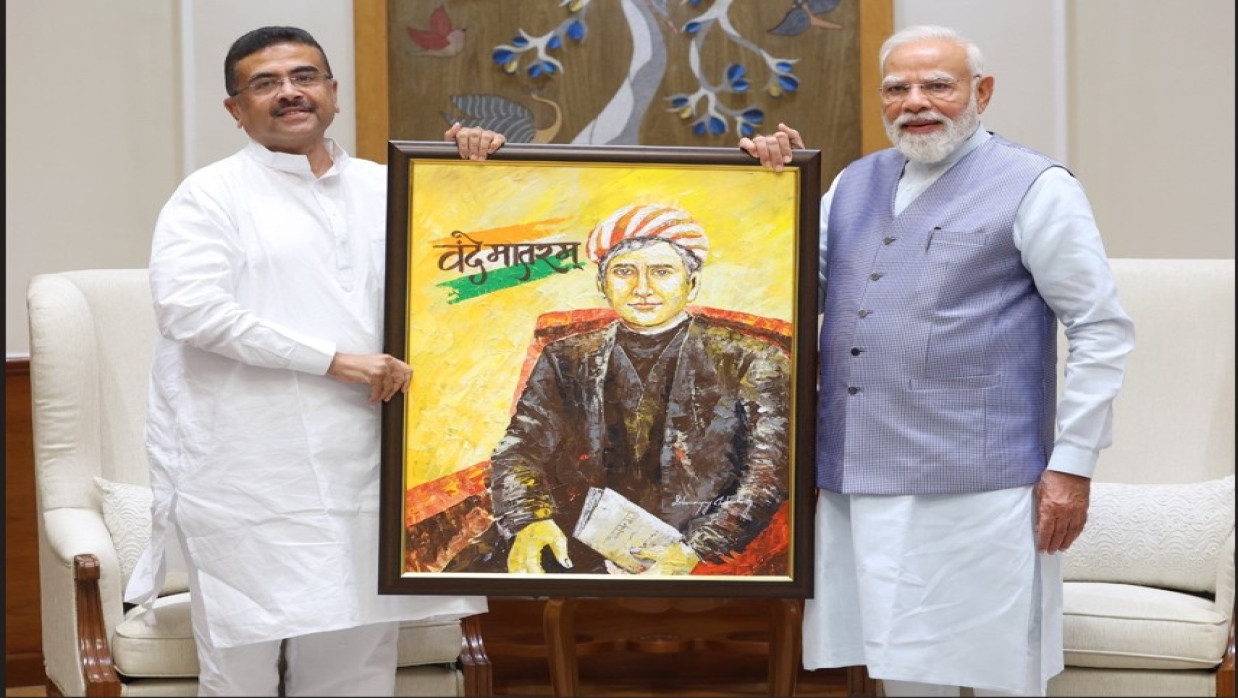
Recently in the elections in West Bengal, India, the Bharatiya Janata Party (BJP) , the Hindutva sectarian party led by Shuvendu Adhikari defeated Mamata Banerjee’s All India Trinamool Congress (AITC ), ending its 14-year rule of the state. The BJP’s win in West Bengal, which has been part of a series of wins by the BJP, India’s ruling party, is a testimony to India’s rising influence of Hindutva-inspired sectarian politics that not only threaten the safety and security of its minorities, especially the Muslims, but also pose a source of much concern for countries that border India.
From a Bangladeshi perspective, the radical transformation of India’s political landscape and social psyche over the past two decades – from liberal democracy to majoritarian sectarianism - is anything but inspiring; rather, it is deeply worrying.
Many observers trace this transformation to the rise of Narendra Modi, with his tenure as Chief Minister of Gujarat and the anti-Muslim riots of 2002, which many believe he passively encouraged. Since then, a powerful current of Hindu sectarian revivalism — variously described as Hindutva, Hindu cultural nationalism, or civilizational nationalism — has steadily moved from the ideological margins into the centre of Indian political life, if not Hindu India’s way of life these days.
Today, the Bharatiya Janata Party (BJP) and its allies govern most Indian states and union territories, giving the movement unprecedented institutional reach. Ironically, the ideological roots of Hindu revivalism that emerged in late nineteenth-century Bengal appear to have come full circle with the BJP’s recent electoral victory in West Bengal.
For many in Bangladesh and elsewhere in South Asia, the most troubling aspect of Suvendu/BJP’s victory is not merely electoral success, but the accompanying social polarisation; this transformation is not merely an electoral transition, but a warning of social polarisation and open hostility towards Muslims.
Reports of post-election violence, attacks on homes and businesses, inflammatory rhetoric, and the renaming of places associated with India’s Muslim past have deepened fears that the country is moving toward a more exclusionary national identity, which is in contradiction to India’s constitution – a democratic secular polity - which India’s founding fathers formulated to advance India.
Indeed, statements by some regional political leaders in states such as Assam and West Bengal have further intensified the anxieties of the Muslims.
Critics argue that these developments are part of a broader attempt to centralise political and cultural power around the BJP and Narendra Modi personally. This has led some commentators to draw comparisons with other highly centralised political systems of the twentieth century, including that of Mao Zedong’s China during the Cultural Revolution, and some even compare Narendra Modi’s India with interwar Europe under Adolf Hitler.
No doubt that such comparisons are extreme but given the rise of the BJP’s grip over India and its sectarianism, the fear is genuine.
Nevertheless, concerns about India’s human rights backsliding cannot be ruled out completely, can they? Besides, the rising spectre of one leader and one party; personality-centred politics; the rise of ‘Godi media’ (an appeasing media) and increasing pressure on freedom of speech, curtailments of dissent by the NGOs, universities, and intellectuals; and attempts to reshape historical narratives, educational content, and cultural identity around a majoritarian nationalist framework are disturbing.
Some analysts therefore describe present-day India not as a totalitarian state, but as an “illiberal democracy”, with electoral majoritarianism — where democratic institutions promote political and social isolation, space for and marginalisation of minorities and where voices against the majority dissent steadily narrow and are either stifled or ignored.
The comparison with Mao’s Cultural Revolution is usually less about communist ideology and more about cultural “purification.” Mao sought to destroy the “Four Olds” — old ideas, customs, culture, and habits — to reshape Chinese society around a communist revolutionary identity.
Critics argue that aspects of Hindu nationalist politics similarly seek to erase or civilisation, minimise centuries of Muslim influence on Indian culture and civilisation through symbolic policy interventions and political acts, for example banning beef consumption (Hindus, the majority people in India, regard cow as a deity and this prohibit consumption of beef) renaming cities and public places, revising textbooks by deleting India’s Muslim history, redefining national identity, and portraying Muslim rule as invasion, an affront to the Indian civilization.
More troubling is the recent rise in venomous anti-Muslim rhetoric that has contributed to polarisation of Indians along religious lines – the majority Hindus and the minority Muslims, more so, India’s political polarisation, since Modi’s rise in Gujarat in 2001.
The communal messaging witnessed during recent election campaigns in states such as West Bengal and Assam, has since promoted targeted violence against Muslims in both these states of India.
Some civil society organisations have even drawn parallels between the rise of Muslim othering in India and the persecution of Jews in Nazi Germany. Such comparisons should not be made casually, because the Holocaust was a singular historical atrocity involving industrial-scale genocide. Nevertheless, the comparison emerges from concerns over dehumanising propaganda, collective suspicion toward a minority community, and the portrayal of Muslims as demographic, cultural, or political threats to the nation.
Furthermore, A US-based expert tracking on communal harmony in India has testified before the US Commission on International Religious Freedom (USCIRF) on “senior political leaders' role in enabling hate and violence, …in demolishing minority properties, social media platforms' amplification of hate speech, and the growing transnational repression targeting critics abroad.” The testimony has submitted proofs of involvement of the top leaders, central and state systematic repression of the minorities especially Muslims as "embedded in bureaucracy, codified in law, shielded by absolute impunity, and steadily more ruthless in execution," .
For many in Bangladesh, the rising trends in Muslim persecution in India are seen with great apprehension. These sectarian initiatives are not only about India’s internal trajectory but also about the broader implications for South Asia, especially in the neighbouring Muslim-majority countries such as Bangladesh, where they host a large number of Hindu minorities as well.
However, the good news is that BJP’s sectarian policies have started to hurt India itself, politically and, more importantly, economically. Most Hindus and Muslims prefer and continue to live side by side without seeing one another as enemies. The social realities of the Sub-Continent seem to be still stronger than the narratives of hatred propagated by demagogues , television studios and social media networks .
Ultimately, the future of India — and perhaps the stability of South Asia itself — may depend on whether those quieter traditions of coexistence can prevail over the politics of fear, hate and division. Let us hope for the best.

0 Comments
LEAVE A COMMENT
Your email address will not be published