

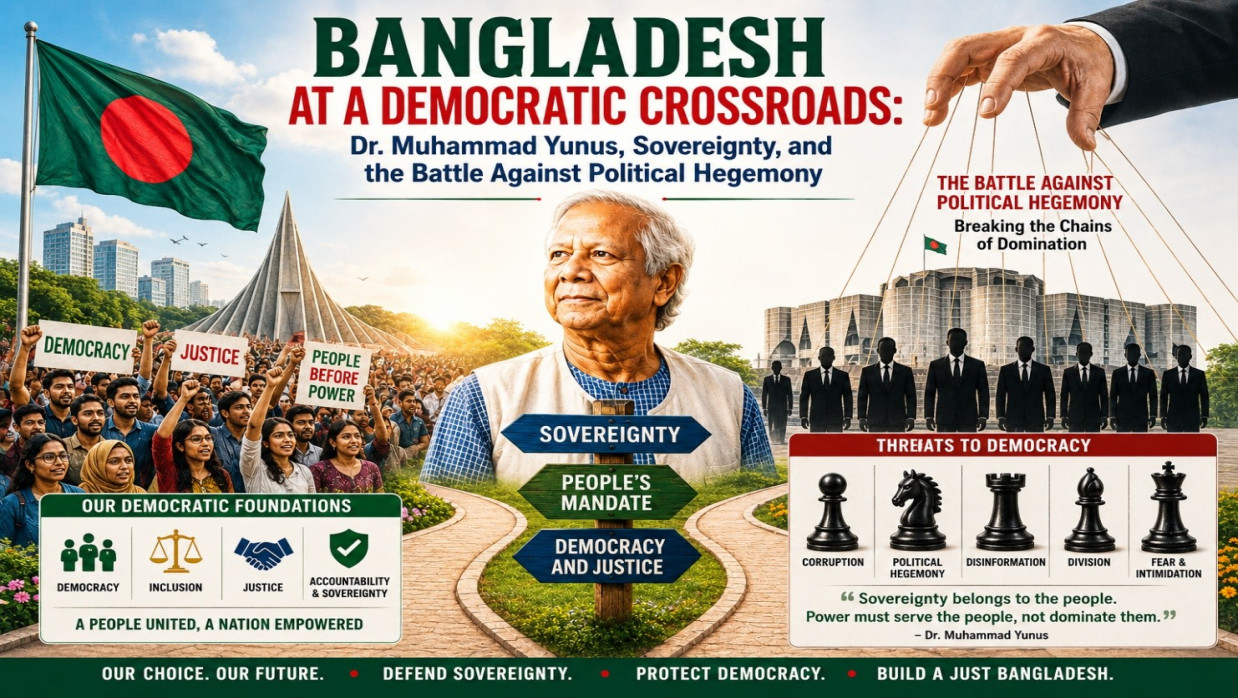
However, the political shift after the collapse of Sheikh Hasina’s administration in August 2024 has changed the entire political landscape of Bangladesh in unforeseen ways. The main protagonist in this political shift is none other than Nobel Prize winner Muhammad Yunus, who, in the guise of the interim leadership, soon found himself both recovering from the chaos and engaged in one of the greatest political struggles of all time. The simple politics, which started out as a solution to restore order, soon took an unexpected turn.
Although the smear campaigns launched against Dr. Muhammad Yunus seem like regular political attacks at first glance, they actually signal a broader effort to discredit a new model of leadership grounded in reform, accountability, renewal, and sovereignty. Indeed, as history shows, leaders who transform their countries' systems are often subject to smear campaigns because they seek to undermine the old model of patronage, authoritarianism, and vested interests that resist change.
In this light, Dr. Yunus gradually became the symbol of much more than just another administrator of transitional periods. For many Bangladeshis and international political observers, he represented an ideal example of a new political paradigm for the country – one based on good governance, institutional reforms, transparency, and respect for the international community. Thanks to his high standing abroad and his clear vision of the need to restore democratic institutions, Dr. Yunus offered hope to people seeking a new approach to confrontation-free, personality-based politics.
Smear campaigns launched against reformers usually employ several common techniques: repeating accusations, creating emotional tension between opposing sides, selectively using facts, spreading digital propaganda, and sowing mistrust in a leader, no matter how false or misleading the information might be. Not only do such campaigns target specific people, but they also aim to make the population feel that a complete democratic revolution is impossible. With regard to Dr. Yunus, these smear campaigns may actually be a sign of fear that he will become a key figure of the new political culture of accountability and independent decisions.
Nevertheless, the irony of fate makes smear campaigns against Dr. Yunus reinforce his status as a symbol of reform and change. The harder he is attacked, the more clearly people recognize him as someone who does not fit into the existing political model. At the same time, many Bangladeshis believe that this man will successfully guide the country through its democratization period.
The Politics of Narrative Control
Hostility towards Dr. Yunus is best explained using two related communication theories: Elisabeth Noelle-Neumann’s Spiral of Silence and Herman and Chomsky’s Propaganda Model.
The Spiral of Silence theory postulates that dominant political discourse silences criticism through instilling fear of political consequences, including social ostracization. Under the prolonged period of the Awami League government, a majority of people – including journalists, scholars, and members of civil society – chose to remain silent about pertinent issues like corruption, enforced disappearances, threats to press freedom, and vote rigging.
But the youth-led revolt of August 2024 shattered this state of affairs. After years of pent-up public anger, this was manifested in a mass protest movement on social media and in political opposition to the government. With the downfall of the previous government, a new political platform emerged where free expression was possible.
However, it would seem that the attacks on Yunus are intended to close down this space for democracy. Through the creation of a discourse in which Dr. Yunus becomes a problematic individual or one who operates out of the hands of foreigners or is dangerous politically, an attempt is made to reignite feelings of doubt among the population.
The Propaganda Model by Herman and Chomsky helps explain how political actors can use the communicative process to manipulate consent and change people’s memories. Outrage, emotional manipulation, digital misinformation, and controversy creation become instruments used to manipulate political legitimacy. In the case of Bangladesh, there have been increasing instances in which issues such as vaccines, deals, political decisions, and transitions have been used to challenge the moral legitimacy of Dr. Yunus.
Why Dr. Yunus Became a Political Threat
The animosity towards Dr. Yunus did not start once he became an interim leader. For a long time, he was eyed with mistrust by the former regime because of his international reputation and his high moral standing. He was different from typical politicians because he had gained international recognition, which was hard to manipulate.
This was because his focus on social business, responsibility, and good governance put him beyond the usual patronage system in Bangladeshi politics. Most importantly, his vision of leadership ensured that he could command international trust while maintaining an element of independence from politics.
Dr. Mahbub Ullah, political analyst and Professor (attached for your reference), says that “Sheikh Hasina has been attacking Dr. Yunus since she was in power” and “Pro-India political establishment has been opposing him more and more since he started opposing their regional hegemonic power.”
This statement highlights the deeper geopolitical realities. Years ago, many critics pointed out that relations between Bangladesh and India during the past government's regime were too one-sided regarding water sharing, border dynamics, an unequal trade system, and strategic alliances. The figure of Dr. Yunus is an icon of the prospect of a balanced foreign policy through diverse diplomacy. That repositioning inevitably alarmed political and strategic actors invested in maintaining the previous status quo.
The Successes of the Yunus Interim Administration
Despite inheriting one of the most fragile political environments in Bangladesh’s history, the interim administration under Dr. Yunus achieved several notable successes.
- Preventing Institutional Collapse
After the political crisis in 2024, instability became a threat to Bangladesh, and the country could have become institutionally paralyzed. The governance problem had been seriously affected. The caretaker government was able to keep the administration process moving without any reprisals or violence from its citizens.
- Restoring International Credibility
One of the most significant strengths of Dr. Yunus was his ability to repair Bangladesh’s reputation abroad. Criticisms of Bangladesh in the past have been linked to a lack of democracy, restrictions on press freedom, and problems with elections. However, as an internationally acclaimed Nobel Prize winner, Dr. Yunus instantly lent credibility to Bangladesh and helped it reengage with the international community.
- Reopening Democratic Space
However, the interim government restored space that had been limited for many years. Students, journalists, academics, and others gained the freedom to discuss matters publicly without fear of their safety, as was common in earlier times. It seems almost ironic that the democratic freedom of speech granted after the transition period is now being used by Awami League members to form political groups on a digital platform.
- Challenging Political Impunity
The administration led by Dr. Yunus was another attempt to counter charges of corruption against the previous government and other forms of violations, such as disappearances. It was important to remove Dr. Yunus from his post because he was representing the interests of accountability.
- Sovereignty, India, and the Question of Regional Hegemony
In terms of political sensitivity, the most problematic aspect of Dr. Yunus’s leadership was his apparent willingness to go against the cultural trend of Bangladesh's regional dependency on India.
To many in Bangladesh, this was not an issue of animosity towards India as a neighboring country, but rather an expression of the desire for equality, dignity, and the freedom to make policy without external pressure. In fact, through the years, there have been elements within Bangladeshi civil society and the political opposition who claim that their previous governments were too accommodating towards Indian interests.
A Different Kind of Diplomat – Dr. Yunus stood for a different kind of diplomacy, one that entailed establishing healthy ties with India alongside asserting Bangladesh’s sovereign right to decide matters on its own. His international fame and independent connections helped him craft such a balanced foreign policy.
The growing geopolitical significance of Bangladesh within the Indo-Pacific only deepened this dilemma. With Bangladesh's increasing geopolitical significance in the Bay of Bengal region, any efforts to diversify or recalibrate its foreign policy were likely to create geopolitical unease.
In other words, the opposition to Dr. Yunus was not only domestic, but also took on a much wider connotation in terms of wider regional considerations about political influence and strategic access.
- China, Development, and Diplomatic Diversification
Another key aspect of Dr. Yunus’s importance is that he was receptive to fostering greater ties between Bangladesh and China in various areas.
This approach was not ideological; it reflected pragmatic diplomacy. Many policymakers increasingly recognized that overdependence on any single geopolitical partner could limit Bangladesh’s bargaining power and developmental autonomy. Expanding engagement with China thus emerged as part of a broader effort to diversify international partnerships.
One of the most symbolic examples was the proposed Chinese-supported Teesta River
Comprehensive Management and Restoration Project. The unresolved Teesta water-sharing dispute has long been a source of frustration in Bangladesh over regional inequities and stalled diplomacy. Millions of people in northern Bangladesh continue to face seasonal water shortages, agricultural instability, and river erosion.
Chinese technical and financial assistance for the Teesta project was therefore viewed by many Bangladeshis as more than an infrastructure initiative. It represented the possibility of reclaiming developmental sovereignty over one of the country’s most sensitive national resource issues.
Moreover, increased collaboration with China in areas such as healthcare, industrial development, transport, and IT was driven by a desire to pursue multidimensional diplomacy for economic gains without compromising sovereignty. Nevertheless, those opposed to Dr. Yunus pursued diversification from a competitive strategic perspective.
The Digital Battlefield and the Campaign to Discredit Dr. Muhammad Yunus
The fight over Muhammad Yunus is not a mere political struggle, as seen in similar cases. It is rather an advanced form of narrative politics, whose main aim is to discredit Mr. Yunus and the interim government in order to sabotage the emerging reform processes in Bangladesh.
Based on recent observations, the networks of individuals supporting and sympathizing with the Awami League, both inside Bangladesh and abroad, have apparently become more aggressive in their online efforts to manipulate public perception and portray Dr. Yunus’s leadership and government negatively. Using social media activism, propaganda, disinformation, misleading imagery, and political sloganeering, such networks seek to depict the interim government as incompetent, unstable, or even responsible for outbreaks of unrest and mob violence, even though there is little evidence or context to support such claims about the Yunus government.
On the other hand, many analysts point out that some parts of the mass media have not done their job properly in investigating these stories and examining the real political interests driving such operations. The lack of balanced analysis has enabled various false statements, biased viewpoints, and political allegations to spread rapidly.
This trend represents a much larger shift on the international political battlefield, in which the question of legitimacy is fought not through ideological arguments but through algorithmic influence campaigns, polarization, repeated messaging, outrage manipulation, and propaganda. The age of the internet means that political battles are waged through viral narratives rather than truth, with repetition playing a key role in redefining public memory.
In this newly defined battleground, the objective does not seem to be the tainting of Dr. Yunus as a person alone. It seems the bigger goal here is to undermine faith in the democratic transition process, which threatens the interests of existing political forces and past regimes. Here, attempts to portray Dr. Yunus as a weak, unpopular,, and internationally isolated leader are politically motivated.
Modern-day Bangladesh can be described as a case in point of what is happening globally, where democratic countries have developed into information crises in which politics becomes more of a myth than truth.
Civil Society, Academics, and Intellectual Support for Dr. Yunus
Though many vicious political attacks and propaganda campaigns have been mounted against him, there remain large sections within Bangladeshi civil society, academia, intellectuals, and other professional groups who continue to strongly support him and his efforts. Many well-known academics and public intellectuals have seen this crusade against Dr. Yunus not merely as an oppositional political conflict, but as a broader one aimed at preventing democracy from flourishing in Bangladesh.
Among the staunchest advocates has been political economist Mahbub Ullah of the University of Dhaka, who has stated openly that the attack on Dr. Yunus is based on fears of political establishments whose power base is under threat due to the rebirth of democracy and the return of sovereign policymaking. According to Dr. Mahbub Ullah, Dr. Yunus became a victim of politics not because of any administrative errors, but rather as a symbolic representative of a new future of politics in Bangladesh, which was based on openness and respect on a global scale.
In the same vein, renowned professor and scholar Shahabul Haque from the Shah Jalal University of Science and Technology appreciated the role of the interim government in establishing democratic space and renewing citizens' faith after a long period of fear and polarization in politics. The professor, Dr. Shahabul Haque, is believed to have opined that democracy in the country hinges on protecting institutions and not individuals. Furthermore, he opined that Dr. Yunus’ presidency was an opportunity to rebuild people’s confidence in the government.
Apart from these people, many academics, journalists, lawyers, culturalists, diaspora intellectuals, and middle-class professionals in Bangladesh have shown their appreciation for the caretaker government's work in maintaining stability in the country at such a turbulent time in its recent history. Many have praised the global reputation of Dr. Yunus, his credibility, and his diplomatic skills, which contributed significantly in helping restore the image of Bangladesh on the global stage following years of negative coverage regarding its democracy.
But beyond just being an interim leader in politics for many people in the civil sector, Dr. Yunus also stands for something bigger. He stands for a vision of a more democratic, accountable, and internationally respected Bangladesh. According to his supporters, his approach of emphasizing institutional reform, conducting an independent foreign policy, engaging youth, and encouraging civic involvement resonated with young people during the 2024 mass movement.
Importantly, the fear among intellectuals is that the current political environment of disinformation and propaganda, along with narrative wars related to Dr. Yunus, poses a long-term risk to democracy in Bangladesh. It has been noted that when the political process shifts away from policymaking towards personal attacks and misinformation, it poses a grave threat to democracy.
Therefore, the endorsement of Dr. Yunus within certain circles of civil society in Bangladesh cannot be said to be an expression of mere admiration for him alone, but also a general defense of democracy, institutionalism, the academic, and a political system that is less fear-based.
Bangladesh’s Democratic Crossroads
However, the entire movement against Yunus symbolizes a much larger challenge to Bangladesh's future identity and democratic aspirations as a nation. The issue here is not just about a single leader or even an interim government, but about the future of Bangladesh as a country.
Is the nation going to embark on a journey towards democratic reconstruction, in which institutions, accountability, pluralism, the rule of law, and sovereign decision-making come into play? Is the nation once again going to tilt towards a politics of authoritarianism, cultism, vengeance, and dependence in the name of political stability?
With regard to the political messaging, media narrative, and the highly coordinated social media attacks against Dr. Yunus, there is a strong possibility that the destabilization attacks will not stop at targeting his leadership but will expand to destabilize any political force that refuses to bow to the reassertion of authoritarianism. History shows that transitional politicians and political leaders who attempt reform are often the first targets for such reasons.
Nevertheless, despite all these challenges, Dr. Yunus still receives widespread backing among ordinary citizens, young individuals, civil society groups, thinkers, and millions of Bangladeshi expatriates abroad, earning money for their families through remittances, who regard him as a figure representing dignity, democracy, and integrity on the international stage for Bangladesh. In numerous aspects, he now occupies a position within the complex history of reforming transitional political leaders, whose controversial reputations stem not from protecting the status quo but from challenging it.
Whatever our opinion of the decisions made by the transitional government, the deliberate attempts to delegitimize Dr. Yunus through propaganda, selective shock, digital misinformation, and geopolitics are of serious concern for the future of democratic discussion in Bangladesh. This is because such campaigns show that wars of politics in the present age are fought not only through power politics but also through perceptions and emotions.
Ultimately, the struggle surrounding Dr. Yunus is not merely about one individual. It is about whether Bangladesh will define its future through democratic renewal, institutional accountability, national sovereignty, and inclusive political reconstruction or whether older hegemonic forces will return under new political narratives to reclaim the political order that millions of Bangladeshis sought to challenge through their demand for change.
However, in light of the turmoil accompanying the transition, many analysts view Dr. Yunus as having made history by ensuring that Bangladesh did not descend into further turmoil, sustained political violence, or even civil war at one of its most vulnerable times since becoming an independent nation. During a period of instability in the country’s institutions, erosion of confidence in the state, and uncertain times, his stewardship proved stabilizing.
Given his reputation in the international community as a Nobel Laureate, social innovator, and an internationally respected voice in morality, Bangladesh was able to restore its diplomatic integrity and confidence amongst global partners, developmental organizations, and other democracies. Highly regarded by world leaders for his impeccable integrity, exemplary ethical conduct, and lifelong dedication to humanity, he came to represent not just political transition in Bangladesh but also the hope of a more humane, responsible, and respected Bangladesh. In history books, he could be remembered as the man who stood up at a time of national crisis, not to gain personal political power, but to help the country avoid further schism and, hopefully, lead it towards democratic restoration and respectability.
If the necessary reforms required by the ideology of the July 36 Movement are not put into practice, hegemony will definitely find its way back under fresh political slogans, new narratives, and manipulated public feelings to recreate the same system that the masses revolted against. History shows that, as long as democracy is still an aspiration but not yet an accomplished goal, power structures evolve, regroup, and make a comeback under the guise of being defenders of the status quo while simultaneously reinventing the same oppressive system that was being overthrown. Orwell warns us: “The further a society falls from the truth, the more it hates the ones who speak it.”

0 Comments
LEAVE A COMMENT
Your email address will not be published