

by Wahiduzzaman Noor
The May 2025 conflict between India and Pakistan lasted less than a week, but its aftershocks are still coursing through the region. The crisis saw the region’s first live combat test of Chinese-manufactured J-10C fighters, PL-15 beyond-visual-range (BVR) missiles, and networked electronic warfare (EW) against Western and Russian platforms. Much of the analysis has since focused on the two nuclear-armed combatants, India and Pakistan. Every neighboring capital, however, absorbed the results, reassessing doctrine, revisiting procurement choices, and in some cases increasingly moving into geopolitical orbits.
Two sets of lessons circulated regionally. At the military level, unmanned aerial systems (UAS) demonstrated their growing value, lowering strike costs and remaining “deliberately ‘attritable,’” while AI-enabled ISR and networking of multidomain platforms proved surprisingly decisive, especially in the air combat on the first day of the conflict. At the political and strategic levels, states across the region now face difficult choices between the embrace of strategic autonomy and integration into defense ecosystems. In aggregate, these pressures are pushing the region toward an enduring geopolitical polarization and securitization that extends well beyond the India-Pakistan dyad.
Bangladesh: Choosing an Orbit
Dhaka’s defense modernization had already been drifting toward Chinese platforms for years prior to the May 2025 crisis. Bangladesh’s Forces Goal 2030, adopted in 2009 and revised in 2017, set out submarine, frigate, and artillery purchases from Beijing. However, the anti-India posture following the 2024 uprising accelerated the pro-China orientation. The four-day war in 2025 offered a rationale rooted in conflict performance.
Before Operation Sindoor, Bangladesh had been weighing Rafale jets from France. However, amid the anti-India realignment following the 2024 uprising, Bangladesh opened discussions on a Chinese multirole fighter during a March 2025 trip to China by Chief Adviser Muhammad Yunus. When the J-10CE reportedly held its own against the Rafale—though the exact details remain contested—it gave Dhaka political cover to proceed. Within five months, Bangladesh’s interim government granted in-principle approval for the purchase of twenty J-10CE fighters at USD $2.2 billion, including PL-15 BVR missiles, pilot training, and infrastructure, spread across ten fiscal years. Bangladesh is also in active talks to procure the Pakistani JF-17 Thunder, another platform that saw combat deployment in the May 2025 conflict. Pakistan, for its part, has been explicitly pitching the aircraft on that record, consciously highlighting the Bangladesh’s Air Chief’s reported praise for Pakistan’s combat performance.
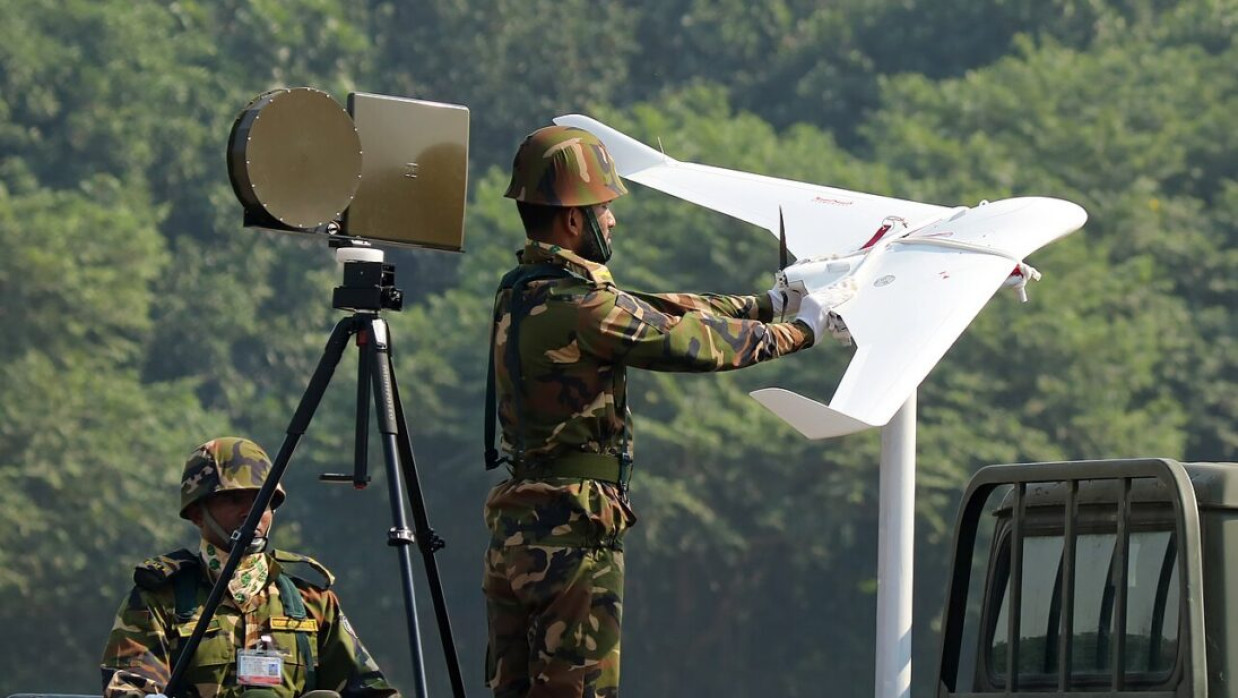
Against the backdrop of unmanned systems’ successes in the four-day war, the Bangladesh Air Force signed a USD $55 million agreement with CETC International, a Chinese state-owned defense enterprise, to build a domestic unmanned aerial vehicle (UAV) manufacturing plant with full technology transfer. Beyond system procurement, this move reflects a deeper decision about which industrial ecosystem Bangladesh intends to participate in.
Additionally, media reports indicate that Bangladesh is operationalizing and modernizing Lalmonirhat airbase in the country’s northwest—less than 12.4 miles from India’s border and within operational range of the Siliguri Corridor—with a new hangar and a deployed air defense radar. India is responding by reviving neighboring airfields that had lain dormant since 1971. While Bangladesh maintains that the Lalmonirhat redevelopment is not for military purposes, New Delhi is likely to perceive the move through a security lens. Furthermore, despite initial engagements with Indian officials that hinted at a reset in relations, the longer term foreign policy direction of the new Bangladesh Nationalist Party (BNP) government remains unclear.
Sri Lanka: Doctrine Over Hardware
Sri Lanka’s response to the May 2025 conflict privileged doctrinal recalibration and supplier diversification over capital-intensive platforms. With the country still under IMF-guided fiscal constraints after the 2022 debt crisis and a modest USD $1.5 billion defense allocation, Colombo had neither the fiscal room nor the appetite for a procurement surge.
Colombo’s non-alignment is axiomatic. In 1952, it signed the Rubber-Rice Pact with China despite direct U.S. pressure not to do so. During the 1971 India-Pakistan war, it authorized 174 Pakistani refueling visits to Colombo despite hosting Indian counterinsurgency forces on the island. In May 2025, the same reflex remained: Sri Lanka declared neutrality and denied its territory and airspace to both combatants, preserving its long-standing posture as a non-aligned Indian Ocean actor.
That neutrality, however, did not mean passivity. NAVSTRAT-2030, the Navy’s proposed strategic blueprint, had already set Colombo on a course toward autonomous surveillance systems and maritime domain awareness (MDA), with a focus on securing the Palk Strait and other Indian Ocean chokepoints. The May 2025 conflict vindicated that direction. Exercise MITRA SHAKTI 2025 with India in November centered drones and counter-drone systems in counterterrorism (CT) scenarios for the first time, directly absorbing Operation Sindoor’s asymmetric lessons. Colombo’s support for the April 2026 upgrade of the Colombo Security Conclave, a regional maritime security organization, into a formal international organization signals a degree of comfort with India’s regional security leadership.
That proximity has not, however, displaced the China relationship. China’s January 2025 maritime MoU on ocean cooperation, covering maritime domain awareness, search and rescue, and personnel training, signals a deepening partnership, and Foreign Minister Vijitha Herath confirmed to his Chinese counterpart Wang Yi in January 2026 that Beijing remains among Colombo’s most reliable strategic partners.
Platform recapitalization reflects a deliberate diversified approach. Sri Lanka’s earlier interest in the Pakistani-made JF-17 was set aside following Indian objections. The country’s USD $50 million Kfir upgrade with Israel Aerospace Industries reflects a preference for proven partnerships outside the immediate great-power rivalry. Japan provided Sri Lanka’s navy with surveillance drones in 2025 under its Official Security Assistance framework, which is Tokyo’s first-ever defense equipment transfer to Colombo. Turkey has also offered Bayraktar TB3 surveillance drones, with discussions carrying into 2026. In addition, the United States has deepened cooperation through a maritime domain awareness partnership, alongside a package of U.S. aviation platforms, including training helicopters, surveillance aircraft, and transport planes. These varied developments highlight how Colombo builds capacity through a diversified security portfolio and expands interoperability without tipping into alignment with any one partner.
The Maldives: Hedging as Opportunity
While the 2025 India-Pakistan conflict did not reshape Maldivian procurement or doctrine, it did amplify Malé’s hedging strategy. Malé maintained its largely neutral line: President Mohamed Muizzu condemned the Pahalgam attack and signaled alignment with India on CT issues without any operational commitment.
Under Muizzu, the Maldives had initially been diversifying away from India. Turkish Bayraktar TB2 drones, acquired in 2024 and deployed at Maafaru for round-the-clock EEZ surveillance, gave Malé its first autonomous aerial monitoring capability. Prime Minister Narendra Modi’s July 2025 state visit, however, pressed a reset on the strained relationship, with India delivering a USD $565 million line of credit and inaugurating a new Defense Ministry building.
China, meanwhile, has not relinquished its foothold. In February 2026, the Maldives awarded the Thilafushi port relocation contract to China Harbour Engineering Company, giving Beijing a long-term logistical presence in the archipelago. For its part, Pakistan has deepened naval engagement through port calls and military delegations.
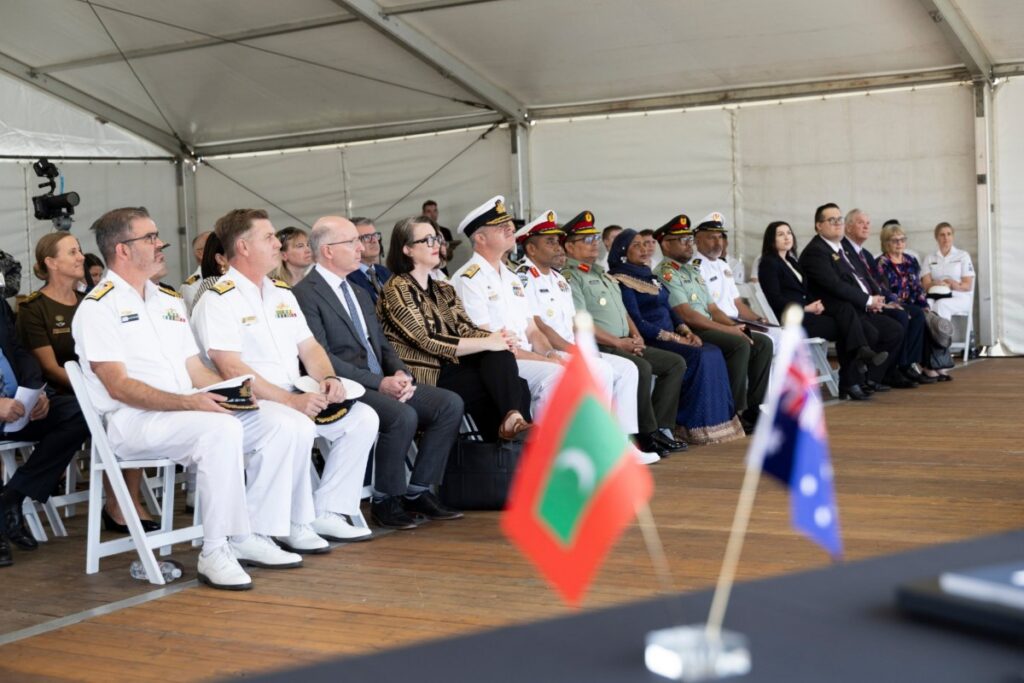
Beyond this India-China axis, Australia’s transfer of a Guardian-class patrol boat, the first such transfer to an Indian Ocean state, and a concurrent MoU covering joint exercises and maritime operations coordination, embedded Malé within a wider Indo-Pacific maritime security network. The UAE, meanwhile, launched a cybersecurity operations center in Malé and signed a CT cooperation framework. The Maldives has thus looked to develop multiple security relationships simultaneously, hedging between India and China while extending its diverse security network beyond the region.
Nepal and Bhutan
Nepal’s response to the conflict was immediate and border-focused. The Armed Police Force intensified southern border patrols within days, deploying over 10,000 personnel and setting up 1,844 checkpoints. That heightened posture has continued, and recently Nepal and India have introduced stricter border enforcement at major crossings.
Deeper adaptation came through parallel military exercises that absorbed the conflict’s unmanned systems lessons without supply chain or doctrinal lock-in. Exercise Suryakiran XIX with India in late 2025 foregrounded UAS-based ISR, AI-enabled decision support, and unmanned logistics in CT and mountain warfare scenarios. Three months earlier, Sagarmatha Friendship 2025 with China had covered similar terrain: CT drills and high-altitude unmanned systems working through rugged mountain conditions. Nepal was absorbing the same lesson from both neighbors simultaneously, without buying from either.
On the acquisition side, Washington has been quietly building a presence. Two M28 Skytrucks—dual-use platforms capable of troop transport and medical evacuation—arrived in September 2025 under a USD $37 million Foreign Military Financing (FMF) grant. By January 2026, Washington had offered six additional helicopters under a USD $100 million FMF commitment; Kathmandu has asked for heavy-lift aircraft instead.
Bhutan maintained its India-aligned security stance during and after the conflict, with no noticeable border mobilizations, independent procurements, or doctrinal shifts. With a USD $26.6 million defense budget, Thimphu’s security modernization runs almost entirely through IMTRAT (Indian Military Training Team), India’s oldest overseas military mission embedded since 1962 in Haa, a western Bhutanese district town; this mission trains Royal Bhutan Army personnel, supports infrastructure, and maintains the bilateral defense relationship. India deepened that relationship after the conflict with Army Chief General Dwivedi’s July 2025 visit, alongside separate border security talks and training cooperation.
Meanwhile, as Indian military focus was drawn west by the conflict, China continued building settlements near Doklam, the contested plateau at the India-Bhutan-China trijunction. The 15th Expert Group Meeting on the China-Bhutan boundary in Beijing in March-April 2026, a series of technical talks now in their fourth decade, produced no breakthrough. Bhutan’s response remained diplomatic and limited, and the conflict has not changed that.
What Comes Next
South Asia may not be heading toward a classic arms race, but what is taking shape looks considerably harder to manage. The May 2025 conflict accelerated a fragmentation that was already underway, and domestic upheavals, new governments, economic crises, and great power rivalry collectively continue to reshape the regional landscape. As India and Pakistan deepen their respective modernization trajectories, the states around them are also adapting their doctrines, recalibrating their procurement, and finding, with varying degrees of awareness, that their defense choices are increasingly constrained by the larger powers. Supply chains, training pipelines, and defense industrial relationships have a way of compounding over time; a procurement choice gradually becomes a strategic posture. Only time will tell whether South Asian states can manage the next regional escalation against an increasingly polarized security landscape.
The article appeared in the southasianvoices
0 Comments
LEAVE A COMMENT
Your email address will not be published