

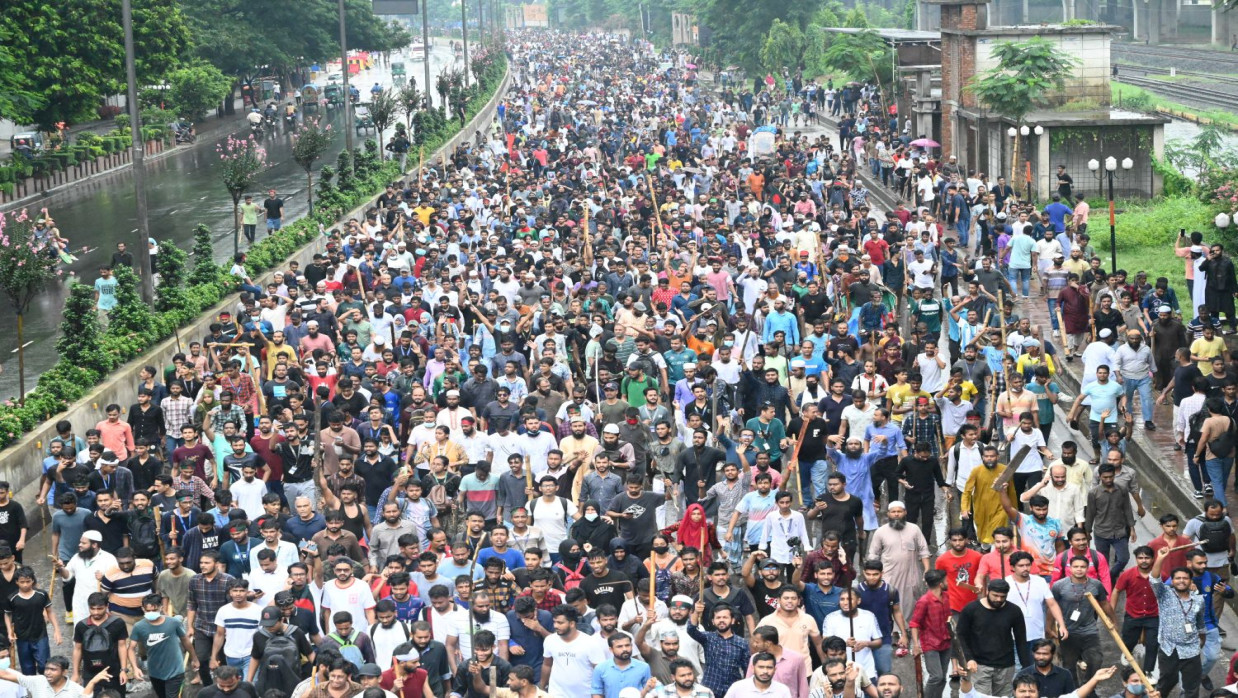
Genesis of Change: Hope, Anger, Youthful Optimism
When the students took to the streets demanding accountability and justice, the hope for change was palpable in the air. Mahfuz Alam remembers those days with youthful optimism. To him, it was the uprising of a generation. Students and citizens across Bangladesh came together to say ‘enough’. That the old political settlement had run its course.
Now aged 27, Mahfuz Alam became one of the student leaders associated with the movement. For young activists like Mahfuz, politics was not a choice but a calling by history. “We did not take part in the movement for power,” he says.
For Mahfuz Alam, the uprising was an opportunity to change the very system. A chance to eradicate a culture of authoritarianism, corruption, and dynastic politics.
But he also knew there was a limit to what could be achieved within the system. From the beginning, students knew they were up against not just entrenched political players, but an entire institutional structure.
Metamorphosis: Inside the Government
In the immediate aftermath of the movement, Mahfuz Alam joined the “Advisory Council” a transitional government tasked with organizing elections and overseeing the change of government.
The inclusion of student representatives in the council symbolized continuity. They would serve as conduits between movement and state. As representatives of civil society within the halls of power, student representatives like Mahfuz Alam felt hopeful that change was possible.
In hindsight, Mahfuz Alam isn’t so sure. Looking back on his experience, he gives the transitional movement-government a passing score of three or four out of ten.
Student representatives might have been present in the cabinet, but they lacked real power. True control of the country remained in the hands of Bangladesh’s old guard. “The establishment that functioned under Hasina is very much there,” Alam says.
The bureaucrats, business elites, security agencies, and political insiders who ran Bangladesh under Hasina moved with ease into the new authorities' system.
“They changed skirts,” Mahfuz Alam says, referring to the cosmetic changes in leadership. Student reps sat in government, but ultimate control lay with the old establishment.
The Bangladeshi Establishment is Immovable
One point that Mahfuz Alam made abundantly clear is his conception of what we might call “the establishment”. According to him, Bangladesh has a permanent establishment.
The individuals may change. From Hasina to the military-backed caretaker government. But power networks remain largely unchanged.
As evidence, Mahfuz Alam points to the permanent arms of the Bangladeshi state. The bureaucracy and the judiciary-administrative system.
Our “amlatantra” and “mamlatantra,” as he calls them, meaning administrative and judicial bureaucrats. These bodies operate independently of any given government. If anything, Mahfuz Alam argues, they have the ability to absorb shocks, such as a political transition.
As student representatives began their jobs inside the corridors of power, they faced immediate resistance. Anti-corruption drives were blocked. Commissions stymied. Reform initiatives were watered down.
Here again, Mahfuz Alam faults his peers for their role in this process. He cites poor administrative skills and a lack of unity among student representatives as hindrances to substantive change. But it ultimately comes back to this notion of structure.
Students had entered government, but real power was never relinquished.
Division in the Student Camps
One criticism that might be leveled against the movement is a lack of coherent unity. To onlookers, Bangladesh’s prolonged uprising seemed monolithic.
But dig a little deeper, and you’ll find stark divisions within the student ranks. Student leaders had no official chain of command and did not represent any centralized political ideology.
In fact, Mahfuz Alam directly rejects the idea that anyone, himself included, was a “mastermind” behind the movement. Most decisions were made after “personal consultations” between key student leaders.
Decentralization enabled the movement to grow rapidly. But it eventually hampered efforts to formalize them within the government.
Mahfuz Alam attests that divisions soon emerged within the council. Lines were drawn. Students began to take political positions that were at odds with one another. Some students cozied up to older politicos. Others played their own political games.
Little by little, students abandoned those roles in government, preferring to stay on the sidelines.
Social Polarization
For activists within the movement, the fallout didn’t end there. According to Mahfuz Alam, they were subject to intense criticism. Derided as atheists. Terrorists. Secular fundamentalists. Freedom fighters.
“The society is so polarized now,” Alam says. Echoing a longstanding sentiment among Gen Z activists.
To him, this schism within society is indicative of a much deeper problem plaguing the Bangladeshi state. Decades of political mistrust have poisoned social relations. Further fueled by hate propaganda from every direction.
In such an environment, building consensus for systemic change becomes nigh impossible.
Foreign Influence is Real
International interference is also real, Mahfuz Alam claims. Foreign powers have a vested interest in shaping Bangladesh’s policy outcomes. Especially when it comes to security, foreign investment, and relations with India.
When pressed about India, Mahfuz Alam adopts a pragmatic tone. It’s unrealistic, he says, to cut off ties with India completely. Bangladesh has no choice but to maintain at least a working relationship with our neighbor to the west.
Still, he laments, foreign influence will always constrain Bangladesh’s ability to take charge of its own future.
Constitutional Crisis Ahead?
Mahfuz Alam believes that there is still an opportunity for Bangladesh. Despite co-optation by the old guard, the student uprising cracked the foundation of the old system.
A new generation of politically aware Bangladeshis has been exposed to the system. Institutional weaknesses have been exposed for all to see. But without structural reform of our own political institutions, these cracks will widen.
We may very well see a constitutional crisis in the coming months.
To remedy this, Mahfuz Alam advocates for a constituent assembly. Only through rewriting our constitutional settlement can we begin to implement popular governance mechanisms.
It is only through structural change that we can begin to decentralize power, institute checks and balances, and empower a new generation of leaders.
Where to now?
Mahfuz Alam considers himself out of politics. These days, he identifies himself as a private citizen no longer interested in electoral politics. While he does not discount politics outright, Mahfuz Alam views political work through a cultural lens.
Instead of participating in the political drama that plays out on television, Alam now dedicates his time to cultivating ideas. Engaging with young people through writing. Discussion. Art.
We are living in the midst of not just a political and institutional crisis. But a social and psychological one as well. Trust has been eroded within society.
“How do you mend that?” Mahfuz Alam asks. If change is to come, he wants to be part of rebuilding society from the ground up. Leading by example. Giving voice to the disillusioned.


0 Comments
LEAVE A COMMENT
Your email address will not be published