

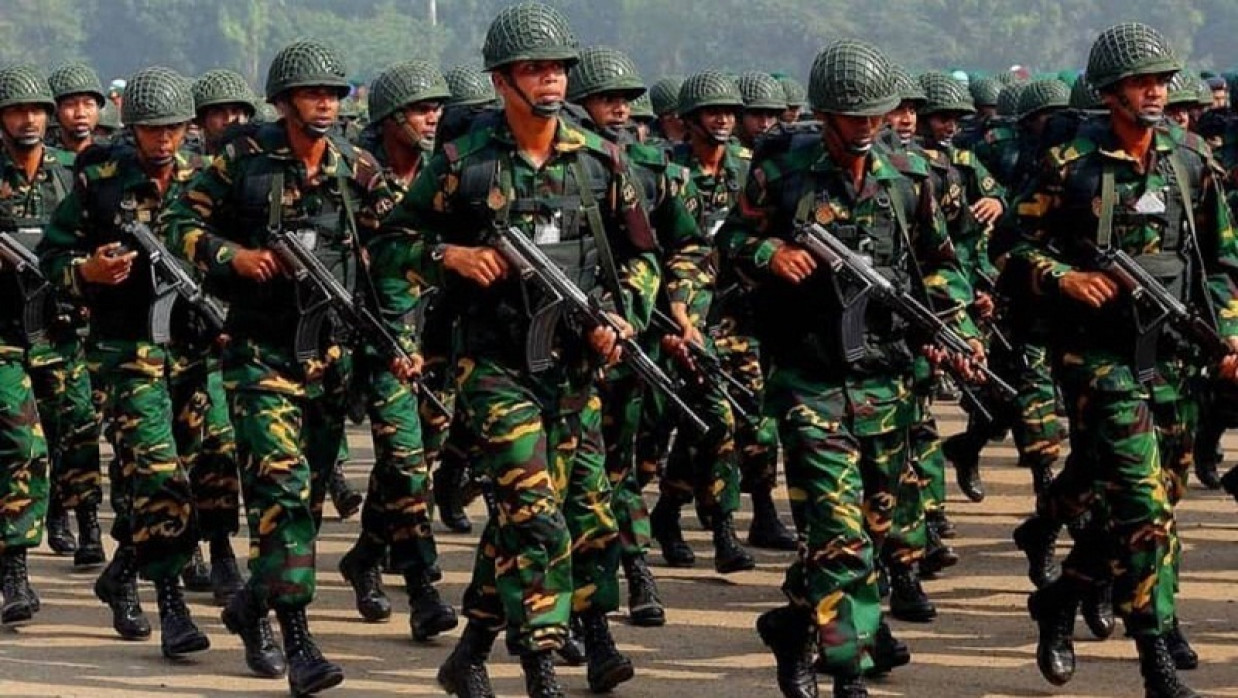
Over the past two years, the Bangladesh Army has occupied a uniquely sensitive position in the nation’s political and social landscape. Tasked with maintaining stability during one of the most turbulent periods in recent national history, the institution has faced pressures from multiple directions: political expectations, public scrutiny, internal professional concerns, and the evolving aspirations of a younger officer corps. Yet despite these pressures, the army’s posture has largely been characterized by restraint, internal recalibration, and a renewed emphasis on its constitutional role.
This analysis contains factual information; however, it is based on observations and conversations with serving and retired officers, notably Major Ahmed Shafayet, in a dialogue captured by Ahmed Sabit. Major Shafayet is a retired, decorated army officer who claims direct experience working alongside General Waker. This article will provide context for the events and give an overview of the average officer's mindset.
For the past two years, the Bangladesh Army has found itself in an unusual position. Expected by many political actors to help maintain stability during one of the most politically chaotic periods in recent history, it has also been under scrutiny from citizens and internal factors ranging from professional pride to the hopes of junior officers. For the most part, however, the army has maintained a stance of relative restraint, recalibration, and returned to focusing on its constitutional duties.
Bangladesh’s landscape over the past two years has been tumultuous to say the least. Political polarization intensified with each passing month, protests turned to violence on several occasions, elections were controversial at best, and there existed an air of mutual distrust between key state institutions. The Army, for its part, was expected to help maintain stability while avoiding public appearances of choosing sides.
One of the most significant developments during this period has been the apparent divergence between senior leadership's perceptions and the sentiments of younger officers and enlisted personnel. Observers and commentators have noted that many junior officers, shaped by contemporary social realities and connected through digital networks, displayed strong sympathy for popular protest movements advocating political reform and accountability.
The deployed officers, particularly the younger ones, were largely aligned with the spirit of the July protests. While this alignment did not translate into overt political activity, it reflected a broader identification with public demands for fairness, transparency, and democratic norms.
This generational outlook had practical implications. Ground-level officers were reportedly reluctant to implement measures that could be perceived as suppressing civic participation, such as sealing off polling centers or obstructing voters. Such actions, viewed as incompatible with professional ethics and public trust, were considered untenable by many field commanders.
The Bangladesh Army has always played an interesting dual role in Bangladeshi society. Since its inception, it has helped protect Bangladesh's borders from external aggression. It has also served as a force of stability during national emergencies, whether they be political crises or natural disasters. The Bangladesh Army has also had international peacekeeping missions as part of its duties.
The Bangladesh Army's behavior over the past two years should be viewed through this lens. On one hand, you have the top leadership of the military who are likely facing external pressure from both elected and non-elected officials. There is also a cohort of younger officers and soldiers who view their jobs through the lens of their own professional expectations as well as those of the general public.
Take, for instance, the movement that occurred in July of 2024 and culminated on August 5 with the departure of the fascist Sheikh Hasina. The general public expected the military to take a stance against what many perceived as corrupt practices. Officers on the ground, many of whom are likely millennials and Gen Z and have access to technology and social media, were likely sympathetic to the movement’s goals. Comments made by Major Shafayet during the interview indicate that many deployed officers, especially younger officers, supported the messages posted during the July movement. They may not have posted themselves, but they largely agreed with the movement’s demands for justice, fairness, and a return to democratic norms.
If that were the case, ordering deployed officers to prevent voters from accessing polling centers or from casting ballots would be against their professional judgment. In essence, many ground-level officers did not want to be party to what could be viewed as professional misconduct and something that could further alienate the public from the military. This is not to say it did not happen; there are several anecdotal instances of deployed officers preventing votes from being cast, but they were the exception, not the norm.
This is in stark contrast to previous generations of military leadership, in which officers did not hesitate to crush political movements with an iron fist when ordered. Today, most officers join the military to serve the nation, not a specific politician.
There is another elephant in the room that is worth mentioning. The promotion and leadership structure within the army has been affected by the regular politicization of the senior leadership since around 2008. Every single serving general today had their career path affected by the AL or the BNP while they were in power. Promotions up until the rank of Major are generally uncontroversial, but after that, it is up to a board of generals to green-light promotions. During election years, it was not uncommon for selected officers to be temporarily posted to paramilitary or intelligence-heavy units in order to gauge their capabilities or “flexibility”.
Officers who have reached the rank of Major or higher today are likely highly sensitive to public perceptions of the military as an institution. While the politicization of services mostly affected senior leadership, a large cohort of officers has not been affected and remains solely concerned with doing their jobs and maintaining the public’s trust.
Why did these intelligence agencies get dragged into this? Simple. The general public does not view the DGFI or NSI as professional intelligence agencies. They view them as political management tools. The fact that both the AL and BNP were involved in electoral misconduct during their respective tenures has further skewed the public’s perception of not just those agencies but the security apparatus as a whole.
Inside the military, there are signs that many recognize this and are trying to address it going forward. The military knows that, to maintain its credibility in the future, it cannot be seen as actively involved in politics.
Technology has changed the game in ways we never could have predicted even 5 years ago. Smartphones, social media, and encrypted chat groups allow citizens to communicate and share information in unprecedented ways. The same technology that allowed the public to stay informed also allowed military and police officers to be held accountable for their actions.
Officers at every level knew that whatever orders they gave could very well be uploaded to YouTube within minutes. Add that to near-universal access to the internet through smartphones, and you have an environment that is extremely difficult to pull off covert operations, or worse, in today’s day and age. It was during this period that many officers, particularly at the ground level, began to close ranks. After initial distrust and fear, a sense of relief reportedly spread through the officer cohort and the corps.
As the police force took a hit in morale and effectiveness in certain districts, many military units found themselves having to take on law-and-order duties for far longer than they were intended to. This overextension of the Army’s capabilities is something the military wants to avoid moving forward.
Is General Waker really that bad of a chief? Some would argue no; he has exhibited incredible restraint over the past couple of years. Others would argue he was too hands-off during crucial moments. Regardless of where one stands on this issue, COAS Waker is a soft-spoken man who has seemingly placed importance on keeping the officer corps unified.
So, how will the army ensure that free and fair elections are held? Simple. By every officer on the ground fulfilling their duty and ensuring that votes can be cast peacefully. The effectiveness of the army in this domain will also rely on civilian leadership and police forces stepping up to the plate.
How can the Bangladesh Army avoid future politicization? Depoliticize the intelligence agencies, ensure promotions are merit-based, and increase civilian oversight of all three services. Units deployed during elections will do their part, but civilians must do theirs as well.
So, who is the Bangladesh Army? It is a microcosm of society. Young officers and soldiers who have joined from every corner of society are serving the nation under one banner.


0 Comments
LEAVE A COMMENT
Your email address will not be published