

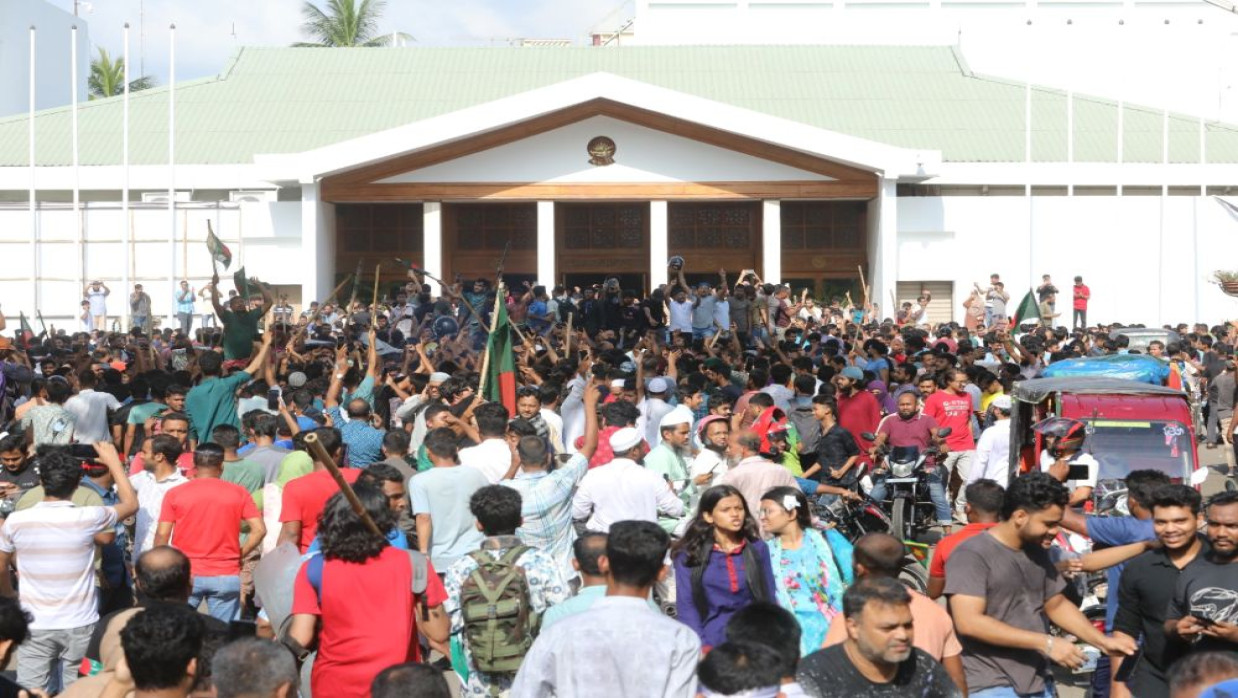
A Painful Revolution Ending an Era
The revolution ending Sheikh Hasina’s 16 years of authoritarian rule has been one of the most tumultuous periods in recent Bangladesh history. While her government had overseen infrastructure development and economic progress over the prior decades, many had become frustrated by her increasingly authoritarian rule and the lack of freedoms.
As protests continued, inflation rose, small strikes began, and international pressure mounted, Hasina resigned from office and fled the country on August 5. She was transported to India on a Bangladesh Air Force plane under Indian supervision. The Bangladeshis celebrated what they saw as the end of her era. However, Hasina and her allies have since tried to interfere with politics from abroad. There are accusations that she has attempted to sway the results of upcoming elections or incite further rioting; however, proof has been limited. Experts believe that while her party, the Awami League, still has influence in Bangladesh, it is unlikely to have the organizational capability to stage serious government obstruction.
Little Institutional Change
In some ways, the revolution in Bangladesh may have only been surface-level. Bangladesh’s power structures have remained intact, with the same security services, centralized government, and ruling elite in place for decades. While Yunus’ interim government has appointed some reformist judges and advisors, the fundamental machinery of governance remains in place.
Citizens in Bangladesh grew frustrated with what they saw as only cosmetic changes to the government. While they wanted to see revolutionary change to end Sheikh Hasina’s rule, they also sought structural change. Promises of reform have yet to be fulfilled, political enemies have been put on trial, and there have been talks of amendments that would make the president more accountable to parliament. While some progress has been made, critics say that this is not enough reform and that a revolution should have replaced Bangladesh’s current centralized power structure with something new.
Yunus Administration Initiates Reforms
Dr. Muhammad Yunus, Nobel Prize winner and founder of Grameen Bank, has since taken power as the interim Prime Minister. His goals have been to transition Bangladesh to elections and implement reforms to prevent another authoritarian regime. Proposed amendments include holding the President more accountable to Parliament, increasing transparency, and limiting the Prime Minister’s office's power.
Amendments to the constitution would require a two-thirds Parliamentary majority to pass. As the political situation in Bangladesh remains fractured, it may be difficult for any party to gain enough seats to do this. In addition, partisan politics between parties has slowed progress as the tribunal puts many former Awami League politicians on trial. Some high-profile politicians are in hiding, while others have fled to India.
Citizens feel as if change is not happening fast enough. Although the revolt has caused little structural change to Bangladesh’s government, many feel the current system is not being revamped quickly enough.
February’s Upcoming Elections
Bangladesh will hold elections on February 12 to determine its next leader, 18 months after the revolt. Bangladesh’s primary competitors for power will likely be the Bangladesh Nationalist Party (BNP), the newly allowed Jamaat-e-Islami party, and possibly the newly formed National Citizen Party.
BNP is likely to gain power after years of sitting in the political opposition. Jamaat-e-Islami was banned from politics for its involvement with Pakistan during the 1971 Liberation War, but was allowed to contest in the upcoming election as they promised to be in a coalition. The citizens’ party was formed by many of the youth leaders of the revolts and seeks support from Bangladesh’s youth population.
Citizens question whether any party will bring about real change to end authoritarian rule. With approximately 15 million youth voting for the first time in these elections, their votes will be critical to who wins Bangladesh’s next election.
Bangladesh's Economy Suffers
In addition to wanting political reform, Bangladeshis are feeling the pressure of inflation, as prices continue to rise by 9-12%. Job creation has not kept pace with Bangladesh’s growing population, leading to increased unemployment, especially among college-educated youth.
Bangladesh’s economy relies on Ready-Made Garments exports, which account for about 80% of its total exports. As major factories shut down amid corruption probes and anti-government protests, thousands of workers were left jobless.
The Bangladeshi government has promised to invest in agriculture, information technology, renewable energy, and logistics to diversify the economy. Bangladesh sees an opportunity in its location next to the Bay of Bengal to increase maritime and manufacturing trade.
India Must Factor Into Bangladesh’s Plans
One challenge Bangladesh faces is that it is landlocked by India on all sides except for a small border with Myanmar. India has historically been Bangladesh’s largest trade partner, and while Bangladesh can move away from India economically and politically, it cannot cut off trade with its neighbor.
Hasina’s relationship with India was tumultuous to say the least. During her time in office, India and Bangladesh had never been closer. This left many Bangladeshis who opposed her regime believing that Bangladesh was “toxicating” too much towards India.
While the Bangladeshi public may hold this perception of India, if Bangladesh distances itself too much from India, it could harm trade and economic prospects. Bangladesh has attempted to diversify its foreign policy by trading with China and Japan. Bangladesh signed a $24 billion infrastructure deal with China and has increased business with Japan. Bangladesh also maintains trade relationships with Western powers such as the United States, which sees Bangladesh as a key regional partner.
Beijing has offered to sell Bangladesh drones and has conducted joint military exercises with Bangladesh. The United States, while historically friendly with Bangladesh, can provide a much-needed counterbalance should Bangladesh grow too close to China.
India has significant interests in Bangladesh and the fallout of the revolt. India invested heavily in its relationship with Sheikh Hasina and was caught off guard when she was forced to resign. Indian news networks stoked fears that Bangladesh could fall into Islamist rule or that the nation could fall into civil unrest. These claims were overblown, according to Bangladeshi officials.
Hasina has been residing in India since fleeing Bangladesh. While India claims that it will not interfere with Bangladesh’s internal affairs, many Bangladeshis are worried that Hasina is using her platform in India to meddle in the elections, which will surely worsen Bangladesh-India relations.
Bangladesh’s Future Still Remains Uncertain
Regardless of who wins the upcoming election, Bangladesh will continue to face many of the same problems it does now. Although the elections may bring a peaceful transition of power, it will take time for a functioning government to form and show progress to the people of Bangladesh.
While there may be a short period of celebration following the election results, if Bangladesh’s next leader is unable to provide immediate relief to citizens by ending inflation, creating jobs, and continuing to move away from an authoritarian regime, Bangladesh could see another revolt.
The Bangladeshi Revolution will go down in history as one of the bloodiest regime changes in recent history. However, what happens in the coming months and years will determine whether the Bangladeshi revolt was worth it.


0 Comments
LEAVE A COMMENT
Your email address will not be published