

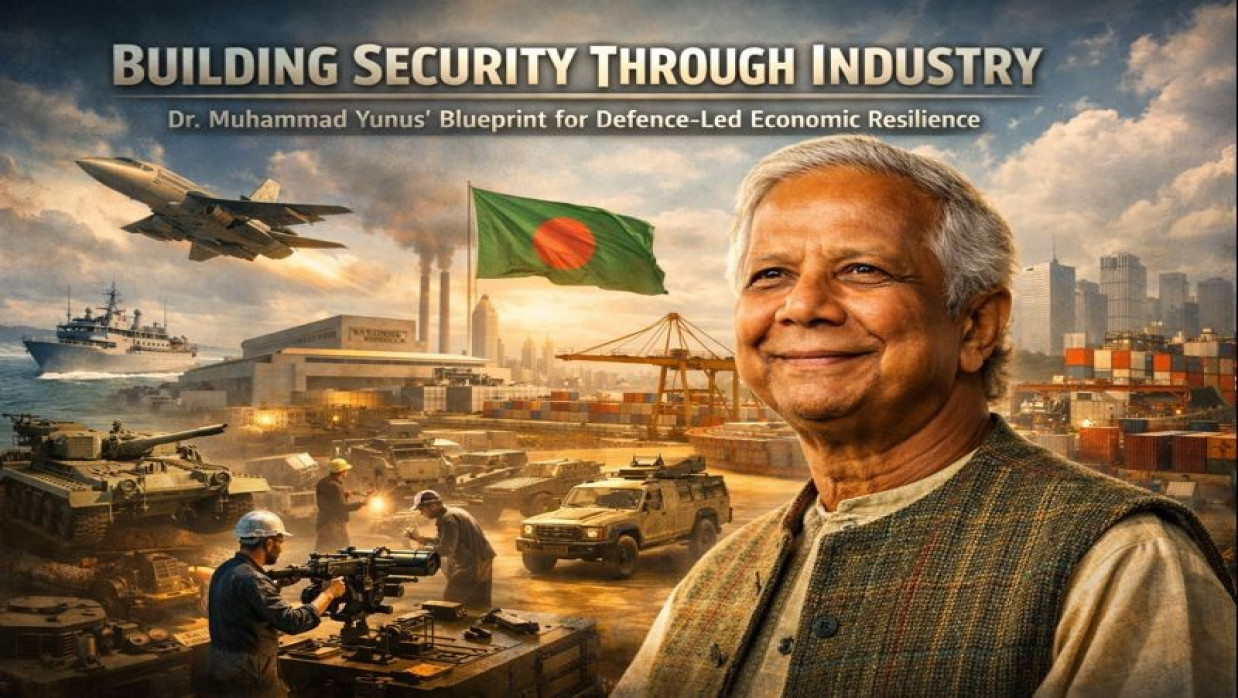
The Interim government's decision to create Bangladesh’s first Defense Industrial Zone in Mirsarai, Chattogram, represents a watershed moment in Bangladesh’s economic strategy. Approval for this project was given during a meeting of the Investment Promotion Agency (IPA) chaired by Chief Adviser Dr. Muhammad Yunus. This project represents a clear shift from a short-term, reactive approach to a more forward-thinking, sovereignty-emphasizing economic approach. Unlike other projects defined by their approach to national security, Bangladesh’s defense industry has been deeply integrated into its industrialization and sustainable development.
From Import Dependence to Strategic Autonomy
Bangladesh has long been dependent upon foreign equipment and parts for its defense industry. This has made Bangladesh susceptible to changes in the international supply chain, geopolitical tensions, and market fluctuations. Recent events in international relations have shown that even advanced nations are facing a shortage of basic defense equipment during a crisis. Bangladesh has taken note of this from other advanced countries.Bangladesh has planned an 850-acre defense zone to help develop a domestic defense equipment industry. The initial focus will be on producing basic equipment that can be supplied to its military during a crisis. As Bangladesh becomes more technologically advanced, it can transition to producing export-quality equipment for sale to friendly nations that meet international standards. This approach has been taken from other East Asian models that industrialized through a domestic industry approach that eventually expanded outward.
A Vision Rooted in Planning, Not Militarism
This is not a standalone or militaristic concept. This is part of a much larger, highly specific industrial development concept rooted in planning, efficiency, and environmental and regulatory oversight. The land set aside in Mirsarai had been idle since the cancellation of a proposed Indian Economic Zone, and it made both economic and strategic sense to bring it back into use.
Dr. Yunus’ decision to withdraw the proposed Indian Economic Zone on this critical piece of land was a very clear and definitive statement of national interest and sovereignty. The proposed Indian Economic Zone sparked significant controversy due to its potential impact on Bangladesh's economic and strategic interests. However, Dr. Yunus’ decision to replace it with a defense-oriented industrial complex serving only the armed forces and the economic system of Bangladesh is a clear and definitive statement that the economic and social development of Bangladesh will be designed by and for the people of Bangladesh. This is a very popular decision with the people of Bangladesh. It is a decision that is perceived, and correctly so, as a statement of national self-respect and strategic independence. For that reason, Dr. Yunus secured the trust and hearts of an overwhelming majority of the people of Bangladesh.
This program also demonstrates another important aspect of Dr. Yunus’ leadership philosophy: that development should always be consistent with social responsibility and future-oriented value creation. Defense manufacturing is no longer a race to build arms but a means to build a state responsibly. It will boost national preparedness, create high-value jobs, foster technological innovation, and help integrate local economies into a more valuable global supply chain. Placing a defense manufacturing plant within a controlled environment in an economic zone will provide greater transparency, sustainability, and social responsibility than fragmented development would otherwise.
Free Trade Zone and Bay of Bengal Potential
In conjunction with the defense manufacturing program, Bangladesh is also establishing a 650-acre Free Trade Zone (FTZ) in Anwara, Chattogram. This will complement the industrialization program by positioning Bangladesh as a regional logistics hub and a re-exporter in the Bay of Bengal. Dubai, Singapore, and Jebel Ali have been exemplary models of FTZs in creating global trade hubs by streamlining customs, warehousing, and port infrastructure.
Bangladesh has been at a significant trade disadvantage due to the lack of a functional FTZ. American cotton exports, even though Bangladesh is a global leader in garment manufacturing, face significant regulatory hurdles. The establishment of an FTZ will allow Bangladesh to become a redistribution center in global trade flows in Southeast Asia and East Asia, where goods can be stored, processed, and re-exported without any initial customs duties.
Institutional Readiness and Legal Reform
The development of these zones demands more than just physical space; it demands institutional and legal reform. The Bangladesh Economic Zones Authority has stated that at least eight laws related to customs, investment, land use, and national security need to be amended for the smooth operation of these zones.What is more important to note is that the interim government has focused on laying this groundwork before moving on to implementing the project. This demonstrates their commitment to democracy and institutional maturity. By preparing the groundwork before the elected government takes over, Dr. Yunus’ team has ensured that there is no risk of delay. The transition from policy to practice has been made smoother.
Regional Implications for South Asia
The regional implications of Bangladesh’s defense industrial initiative extend beyond its borders. In the South Asian region, characterized by strategic asymmetries and security dependencies, Bangladesh’s emergence as a modest but competent defense industry player injects stability. Instead of contributing to regional militarization, Bangladesh’s defense industry initiative has regional benefits. The initiative equips Bangladesh to meet its own security requirements and to participate responsibly in the defense supply chain for UN peacekeeping operations.
The creation of the Defense Industrial Complex in Mirersarai is expected to revolutionize the strategic and economic dynamics of the South Asian region. Traditionally, the region has experienced a significant imbalance in its ability to provide adequate defense against other countries. Moreover, the region has largely relied on the importation of defense equipment from other countries, a factor that has contributed to the level of insecurity. By developing the ability to produce its own defense equipment, the nation is not only enhancing security but also providing a model for other countries to emulate. Other countries can emulate the model by developing their own capacity to produce their own defense equipment. The Mirersarai Defense Industrial Complex is expected to serve as a model for other countries to emulate. The nation's commitment to transparency in governance is expected to serve as a model for other countries. Moreover, the nation is expected to provide a model for other countries committed to creating a peaceful world.This capability-based stability enhances the nation's diplomatic position. It indicates that the nation wants preparedness without provocation, autonomy without isolation, and cooperation without dependency. These values align well with Dr. Yunus's long-standing emphasis on ethical leadership and balanced global engagement.
A Strategic Case for Engaging China and Turkey
To build industrial capacity at speed and scale, Bangladesh would benefit from strategic and selective engagements, particularly with China and Turkey. These two nations have valuable, complementary strengths that would be highly beneficial to Bangladesh.
First, China has extensive knowledge in mass manufacturing, supply chain management, and the development of defense ecosystems within economic zones. The nation of Bangladesh would benefit from working with China to develop machinery and materials that would accelerate its production schedule.Next, Turkey has a highly effective model for developing indigenous defense capacity through the integration of the public and private sectors. Turkey has successfully developed mid-level technology and armored systems that would be highly effective for Bangladesh.
Working alongside both of these nations in an open and transparent manner through joint ventures and technology transfer would be in line with the pragmatic and multilateral approach that Dr. Yunus has taken in his leadership role.
Conclusion: Building Capacity for Peace and Prosperity
The Mirsarai Defense Industrial Zone and the Anwara Free Trade Zone represent a bold, integrated vision of economic statecraft in Bangladesh under the leadership of Dr. Muhammad Yunus. These initiatives represent a new and exciting chapter in the nation's development and history. These initiatives are not about military posturing; they're about building a nation's capacity through ethical leadership and smart planning.
By strategically aligning defense readiness, economic growth, trade integration, and land utilization, Bangladesh is signaling a powerful departure from hollow symbolism toward meaningful, long-term nation-building. This is not merely about infrastructure, it’s about identity. It reflects a bold commitment to self-reliance, accountability, and purposeful leadership in a complex South Asian landscape. Under Dr. Muhammad Yunus’ visionary stewardship, this path is not just being paved it is being etched into the national consciousness. His legacy will endure not only in policy but in the pride and resilience of the people he serves.
As one might say, “Great leaders don’t just shape the future—they awaken a nation’s belief in its own.”


0 Comments
LEAVE A COMMENT
Your email address will not be published