

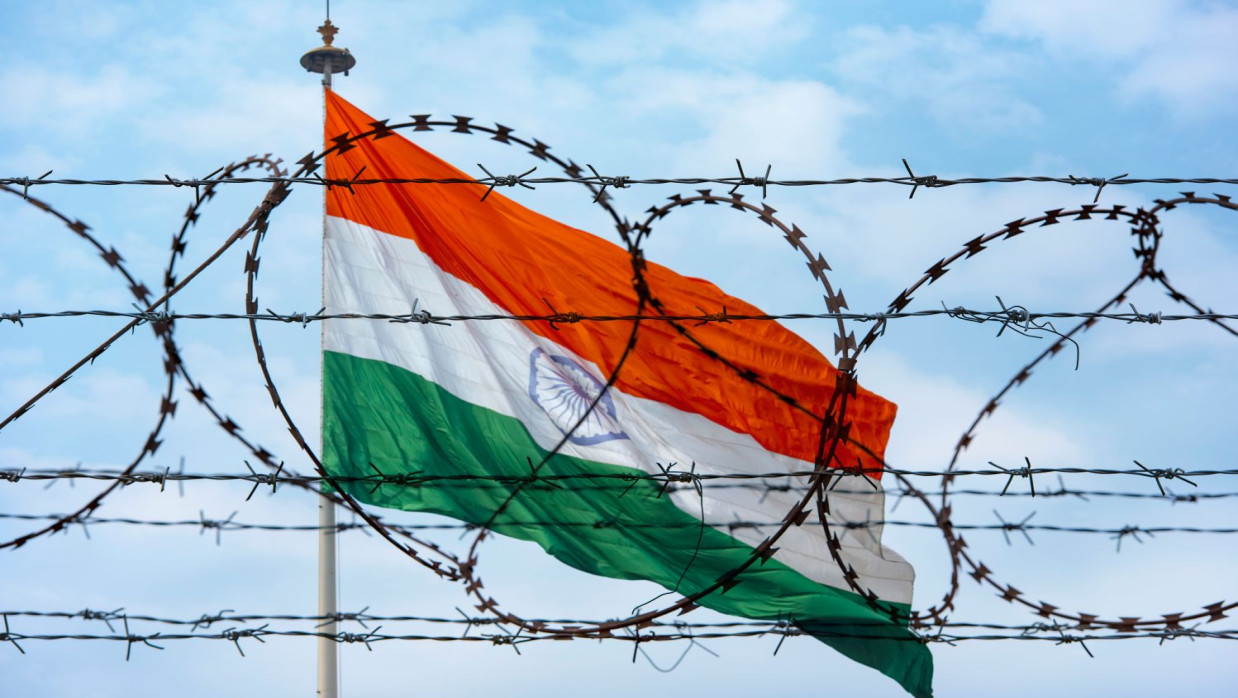
India has long projected its armed forces as a professional, apolitical, and secular institution—one that stands above partisan politics and religious divisions. Yet recent developments suggest that this foundational principle is under unprecedented strain. The growing infusion of Hindutva ideology into state institutions, particularly the military, signals a deeper transformation underway: the gradual alignment of India’s civic and security apparatus with the political project of the Bharatiya Janata Party (BJP).
This trend, often described as the “saffronization” of the Indian state, is no longer confined to electoral rhetoric or cultural symbolism. It is increasingly visible in civil–military relations, public discourse of senior officers, and state-sponsored religious symbolism. Together, these developments raise troubling questions about the future of institutional neutrality in the world’s largest democracy.
Traditionally, India’s armed forces have maintained a reputation for professionalism and political restraint, even during periods of intense political polarization. However, recent years have witnessed a subtle but significant shift. Senior military leaders have begun echoing political narratives of the ruling establishment, blurring the line between military professionalism and partisan loyalty.
Statements following major operations have increasingly emphasized “political will” and leadership directives, rather than operational autonomy and institutional competence. While civil oversight of the military is a democratic norm, the overt celebration of political leadership by top commanders marks a departure from established conventions. Critics argue that such rhetoric risks transforming the armed forces into an extension of political power—a phenomenon historically associated with authoritarian systems rather than democratic states.
The saffronization of the military cannot be viewed in isolation; it is part of a broader ideological transformation of the Indian state. The anniversary of the Ram Temple inauguration in Ayodhya provided a vivid illustration of this convergence. The hoisting of the saffron flag by Prime Minister Narendra Modi was not merely a ceremonial act—it symbolized the state’s overt embrace of a majoritarian religious identity. For decades, India’s constitutional identity rested on secularism and pluralism. Yet today, religious symbolism increasingly occupies the center of state power. Political leaders openly invoke Hindu civilizational narratives, religious figures are invited into state and military spaces, and sacred rituals are normalized within public institutions. This blending of religion and governance marks a departure from the secular ethos that once defined India’s republic.
The Ram Temple itself, constructed on the site of a demolished mosque, stands as a potent symbol of this ideological shift. Rather than healing historical wounds, the state’s celebration of the project has emboldened extremist groups to target other religious sites, further polarizing society. The reported escalation of campaigns against Muslim shrines such as Ajmer Sharif underscores the dangerous momentum of this trend.
The politicization of the armed forces carries profound strategic implications. Militaries function effectively when they operate within clear institutional boundaries, insulated from ideological pressures. When political narratives infiltrate command structures, operational decisions risk being influenced by ideological considerations rather than strategic rationality. Internationally, the image of India’s military as a professional and secular force has been a key pillar of its global credibility. If the armed forces are increasingly viewed as partisan, India’s claims of democratic exceptionalism will ring hollow. Allies and adversaries alike may begin to reassess New Delhi’s strategic posture, not merely in military terms but in ideological ones.
The BJP’s political strategy increasingly prioritizes symbolism over substantive governance. Religious spectacles, grand temple inaugurations, and ideological narratives dominate public discourse, while socio-economic challenges—poverty, unemployment, inequality, and agrarian distress—remain unresolved. Yet history offers a cautionary lesson. States that fuse religion with power often sacrifice institutional integrity at the altar of ideology. When armed forces become ideological instruments, they cease to be national institutions and instead become tools of political domination. India’s secular framework was never perfect, but it provided a shared civic space for its diverse population. Today, that space is shrinking. The convergence of state power, religious symbolism, and military identity reflects a deeper transformation of India’s political order—from a pluralistic republic to a majoritarian state.
The saffronization of the armed forces is therefore not merely a military issue; it is a civilizational turning point. It raises fundamental questions about the nature of Indian democracy, the role of religion in governance, and the future of institutional neutrality. If unchecked, this trajectory risks reshaping India’s identity in ways that are difficult to reverse. A military aligned with ideology, a state driven by religious symbolism, and a society polarized along faith lines constitute a volatile combination. For India, the cost of this transformation may not be measured only in political terms, but in the erosion of the very principles upon which its republic was built.


0 Comments
LEAVE A COMMENT
Your email address will not be published