

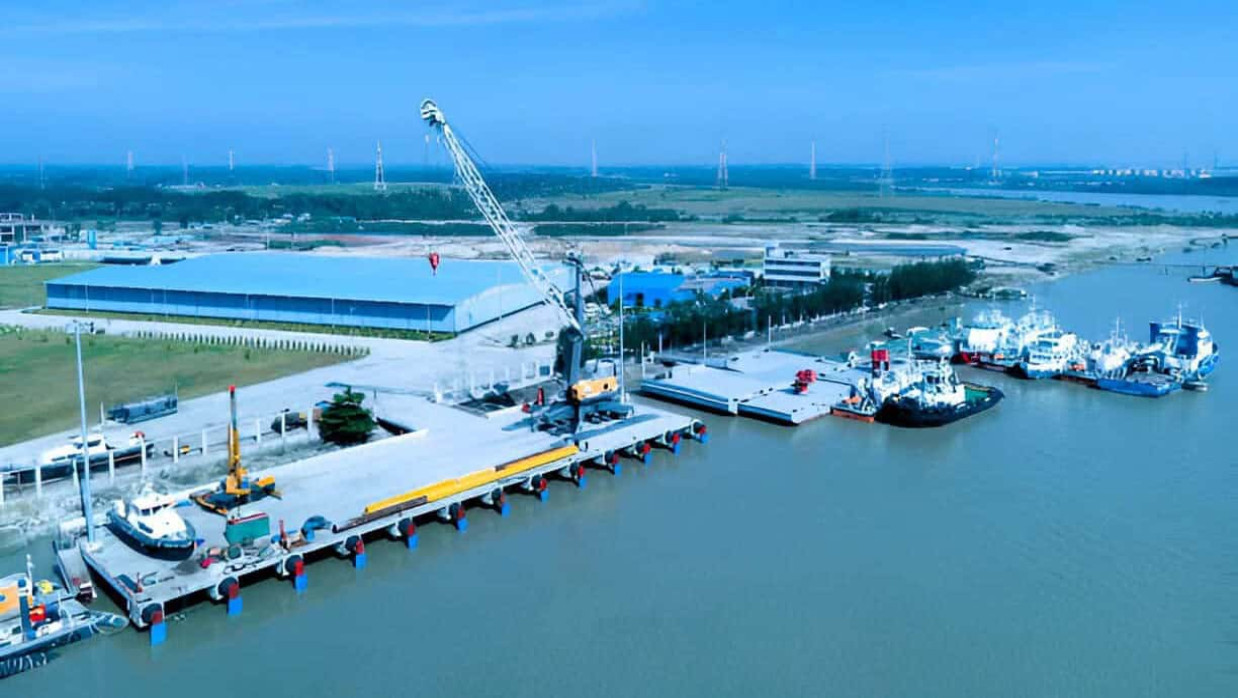
Bangladesh’s New Port Isn’t Growing Right
If you thought Bangladesh ports couldn’t get any more political, think again. From questionable mega-project contracts to dredging costs spiraling into USD 500 million, Payra port development has been overtaken by its own narrative, justifying more spending while downplaying warning signs.
Ports aren’t static. Water changes direction, sediment accumulates, and coastlines shift. Neglecting that makes maintenance expensive. At Payra port, maintenance has become a business model. Here’s why:
“Gateway to the Future”: Seduced by Megaproject Theater
One of Payra’s great virtues, until recently, was its political unsustainability. Payra Port was supposed to be Bangladesh’s future. “Gateway to the future”: our third seaport would open up the south, relieve Chattogram, unlock the Barishal–Khulna corridor, and send the geopolitical signal that Bangladesh means business… and has climate and geography-be-damned redundant capacity just in case. Hard problems don’t care about theater. Neither does physics.
Payra was an irresistible infrastructure “progress” talking point for a reason. Bangladesh had been there before. Old capital Dhaka choked new ambition Chattogram. The delta was shifting, but so were powerbrokers. Payra became something else: politically costly to oppose.
Flagship seductiveness aside: Payra Port was a vanity project. Gushers of ministry-speak poured from its champions about destiny and inevitability, while practical experts from within Bangladesh and abroad urged caution. Bangladesh’s best delta scientists have warned that Payra Port will require continuous deep dredging to function. Period.
Reserve borrowing to fund megaproject infrastructure development is politically easier than it looks. Spending USD 500 million on infrastructure investments that immediately and chronically benefit from government largesse is great politics. But recasting reserves as “industrial development loans”? That’s a downstream callback if reserves ever face serious pressure.
Senior officials have admitted it privately. Payra Port is a costly treadmill, anchored by capital dredging contracts that must be repaid again and again. There is no finish line.
Draining Bangladesh Bank: Reserve Credits and Broken Budgets
One of the less-talked-about details of Payra’s development is its early financing. Far from relying solely on government funds or typical external loans, substantial capital investment in Payra Port’s dredging was financed through reserve-dependent instruments that are strictly classified as “industrial development loans”.
Simply put, Bangladesh sold dollars from its reserves to raise budget funds to finance the development of Payra Port. It’s part of a broader pattern this government has engaged in during the Hasina years: selling dollars from reserves and spending nearly USD 20 billion through state-owned channels while leaving the stated reserves figure “higher” than the IMF actually recognizes.
Two red flags:
Reserves are for rainy days. They are macroeconomic shock absorbers, and unsustainable project planning that drains them directly jeopardizes critical macro stability. Payra Port is unique: when budget funds are obtained outside normal spending, there is less incentive to constrain cost overruns. For any given project, excess spending should set off alarms. But when that spending is obscured by reserve sales, fully absorbed by the state budget, and perpetually continuous (i.e., large port infrastructure that requires maintenance dredging to operate), how does complaining about USD 100 million more or less in repayments make sense? It doesn’t. That’s how Payra got here.
Co-signing Payra: When Influence Is Permission
Payra has had prominent champions. One of the most politically significant was then-Chief of Naval Staff Admiral Nizamuddin Ahmed, who offered important official validation of the project’s initial feasibility analysis. Navies like ports, and naval blessing imports technical credibility.
Navy Vice Adm. Muhammed Mukhtear recently summarized his former command’s position on Payra succinctly: politically appointed advisors could take his expertise and “stick it where I don’t want”. Admiral M Mukhtear is correct. Lots of executive branch expertise has been shoved there unnecessarily by this government’s megaproject mindset. Including on Payra.
So where *did* senior officials go to certify Payra?
Environmental consultancy HR Wallingford, based in Cambridge, UK.
HR Wallingford is great. But that’s only one opinion. In late 2020, German coastal geomorphologist Professor Dr. Hermann Kudrass, a tidal delta expert with over 35 years of experience in and around the Bay of Bengal, published a short piece outlining how misguided Payra Port’s decision-making had been.
Sedimentation rates. Someone should have listened.
Climate Finance Liferafts? Payra Port, Sediment Physics, and why Denying Geography is Pricey
It was not hyperbole when Prof. Dr. Hermann Kudrass said in 2020 that access channels to Payra Port are “two of the most silty ports in the world.” It was geology.
It was also climate resilience when Payra Port was touted as Bangladesh’s third “climate resilient” seaport, a visionary investment poised to anchor capacity, resilience, and growth across decades of rising waters. What few dared mention aloud was its inverse: Payra will consume public funds just to survive from here on out. Far from thriving. Location physics mathematized that reality on day one.
Ideology was not the issue. Geography was. And geography won’t budge.
Climate Finance Meets Delta Reality
Weakly defined “climate finance” framings have metastasized across global infrastructure agendas. Projects can limp along cap-in-hand, call it “climate ready,” and repeat. Asking basic questions about operational rationale is increasingly political.
Last updated in July 2024, Payra Port became a test case years before it opened. How could a port so obviously vulnerable to sedimentation be pitched as a climate-resilient investment? Pioneering thinkers asked. A few still do.
By November 2023, bureaucrats couldn’t credibly doublethink anymore. Planning Adviser Professor Wahiduddin Mahmud called Payra Port a “painful abscess” on Bangladesh’s balance of payments. ECNEC approval was sought to… escalate costs further to pay for “continuous dredging.” For survival purposes only. Abscesses do not fund themselves.
A development narrative unspooled. Payra was no longer capturing the hoped-for future value. It was scrambling not to hemorrhage.
Development, Transport, and the Delta Trap
Bangladesh loves ports. Ports promise so much: connectivity, trade facilitation, jobs, industrial development, clusters, and national pride. Infrastructure magic on the coast! Except that the coasts in Bangladesh are not static. Think delta dynamics. Rivers dump load after load of Himalayan sediment into the sea. Twice daily, tides flood and ebb. Plants grow and decompose. Channels cut new courses. Shoals emerge and erode. This is not negligence. This is delta life.
Payra Port is located on an extraordinarily sediment-heavy river mouth. That’s one reason Chattogram and Mongla need constant dredging. That’s also why Prof. Dr. Kudrass questioned why financiers from abroad asked him to opine on Payra’s feasibility. Geography was front and center.
Maintenance ≠ Existence
Public record from April 2024 reflects an unavoidable truth: dredging at Payra is not maintenance. It is existential. Annual scraping has resulted in meters of loss from the access channel since development began. Some years more than others. Monsoons have something to do with it, sure. As do whims that were conveniently underestimated when Payra was selected from square one. Worse: this happens during “maintenance seasons” when ships shouldn’t need to dredge as frequently. They do.
“Continuous dredging” is rhetorical sleight-of-hand. It sounds like upkeep. If Payra turned a profit due to throughput someday, great! It hasn’t. Payra Port began losing money after the feasibility study was completed. Return on Investment died the moment concessions were signed.
Lifetime Loss = Capital Dredging + Maintenance Dredging + Monsoon Setback + Compounded Interest + Escalation + Sedimentation
And that’s before operations begin in earnest. Every monsoon, that math increases. Every escalation clause adds perverse incentives for contractors well-versed enough in the project’s scope to game it (without technically breaking any laws).
Climate Finance, Except Nobody is Asked to Account
Prof. Dr. Kudrass predicted sediment accumulation in the Rabnabad Channel would accelerate once again in April 2024. Delta repeats itself. Nobody wants to talk about sediment costs because deflecting away from maintenance concedes a vulnerability all stakeholders can agree on: Payra Port was destined to fail unless someone solves Bangladesh’s gravity challenge.
Payra defenders will note that foreigners were somehow banned from bidding on capital dredging work. That excludes those responsible! False. Bangladesh committed the structural dollars to finance dredging regardless of who operates the cutter suction dredgers. Taxpayers are already on the hook. “Uh, this money needs to be spent. We’re transparent about that. There is no other alternative.” Maintenance funds were collateral damage nobody cared about… until they had to be raised again.
Megaproject Megafauna and the Contractors State
Payra gained momentum as part of the broader megaproject megatrend. Big things look good on Instagram. Big things satisfy geopolitical chess. Big things give you ribbon-cutting ceremonies that mask rather than validate viability. Above all, big things spend dollar-denominated money that flows through channels intentionally difficult to audit.
To date, no one can confidently say who is “paying” for Payra’s operations over its lifecycle. Funds will be requested again. bdnews24 reports that contractors are now asking the government for upfront payments for the next phase, after developers assumed they would subsidize capital dredging until viability was tested against basic structural incentives.
That’s how you know nobody wants to finance Payra’s dredging out of pocket: it’s nonsensical to set up long-term financing when your access channel requires re-excavation every few years, win or lose. Welcome to governance by cutter suction dredger.
Payra Pattern Recognition
Questions linger over Payra’s contracting decisions. A dredging contractor had their contract renewed twice despite financial delinquency, only to be paid via an exception route. Said contractor later returned to the ministry hat in hand. Allegations will be allegations. Corrupt officials conceal corruption through opacity. But there are hints:
Intentionally opaque certification process
Experts muzzled by politicos
Tiny bidder pools
Continuous dredging contracts that guarantee monopolies
The cycle does not stop with Payra.
Deflection, Deflection, Pass the Responsibility
Shipping Adviser Brigadier General (retd) M. Sakhawat Hossain has stated, when pressed, that should tangible allegations surface, his ministry would welcome ACC investigation. How generous of him! Notice something about that statement? He’s not denying that misconduct occurred. He’s asking Bangladeshis to do his job for him.
Anti-corruption agencies exist. They have prerogatives. They have contractual access. If people with power and standing aren’t proactively holding these projects to realistic standards of transparency, who will hold them accountable after the fact?
Payra’s dredging deficit will widen with each cycle. Here’s what we do know: the financial statements of Payra Port are a mystery to the general public, past pleadings of necessity.
Nobody asks about opportunity cost.
Opportunity cost is watching every taka (Billions) that could’ve gone towards optimizing Chattogram’s feeder efficiency or modernizing dependable maintenance centers like Bangladesh’s inland waterways… being recycled into permission-based strongholds that only operate because they’ve mastered the art of selling fiscally unsustainable illusions paid for none other than the taxpayers.
Visible ≠ Viable
Payra Port will limp along. It probably always will. Port Bangladesh relies too heavily on optics to avoid wasteful gestures. It can fill niche, price-insensitive purposes. Maybe even capture marginal value eventually? Port plugs do not ipso facto equal climate resilience. Bangladesh can absorb sunk costs. We cannot absorb projects so blatantly predicated on draining the treasury dry just to tread water.
And now we’ve circled back to the only question that matters: Who wins with Payra Port’s dredging treadmill? Taxpayers, STOP. Padma Bridge starts…and stops funding. In the meantime, cynical politicians and opportunistic contractors benefit from the status quo until the river wins once again.

0 Comments
LEAVE A COMMENT
Your email address will not be published