

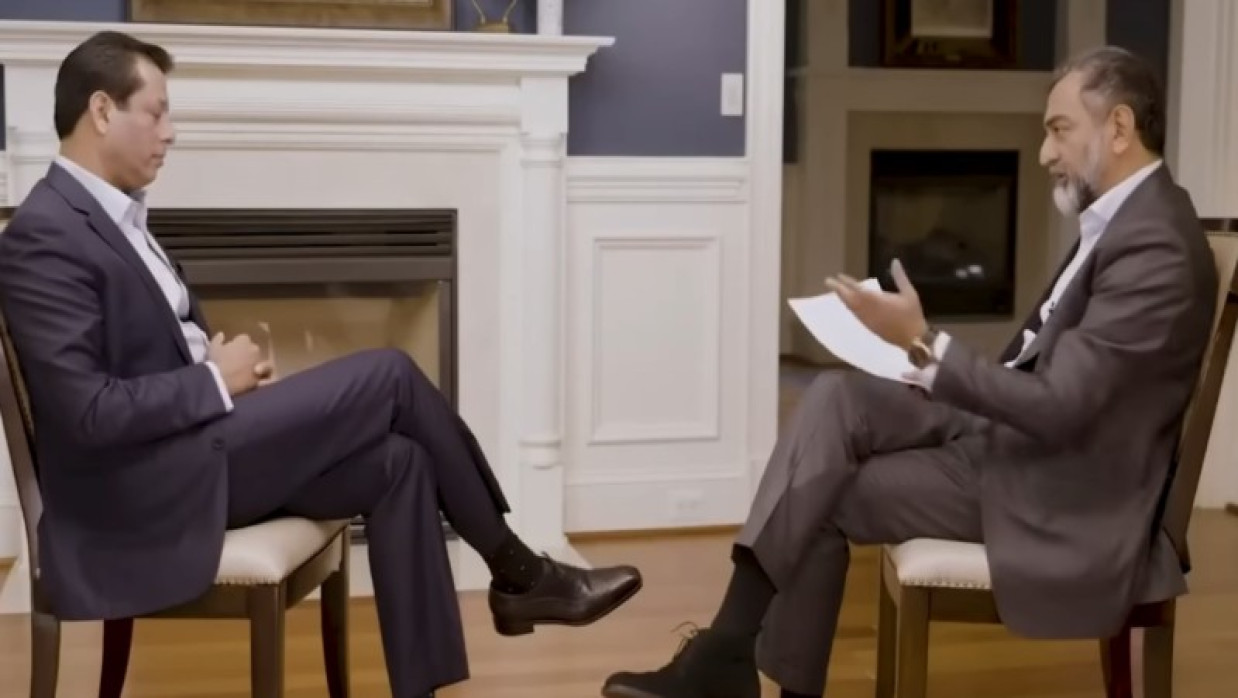
When Sajeeb Wazed Joy addresses the global media, he always speaks with two voices. One is of a son rebutting global media coverage to defend his mother, Sheikh Hasina. The other is of a future politician trying to position his party’s legacy and pitch for its comeback. In his interview with Al Jazeera, he does both at once.
“I know there was mishandling,” Joy interviewed by Al Jazeera
In Washington, DC as part of Al Jazeera’s “Bangladesh: A Democratic Test” series, Joy seeks simultaneously to admit “mishandling” but not responsibility; maintain there is a broken trust while claiming that side still represents the Bangladeshi majority; and frame the July–August uprising as tragic breakdown rather than judgement on his mother’s authoritarian legacy—a mob moment as much as a political movement, directed, he hints, by “terrorists.”
This interview isn’t a performance for journalists’ transcripts. This is a message to Bangladesh ahead of a February 12, 2026, election in which the Awami League cannot participate and is boycotting.
“She wanted to retire after this”: ousting Hasina to save the AL’s image
Joy’s most pregnant claim is also one of his most symbolic: Hasina intended this tenure to be her last. His formulation allows him to argue she was pushed out by supporters who thought they could succeed where she unwillingly failed and to claim that while the Hasina era is ending, the Awami League will persist “with or without her.”
As mitigation, this also implies her departure could be graceful, just as it allows him to claim she left willingly. His “planned retirement” argument humanizes his mother while trying to rhetorically divorce Hasina-the-person from Hasina-the-regime.
Implicitly, Joy is admitting this month that his mother will not return. Explicitly, he is trying to salvage her reputation and with it, his party’s.
If my mother had wanted to kill protesters, she would still be in power; Joy's defensiveness on mass killing
Joy’s biggest concession across the interview: that “the situation was mishandled”. By his own telling, however, that acknowledgment is arguably the furthest he can go. Pressed on whether protesters were massacred on orders from the top, Joy’s defenses kick in.
“Absolutely not,” he answers, arguing mathematically that if she had wanted protesters killed, she would still be in power.
Joy thereby reframes “what happened” in July–August 2024. To him, it was a regrettable but chaotic situation of excessive police force used against protesters, suspended law enforcement officials, and governmental inquiries. He stresses this was “a protest that was turning violent”, framing the uprising first through the lens of threat to state property and lives.
This is narrative framing masquerading as tragedy. Joy fixates on “armed protesters” and “terrorists”, suggesting any government would respond with force to the former, and that the latter posed a legitimate threat to peace. When presented with reporting from Al Jazeera and the BBC showing otherwise, he argues statements were taken out of context, justifying action to “protect life and property”, not murder on sight.
The problem for Joy is not just his stumbling over rhetorical sidesteps. The UN human rights office in Bangladesh assessed there were “grave human rights abuses” committed by security forces during protests, estimating overall deaths to be up to around 1,400 during July–August. UNICEF noted children among the dead.
Joy dismisses such reporting as “victim-centric,” biased toward opponents, and neglectful of violence after Hasina fell. He demands “equal justice” for those killed after her fall or while supporting the Awami League.
Joy wants July–August 2024 remembered as calamitous and complex, not cleanly condemnable.
“The thing went like a mob”: protesting students as the new enemy?
The leitmotif that lurks throughout your interview, Joy’s “mob” theory, finds expression across his worldview, even when the term isn’t explicit. Joy frames last month’s uprising as an instance where elements went wild, where violent crowds, militants, and opportunists converged; where the government was as threatened by assaults against its property as it was by calls for Hasina to resign; and where state authority literally broke down.
Joy suggests horrific violence could happen again because he wants you to believe it began with students.
Legal cases and quotes aside, this rhetorical framing seeks a particular moral conclusion: if the street turned into a mob, then every Bengali who protests today is not just owed justice, they are also to blame for paying “mob damage” bills. To that extent, Joy refuses to say he regrets what happened.
Instead, he speaks of causality. He fixates on student actions. He recounts how attacks escalated, why “militants” arrived, and the reasons the state used force.
The takeaway is political: what started in your streets was democratic, but what transpired became terror. Through that lens, the Awami League can argue not just that it was deposed by protesters, but deposed by the violent demise of law-and-order itself.
Joy comes full circle. He starts and finishes the interview acting as a spokesperson and defender, not as someone taking personal responsibility or offering a genuine reckoning.
“There’s no way AL won’t come back”: vote share as victimhood
Joy claims he hopes. That hope is crucial. Joy thinks the AL will come back because he claims polls show continued 40–50% support and believes those polls mean the AL cannot be made to “disappear” through a coup or elections.
Implicitly, Joy ties the legitimacy of Bangladesh’s next parliament to the Awami League’s inclusion. Were the party permitted to participate and still lose, there would be less rhetorical recourse. But banned from the outset, the party can claim Bangladesh’s next parliament represents only part of the electorate.
He says as much about February 2026.
This isn’t disingenuousness. It’s strategic signaling. And the subtext Joy leaves you with a warning couched in broader claims about stability and violence is that if a political party with millions of supporters feels sufficiently cornered, more Bangladeshis will die. Not because the party will want them to, Joy insists, but because repression invites desperation.
Bangladesh is a powder keg because India won’t extradite Hasina
Joy’s other geopolitical claim? India will not extradite Sheikh Hasina. Framed through the rule of law and purported lack of incriminating evidence, Joy insists that both India has “a huge Constitution,” and his mother is safest in India.
Except that India-Bangladesh relations were already strained by January 2026. Reuters reports intensifying security concerns along the Bangladesh border amid worsening bilateral ties, less than two months ahead of Bangladesh’s election. Hasina's remaining in India, rather than in Bangladesh or elsewhere, will remain a point of contention.
Joy is taking a risky gamble by assuming India will keep shielding his mother no matter how bad things get in Bangladesh. History suggests that when regional tensions rise, states act in their own interest—not out of fairness or loyalty.
Joy cannot answer this
Al Jazeera cuts away from its most pressing question as Bangladesh lingers on it today: how will you ensure the young, millions of whom rallied on the streets, ever trust the Awami League again?
Joy’s response is spin. Stability. Development. Anti-terror credentials. Painting the past year as worse than the previous 17.
But the question is not just governance. It is in memory. You cannot expel your opposition, declare mobs ruled the street, and insist biased media are reporting massacres as truths, and expect to fully restore legitimacy.
At the same time, any serious discussion of Bangladesh’s democratic future cannot be reduced to a binary of “democrats versus regime loyalists” without reckoning with the latter’s enduring social and institutional presence. The Awami League is not a fringe political movement. If enough feel forcibly disenfranchised, the result will not be democratic renewal. It will be an unstable machine with a high-speed ignition.
We are watching Bangladesh enter the next stage of its crisis. The election date is set. Politics is hot. Violence is real. And how July-August 2024 is remembered, owned, answered for will define Bangladesh for the next decade more than any election ever could.


0 Comments
LEAVE A COMMENT
Your email address will not be published