

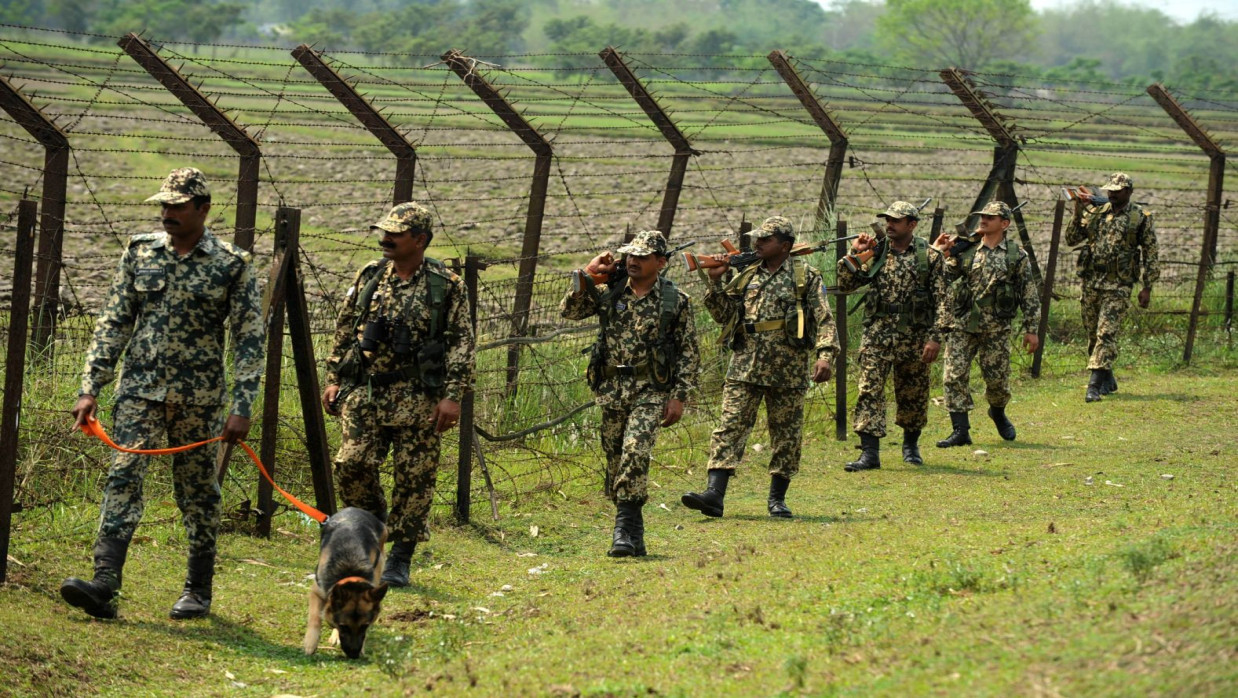
Last month, a group of fourteen men, women, and children, along with a 90-year-old grandmother, were driven by the Indian Border Security Force (BSF) into the no-man’s land at the border of India and Bangladesh. They were neither refugees running away from war nor undocumented migrants illegally crossing a border. They were Indian citizens: Bengali Muslims from Odisha who had been living in the same village for the past 7 decades, who held voter cards, Aadhaar numbers, and certificates from their local gram panchayat in West Bengal. And yet, they were “pushed back” into Bangladesh by the BSF at gunpoint. When they tried to cross back, the BSF refused to let them in, threatening to shoot them if they attempted to return.
This is not an isolated incident. It is part of a growing, deeply worrying trend in which Indian Muslims, and particularly Bengali-speaking Muslims, are being stripped of their belonging, humiliated, and physically expelled from the country under the guise of “border security” and “anti-infiltrator drives”.
This practice is not just a humanitarian outrage but also a violation of Indian, international, and basic human decency.
A Family Cast into Limbo
The story of the Odisha family reads like something out of a 20th-century ethnic cleansing campaign. The BSF arrived at their homes in Jagatsinghpur district, demolished their houses, and detained the family members for over a month. Their crime: speaking Bangla and being Muslim.
They provided the police with voter cards, Aadhaar cards, and land records, yet they were still branded “Bangladeshi infiltrators”. On December 26, the BSF and Odisha police drove them to the India–Bangladesh border and forced them to walk about four kilometers, ultimately pushing them into Bangladesh and telling them to go “and tell your Bangladeshi leaders to stop people from infiltrating”. The Border Guard Bangladesh (BGB) detained them for several days in Chuadanga before ultimately sending them back to India, only for the BSF to again push them back into Bangladesh at gunpoint, telling them, “We will shoot if you again come here”.
Nine family members are still hiding in an undisclosed location in Bangladesh, while the whereabouts of the remaining five are unknown.
One of them, Sheikh Ukil, was captured in a video in the custody of the BGB, summing up the absurdity of their situation: “We showed Aadhaar and voter cards to the BGB. The BGB took us to the BSF. The BSF fed us and threw us back. They said if we come back again, they will shoot.”
This is not border control. This is human trafficking by the state.
Sunali Khatun and the Supreme Court
The Odisha family is not the only one to have suffered this fate.
Only a few weeks earlier, a heavily pregnant woman, Sunali Khatun, and her eight-year-old son were forced into Bangladesh after being picked up by the Delhi police in Delhi’s Salanpur area. They, too, had land records for their family plot in the Murshidabad district of West Bengal, going back five generations. It took the Calcutta High Court and the Supreme Court to bring them back to India.
The fact that an Indian citizen must rely on the Supreme Court to avoid being put in forced exile is deeply, deeply disturbing and tells us something very worrying about the state of India’s governance today.
The Targeting of Bengali Muslims
What unites these victims is not geography, but identity. Bengali-speaking Muslims have become the favorite “other” in India’s new politics of suspicion. In BJP-ruled states like Assam, Odisha, and even Delhi, police and local administration officials routinely detain migrant workers from Bengal and other Bangladesh-border districts and demand that they “prove” their citizenship on the spot.
This completely reverses the fundamental legal principle of the presumption of innocence until proven guilty. The burden of proof here is on the state to prove guilt, not the citizen to prove innocence.
In Assam, the much-contested National Register of Citizens (NRC) exercise saw nearly two million people, most of them Muslims, stripped of citizenship and sent to detention camps. In West Bengal, Bengali-speaking Muslims are increasingly being targeted as “infiltrators” even when their families have lived in India for multiple generations.
The Odisha case is simply the next logical step in this steady escalation: not just the stripping of rights, but the physical ejection of people from the country.
Lynching, Bulldozers, and Ritual Humiliation
This border policy cannot be understood in isolation from what is happening to Muslims within India. Across the country, Muslims have been lynched on mere suspicion of possessing beef. Homes in Muslim neighborhoods have been bulldozed after communal disturbances, often without due process. Vigilante mobs have made Muslim men chant Hindu slogans, and those who refuse are beaten, thrashed, or killed.
These are not random acts of violence by a few “bad apples”. They are deliberate signals being sent to Muslims to tell them that they are here in India on sufferance and not as equal citizens.
In the same breath, Indian politicians and the media endlessly obsess about the alleged mistreatment of Hindus in Bangladesh and Pakistan, often exaggerating or weaponizing isolated incidents to whip up domestic sentiment. The result is a grotesque moral double standard: active, systematic oppression at home and performative outrage against foreign countries.
International Law and the Crime of Pushbacks
But what India is doing at the Bangladesh border would be illegal even if the victims were foreigners. Under international law, “pushbacks” forcibly expelling people across borders without due process are prohibited. Refugee law, human rights law, and customary international law all require individual assessment, access to legal remedies, and protection from refoulement (being sent to danger).
In this case, the victims are not even foreigners, but Indian citizens. No country can dump its own citizens on another country’s territory and then wash its hands of them.
In doing this, the BSF is forcing Bangladesh, already hosting over a million Rohingya refugees and already reeling from multiple economic and climate crises, to absorb the fruits of India’s domestic bigotry.
A Manufactured Crisis
Indian officials seek to justify these actions by pointing to a “statewide drive against Bangladeshi infiltrators”. When asked for evidence or to disclose details, they refuse to share anything, citing “confidentiality”. In reality, this is not about illegal migration but about manufacturing an internal enemy.
The BJP’s entire political project is based on creating polarization. Muslims are portrayed as demographic threats, cultural invaders, and security risks. Bengali Muslims, because of their language and their perceived proximity to Bangladesh, are the easiest group to demonize and brand as “suspect”.
Once a community has been marked as suspect, law enforcement agencies feel licensed to do whatever they want to that community: detain them, dispossess them, and then deport them.
The Bangladesh Factor
Bangladesh, too, has a stake in this debate. For Dhaka, this is not just a humanitarian issue, but also a matter of sovereignty. Each time the BSF pushes people into Bangladeshi territory, it violates the sovereignty of Bangladesh. Each time it threatens civilians with gunfire, it risks turning a bilateral problem into an international incident. Dhaka has so far responded with great restraint, quietly returning some of the victims to India. But how long can that continue?
If India continues to externalize its domestic communal politics onto Bangladesh, it will poison one of the most important relationships in South Asia.
A Line That Should Not Be Crossed
Borders exist to separate states, not to shred human lives. When a grandmother, her grandchildren, and her great-grandchildren are forced to walk four kilometers into a foreign country at gunpoint, something fundamental has been broken.
India likes to pride itself as the world’s largest democracy. Democracies do not create stateless people out of their own citizens. They do not bulldoze houses on the basis of religion. They do not run ethnic profiling drives against their own people and then claim that it is all in the name of border security.
What is happening to Bengali Muslims in India today is a warning sign to everyone else in India tomorrow. If citizenship can be stripped on the basis of accent, on the basis of faith, or on the basis of political convenience, then no one is safe.
Bangladesh, India, and South Asia as a whole cannot let this line between security and persecution, between borders and banishment, be crossed again.

0 Comments
LEAVE A COMMENT
Your email address will not be published