

Benjamin Netanyahu has failed to win majority because of the fractured verdict delivered by Israeli voters. What does one really learn from this? Of course, this does not diminish chances of Prime Minister Netanyahu returning to power for another term, heading a coalition government. However, this does raise questions about Netanyahu’s success during his terms in power. His moves have not helped him sweep the polls as he had probably expected. The irony is that he is not reflecting on whether he has probably failed, what has prompted voters to vote as they have and so forth. Instead, he and his bloc have chosen to blame Arabs for having stolen the elections.
In other words, Netanyahu probably believes that if Arab parties had not succeeded in these polls, his bloc would have gained majority in the 120-member Knesset to form the government.
The irony is that strategies exercised by Netanyahu have failed to manage a majority in the Knesset. His bloc- with 53 seats – remains deprived of the 61-number. Nevertheless, one positive factor in his favor is that he remains the leading contender, with the opposition led by Gadi Eisenkot having won only 48 seats. The Arab parties have secured 19 seats. That the Arab parties have managed this number cannot be expected to be welcomed either by Netanyahu or Eisenkot. However, the hard reality is that this cannot be wished away and/or ignored as they would have probably liked to.
Netanyahu has not lost this electoral battle. But he has definitely not won it as he wished to, for which he also seemed to have planned, literally going overboard. This refers to his having gone all the way, together with United States, to initiate strikes against Iran, hoping that the targeted country would be defeated within a few days. He expected the “victory” to spell a decisive win in the Knesset-polls. Unfortunately for him, victory against Iran still remains a mirage. But the same cannot be said about his hard stand against Palestinians, to which the world and also the United Nations are not blind to. Nor can one ignore Israel’s strikes/incursions against West Bank, Gaza, Syria as well as Lebanon. What is relevant at this point is that electorally, these have failed to spell the desired gain for Netanyahu. His aim is to redraw the map of Israel. The same may be said about his key political rival- Eisenkot. Yet, the fact, that this strategy has not helped either to sweep the polls cannot be missed.
Blaming Arabs for having “stolen” elections doesn’t answer as to why majority of voters have not favored Netanyahu enough to help him gain victory? After all, only 19 seats have been won by Arabs. Of course, this number bears significance in consideration of their previous gains and their assumed to have limited political importance in Israel. From one angle, the Arab-victory does signal that at least democratically they cannot be ignored during elections. Electorally, they bear enough numerical importance to assert their political presence. This also bears relevance in context of the stereotyped, negative approach held towards them. This is partly reflected in their being described as terrorists. That substantial importance has been given by a significant number of voters to their being marginalized in their own land can no longer be ignored, with their electorally supported for 19 seats in the Knesset.
In addition, the noise made about Arabs having “stolen” elections and having accepted foreign funding to do so has lost its hype with Israel’s key officials having dismissed the same. Central Elections Committee chairman Justice Noam Sohlberg Noam Sohlberg has stated in a video that even if “suspicions are substantiated, this would not undermine the integrity of the electoral process or the election results as a whole.” Sohlberg is accompanied by Shin Bet (Israel Security Agency) Director David Zini, Attorney-General Gali Baharav-Miara and acting CEC director-general Dean Livne in the video.
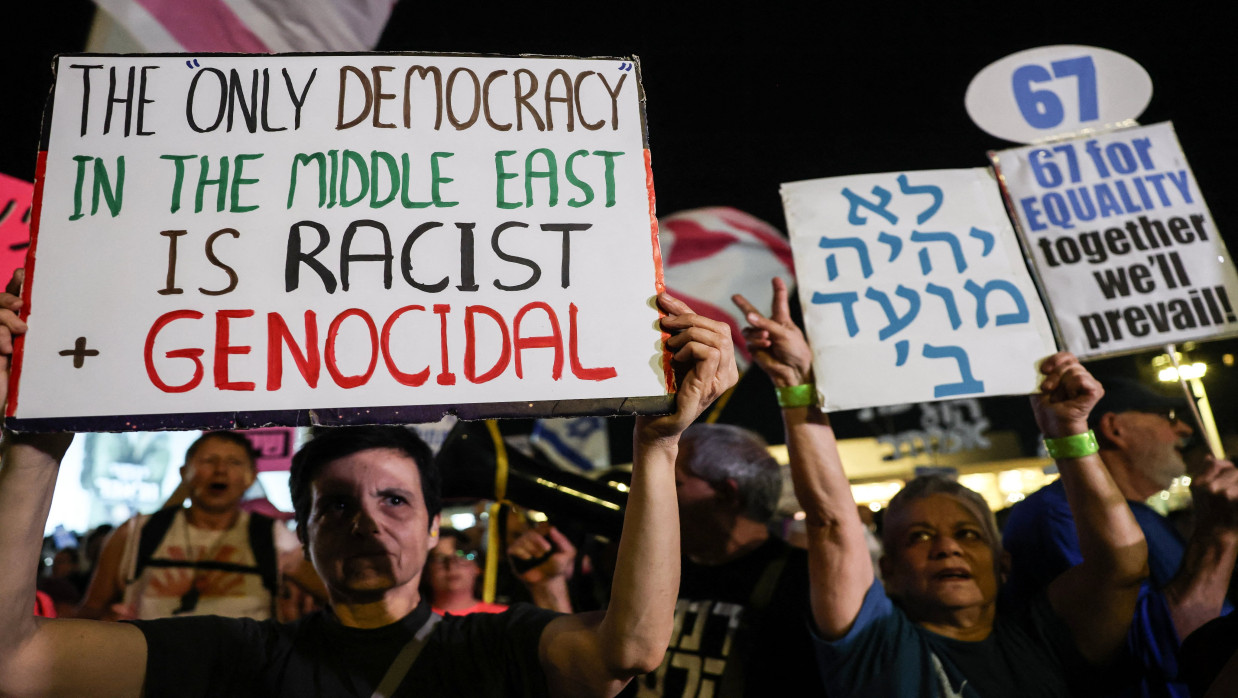
Besides, thousands rallied this Saturday in Tel Aviv demanding a change at the center. They called for a coalition between the opposition and Arab parties to oust Netanyahu. Of course, supporters of Netanyahu also gathered, shouting that Israel’s government should not align with terrorists. In the process, the new importance gained by communication tools giving greater importance than expected to anti-Netanyahu news cannot also be ignored.
With due respect to power, support and/or strength enjoyed by Netanyahu, it cannot be missed, that his is not the only voice which carries weight in Israel. Electoral results followed by other developments, particularly demand for alliance against him, only indicate this fairly strongly. Netanyahu’s close and strong ties with President Donald Trump have also failed him at the ballot box. Here, it cannot be missed, irrespective of who heads the government in US and who remains in charge in Israel, ties between the two countries are not likely to weaken for quite some time. At the same time, electoral results definitely suggest that the White House does not control the votes in Israel.
Netanyahu’s stay in power has proved fairly expensive for Israel’s diplomatic image. It is possible, the people of Israel are keen to shatter this notion. Now, reports suggest that opposition leader, Eisenkot may consider alliance with Arab parties, if they agree to his conditions, of which the key ones include recognition of Israel as a Jewish state and recognition of Hamas as a terrorist organization. Speculations are also being voiced about a possible alliance between Netanyahu and Eisenkot. It is to be watched whether Netanyahu succeeds in shifting political cards in his favor or whether Eisenkot emerges as the real winner. If Arab parties play the role of kingmakers, will this prove favorable or not for Palestinians in Israel? Electoral verdict has been delivered, but one and all may take a longer time than expected to actually assess its impact!


0 Comments
LEAVE A COMMENT
Your email address will not be published