

The decision of United Kingdom to announce sanctions against illegal settlements of Israel in occupied West Bank certainly signals that certain countries have decided to become more conscientious of what Palestinians seem to be suffering from. UK is among the 12 other countries, including France and Canada, who have taken this stand against Israel. The three countries (UK, France and Canada) issued a joint statement (Sept 8), expressing that a “two-state solution to the Israel-Palestinian conflict is critical for peace, stability and security in the Middle East and beyond.” They stated that it is their “fundamental national interest” to “protect and secure this outcome.” The statement describes this as a “turning point” in their “approach to the two-state solution.” Israeli Prime Minister Benjamin Netanyahu, as reports suggest, has not welcomed this move, particularly that of UK. Israel has retaliated by ordering closure of Britain’s consulate in occupied East Jerusalem within 30 days. A similar action has not been announced against France or Canada.
Describing settlements as “illegal under international law,” the three countries chose to “ban importation of goods from settlements” and take measures against those who “facilitate them or profit from them.” The statement also expressed support for a “close and productive partnership with Israel,” “enduring support for Israeli people” and “unwavering commitment to Israel’s security.” In addition, it said, “We support a safe and secure Israel, living alongside a safe and secure Palestine.”
Diplomatically, as per the statement, the three countries have not backtracked from their “enduring” and “unwavering” support for Israel and its people. The “turning point” is apparently marked by their announcing support for Palestine and their approach to the two-state solution. Their announcement of sanctions against illegal Israeli settlements probably aims to confirm this stand diplomatically, not just for Israel and Palestine, but for the world at large.
Israel doesn’t seem to have given much importance to the statement expressing support for it. It also hasn’t paid attention to these countries having announced restrictions only on imports from illegal Israeli settlements and that its impact on their annual bilateral trade is likely to be very little. In other words, UK’s decision to ban imports from illegal Israeli settlements is least likely to affect the annual bilateral trade with Israel, which is around $8.12bn.
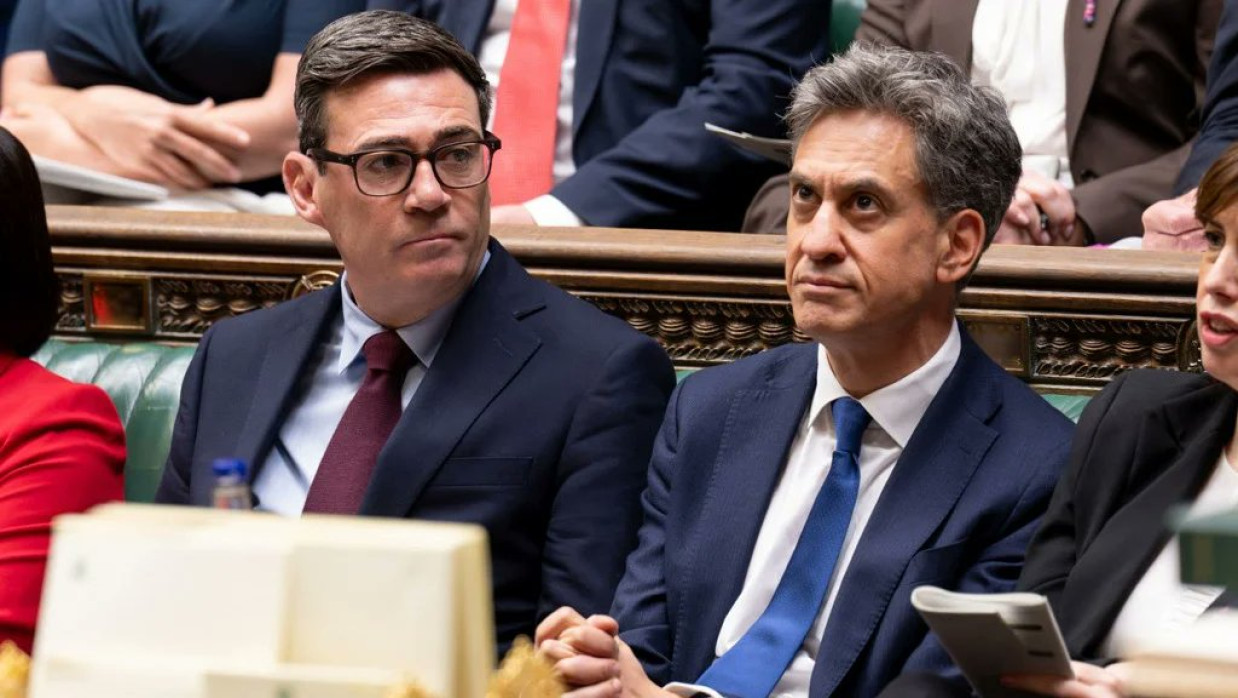
Perhaps, Israel did not expect UK to join other countries in taking action, even though it seems primarily symbolic, regarding its illegal settlements. Here, it may be noted, prior to announcing sanctions, UK Prime Minister Andy Burnham reportedly briefed US President Donald Trump about the same. That UK went ahead with the same suggests that Trump does not oppose them. The fact that UK viewed it pertinent to update US about the same suggests that probably Burnham did not want Trump to get offended by this turn in UK’s approach towards Israel. Given that UK is fairly famous (rather infamous) for giving a lot of importance to its “special relationship” with US, there is nothing surprising about this. It is possible, it is on this account that Israel did not expect any sanctions from UK against its illegal settlements.
Surprise has also been expressed at Trump having chosen to remain fairly quiet on this development. He has yet to comment on sanctions announced by UK, France, Canada and other countries. Netanyahu probably expected him to condemn the same. But Trump hasn’t voiced any such stand yet.
Till recently, Israel had not expected its western allies to display their diplomatic cards against it. Rather, Israel has expected strong support from them on certain issues, it has been fairly vocal about. This includes its discriminatory approach against Palestinians and its anti-Islam stand as well linking both with terrorism. It has also banked on its anti-Islam hype to support illegal settlements in West Bank. It has also counted on the same to retain support of its western allies. But this appears to have suddenly cracked diplomatically prompting its western allies to pronounce their stand in favor of two-nation solution and against certain measures of Israel quite significantly. It clearly spells a major shock for Israel.
Given the new prominence gained by voices of activists in support of Palestinians, including Muslims, in most parts of the western world, the period when these could be ignored or given minimal importance no longer prevails. If nothing else, now at least some importance is being given to creating the impression that their voices are being heard and are being respected. This refers to places where electoral democracy still exists compelling the leaders to ensure that their image as well as prowess does not collapse in their bid to please select power-holders. In essence, it is possible, electoral prowess of those supporting Palestine has had considerable influence on several governments, moving them to announce sanctions against illegal Israeli settlements in occupied West Bank.
If Israel appears to be diplomatically isolated today, it is not simply and only because diplomatic ethics have commanded several countries to adopt this stand towards it. It is also because of the increasing importance gained by those supporting Palestine in their own countries. Democratically and politically, they couldn’t afford to ignore and/or silence the same and hence chose to add some political strength to their own diplomatic voice by choosing to opt for sanctions against illegal Israel settlements in West Bank. Even though these sanctions may be viewed as only symbolic, their diplomatic as well as political significance cannot be ignored, nationally as well as globally!


0 Comments
LEAVE A COMMENT
Your email address will not be published