

The war in Gaza has revived one of the Arab world's most enduring and divisive questions: why have many Arab governments been unable or unwilling to mount a unified political response in support of the Palestinian cause? Across the Middle East, critics increasingly argue that several Arab regimes have subordinated Palestinian interests to their own security calculations, strategic alliances, and regime survival. Although these assessments remain contested, they have become an increasingly influential part of the regional political discourse.
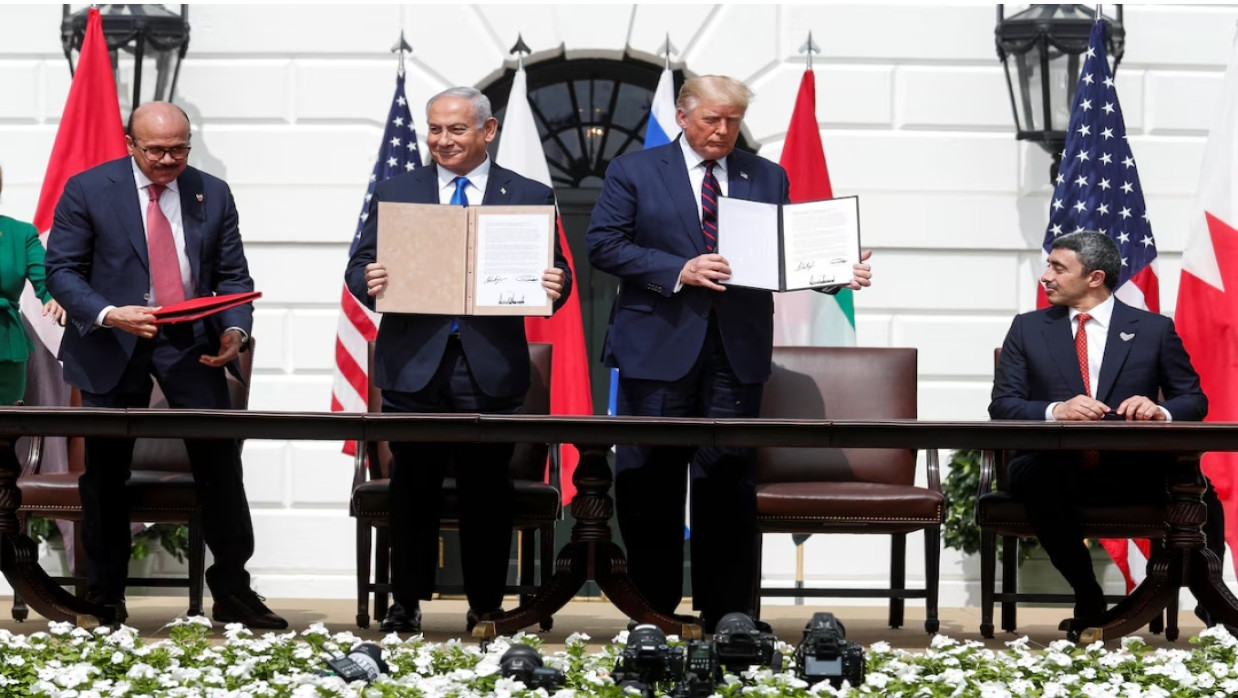
Proponents of the deals between Israel and Arab countries have argued that there is room for normalization with Israel, which will allow progress in economic cooperation, technological gains, and regional stability. Detractors of the agreements say they only benefit the security needs of authoritarian regimes without taking into consideration the wants of everyday Arabs. The claim has also been made that Gulf monarchies are authoritarian regimes whose rulers believe they will only remain secure if they strategically cooperate with Israel and the U.S. Looking at it this way, rather than building upon Arab unity, the Abraham Accords were seen as breaking with 50 years of Arab agreement that normalization must wait for the creation of a sovereign Palestinian state. Critics said that the agreements weakened Arab leverage while Palestinians continue to endure occupation, colonization, and multiple military assaults.
In addition to foreign relations, it is argued that the UAE has become one of the more interventionist regional powers by "building tentacles" of investments, military bases, and alliances from East Africa to the Arabian Peninsula, via Yemen and Sudan. Its footprint in Yemen and across the Horn of Africa, especially its near military base in Sudan, has also led some to conclude that the UAE is trying to extend its regional hegemony far from its own shores, with Abu Dhabi as the driving force. The UAE has also faced accusations of intervening in Sudan and allegedly exploiting business interests in Sudan's gold. Moreover, Abu Dhabi and its allies' partnership with Israel and Western countries has been cited by critics. On the one hand, normalization advocates argue that it contributes to fighting terrorism and ensuring maritime security. On the other hand, their critics accuse them of undermining Palestine and aligning with Israel. Some have used the terms Arab Zionists and Muslim Zionists to refer to governments like the UAE that they accuse of replacing Arab support for Palestine with alliance-building with Israel.
These trends have been part of a broader realignment in Gulf politics. Saudi Arabia and the United Arab Emirates have emerged as leading purchasers of sophisticated Western weapons and Israeli military technology. They have also ramped up security and intelligence collaboration with Israel. Security relationships between the Gulf monarchies and the U.S., Israel, and other Western governments remain deeply enmeshed. Some view these relationships as critical foundations for security and prosperity in the region. Others see them as tools for domestic repression and tools of deeper dependency on foreign patrons.
The Arab world has also been divided by competing visions of regional order. Qatar has courted Islamist political movements such as Hamas, while the UAE and Saudi Arabia have perceived the Muslim Brotherhood and other Islamist groups as threats to their regimes. Egypt has also coordinated its policies with its own threat perceptions towards Gaza and Sinai. This has undermined the potential for a united Arab stance on Palestine.
A further hallmark has been the proliferation of proxy wars. Iran partners with Hezbollah and multiple allied movements; Gulf countries, Türkiye, Western governments, and Israel have all also supported various political and military forces throughout regional conflicts. Hezbollah was formed after Israel invaded Lebanon in 1982 and originally portrayed itself as a Lebanese resistance movement against Israeli occupation. Critics of Western foreign policy claim proxy relationships are disparaged when referring to Iranian-backed organizations, with significantly less criticism of Israeli and Western intelligence agencies conducting their own covert operations in the region, claiming it to be part of a wider political double standard. As a result of these relationships, there have been two major camps: the US-led coalition of Israel and Arab states, which have moved closer through security cooperation and normalization agreements, and Iran and the groups aligned with the so-called "Axis of Resistance". Supporters of Iran's involvement claim this axis to be the dominant anti-Israel faction working to protect Palestinian rights. Critics of Iran, however, point to the negative effect its involvement has had on fomenting instability and fueling sectarian conflict.
Economic development offers another contrast. The Gulf monarchies have amassed great wealth through hydrocarbon exports and investments in finance, infrastructure, tourism, and sovereign wealth funds. However, detractors claim they ultimately remain reliant on Western and Israeli military backing for their long-term security. Iran has built up considerable indigenous capacity in science, engineering, missile technology, and higher education since it came under sanctions and international isolation decades ago.
In the long run, the fate of Palestine is tied to the balance of power in the entire region of West Asia. Analysts often claim that any attempt to establish true Palestinian independence is futile while Israel has disproportionate military dominance in the region with backing from the United States and the Zionists. As such, any durable solution would require sustained diplomatic pressure and greater unity among Arab and Muslim nations, while also finding common ground with regional powers like Iran. Palestine is one of the central geopolitical and humanitarian issues surrounding the twenty-first century and will shape the region's politics for many years.


0 Comments
LEAVE A COMMENT
Your email address will not be published