

Nearly half of the world's heavy rare earths come from mines in Myanmar's Kachin State, Reuters reported in 2025. Those mines sit inside a battlefield. In October 2024, the Kachin Independence Army (KIA) seized a major rare-earth mining hub near the Chinese border, disrupting supplies of minerals used in electric vehicles, wind turbines, electronics and advanced defence technologies. By July 2026, India and Myanmar were signalling closer cooperation on rare-earth mining as New Delhi searched for alternatives in a supply chain dominated by China.
The story begins far earlier than the global race for critical minerals. Myanmar's armed borderlands were once associated internationally with opium and heroin. They later became synonymous with jade, timber and methamphetamine. Today, they are entangled with some of the most strategic minerals of the twenty-first century.
War is usually described as the destruction of an economy. Myanmar presents a darker paradox: decades of conflict have also produced economic systems capable of sustaining armed power. The commodities change and the actors shift, but a recurring mechanism remains - control territory, extract or tax value from it, convert revenue into armed and political capacity, and use that capacity to retain territory. The same networks also ensure that the consequences do not remain inside Myanmar. Narcotics, illicit finance, trafficking, displacement and supply-chain shocks move across borders. In that sense, Myanmar's self-feeding wars export instability even when no actor sets out to "export" it. For South Asia, the consequences are uneven but increasingly connected: Bangladesh absorbs narcotics and displacement pressures; India confronts border insecurity and critical-mineral stakes; while Afghanistan and Pakistan sit within a parallel western synthetic-drug geography that shows how quickly conflict-linked markets can reconfigure regional security. The links are not identical, but the mechanism - armed economies using transnational markets - is regional.
Where the cycle began
Myanmar inherited multiple armed conflicts after independence in 1948, but the political economy surrounding them was sharpened by the Cold War. After the Chinese civil war, remnants of Chiang Kai-shek's Kuomintang (KMT) retreated into northern Burma. Shan State, already connected to opium cultivation and lying beside China, Thailand and Laos, became an arena where armed power and illicit commerce overlapped.
Political scientist Patrick Meehan, in his study "Drugs, insurgency and state-building in Burma", shows why narcotics cannot be understood as a criminal economy running parallel to politics. In contested borderlands, drug revenues, taxation and protection arrangements became embedded in political authority itself. The International Crisis Group similarly traces the interconnection of drugs and armed conflict in Shan State back to the 1950s.
The Tatmadaw also relied at different times on local militias and proxy forces as part of counter-insurgency strategies, while armed organisations fighting the state developed their own taxation and revenue systems. The result was never one centrally controlled "war economy", but an ecosystem of armed actors, brokers, traders and officials whose interests could conflict militarily while intersecting commercially.
From the beginning, the economy was transnational. Opium could be cultivated in Myanmar, but its value depended on routes through neighbouring territories and markets far beyond Southeast Asia. The violence was local; the market was regional and eventually global. The Golden Triangle was an early model of how Myanmar's borderlands could convert weak state control and armed territorial power into cross-border economic value.
When ceasefires commercialised conflict
The end of the Cold War transformed this system without dismantling it. The Communist Party of Burma collapsed in 1989, producing several successor armed organisations. The military government then negotiated ceasefires with a number of ethnic armed groups. Fighting declined in some areas, but the economics of territorial control did not disappear.
Instead, timber, jade, gemstones, mining, plantation concessions, transport routes and border trade became increasingly important. Scholar Kevin Woods described part of this process as "ceasefire capitalism": military-private partnerships and resource concessions in ethnic borderlands could serve state-building and commercial interests even when open warfare temporarily receded.
The insight overturns an easy assumption - that a ceasefire automatically dismantles a conflict economy. Reduced violence can make resources easier to extract. Territory previously valuable because of military geography can acquire a second value as a concession, mine, logging tract, border gate or trade corridor.
Jade demonstrates the scale. Global Witness estimated in its 2015 report "Jade: Myanmar's 'Big State Secret'" that jade production may have been worth as much as $31 billion in 2014 alone. Its investigation documented a sector involving military elites, politically connected companies and drug-linked businessmen, while later work connected the jade economy to armed conflict in Kachin State.
Conflict had moved beyond narcotics into an extractive political economy in which natural resources, armed protection and privileged access to territory could reinforce one another.
The Tatmadaw inside the economy
The Tatmadaw's role requires precision. Myanmar's conflict-linked economy cannot be reduced to an illicit enterprise run by the military. Ethnic armed organisations maintain their own revenue systems; militias occupy different relationships with the state; and criminal entrepreneurs exploit jurisdictional gaps.
Yet the military also developed a substantial institutional economic architecture. In 2019, the UN Independent International Fact-Finding Mission on Myanmar examined the military's economic interests, focusing particularly on Myanmar Economic Holdings Limited (MEHL) and Myanmar Economic Corporation (MEC). The Mission described extensive military-linked business interests and argued that they gave the Tatmadaw significant economic autonomy from civilian oversight.
Armed power therefore does not rely only on illicit cash. It can be sustained through a mixture of formal companies, state-controlled revenues, concessions, taxation, protection arrangements, smuggling and informal finance. Different actors occupy different parts of that system, sometimes competing and sometimes trading across front lines.
The 2021 coup widened an old economy
The February 2021 coup did not create this system. It widened the conditions under which it could operate.
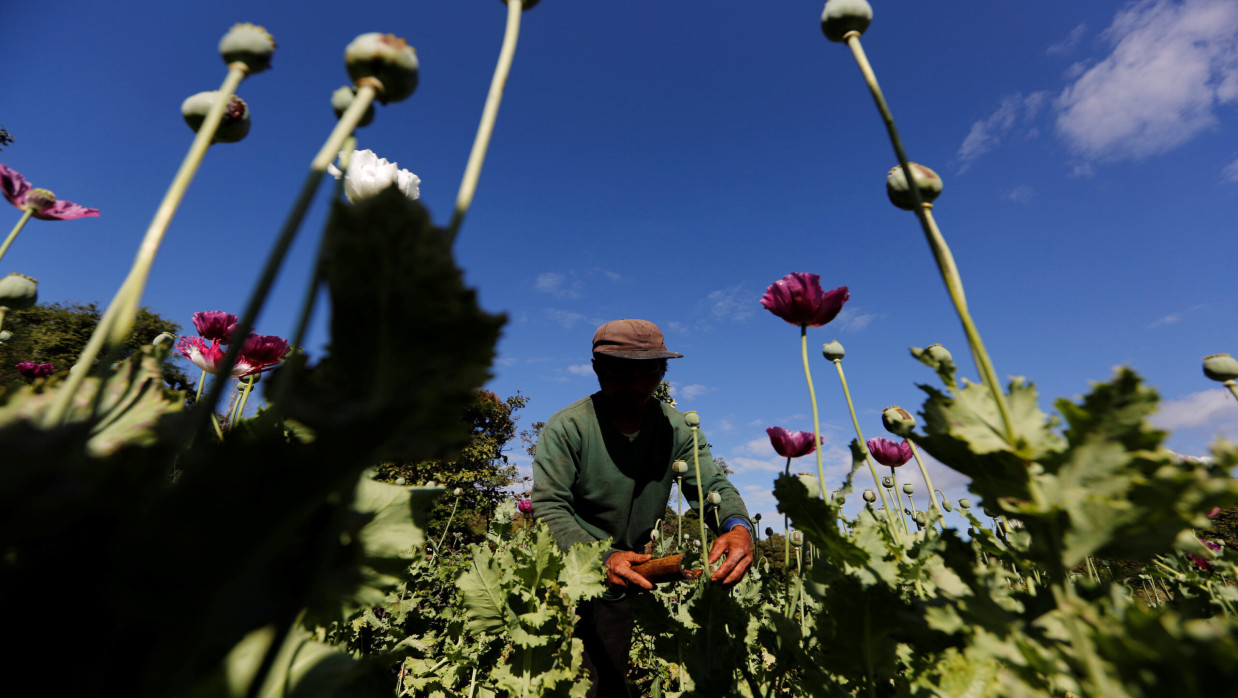
Renewed nationwide conflict, displacement and weakened institutions increased the importance of informal and illicit markets. The clearest measurable example is opium. The UN Office on Drugs and Crime's "Myanmar Opium Survey 2025" estimated 53,100 hectares of poppy cultivation, 17 percent more than in 2024 and the highest level in a decade. UNODC linked the expansion to insecurity, conflict and declining livelihood options.
Synthetic drugs show how the economy evolves rather than merely repeats itself. Opium depends on land, farmers and seasons. Methamphetamine depends on precursor chemicals, laboratories, protection, logistics and cross-border markets. UNODC has repeatedly identified Myanmar as a central source of methamphetamine in East and Southeast Asia, with large volumes moving outward through established trafficking corridors, including towards Bangladesh and northeast India.
The conflict-linked economy is thus no longer constrained by the biology of a crop. Industrial production and transnational logistics allow greater scale, while other criminal businesses in some border areas further diversify revenue opportunities where armed authority and weak regulation overlap.
Sanctions meet a networked economy
After the coup, the United States, European Union, United Kingdom and others expanded measures intended to restrict the military's access to money, weapons, aviation fuel and international commerce.
The United States sanctioned the Ministry of Defence, Myanma Foreign Trade Bank (MFTB) and Myanma Investment and Commercial Bank (MICB), and later prohibited specified financial services involving the Myanma Oil and Gas Enterprise (MOGE). The EU's Myanmar sanctions, extended in April 2026 until April 2027, apply to 105 individuals and 22 entities alongside an arms embargo and other restrictions. The United Kingdom maintains financial, trade and immigration sanctions.
These measures raise the cost of formal finance and market access. But they also expose the adaptability of a networked economy. In his 2024 report "Banking on the Death Trade", the UN Special Rapporteur on Myanmar documented foreign financial institutions involved in transactions connected to military procurement. The evidence pointed not to complete financial isolation, but to attempts to find alternative channels as previous routes became difficult.
This does not mean sanctions are ineffective, nor that they created Myanmar's illicit economy. Their impact is partly a contest between restriction and adaptation. When formal routes close, intermediaries, cross-border banking relationships and alternative jurisdictions can become more valuable. Neighbouring states thus become part of the economic geography through which Myanmar's conflict actors respond to pressure.
Rare earths change the stakes
Nothing illustrates the transformation better than heavy rare earths.
Global Witness reported that Chinese imports of heavy rare-earth oxides from Myanmar rose from 19,500 tonnes in 2021 to 41,700 tonnes in 2023. Much of the mining was concentrated in Kachin State close to the Chinese border, where extraction has also generated serious environmental concerns. Dysprosium and terbium are important for high-performance permanent magnets used in electric vehicles, wind turbines, electronics and other advanced technologies.
Figure 3. China's imports of heavy rare-earth oxides from Myanmar, 2021 and 2023 (tonnes). Data reported by Global Witness from Chinese customs records.
Then battlefield control altered the supply chain.
In October 2024, the KIA announced that it had seized Chipwi and Pangwa, key areas in the rare-earth belt. Reuters reported that the takeover threatened supplies to China. In 2025, Reuters described Kachin as producing nearly half of the world's heavy rare earths and reported that fighting and Chinese pressure over the KIA's advances had become intertwined with concerns about mineral supply. Rare-earth mining was also reported to be expanding in territory controlled by the United Wa State Army in Shan State.
By July 2026, India and Myanmar were signalling closer rare-earth mining cooperation as New Delhi looked for additional sources of critical minerals.
Rare earths reveal the second half of Myanmar's political economy of war: violence may remain geographically local, but its economic consequences do not. A change in control of a remote township can affect Chinese processors, Indian resource strategy and global manufacturers dependent on critical minerals.
Myanmar's conflict economy has therefore travelled from supplying narcotics markets to intersecting with the global energy transition and strategic industrial competition. It is not a neat progression in which rare earths replace opium or methamphetamine replaces jade. The older economies remain; new layers are added.
How war feeds war
The central mechanism is straightforward.
Territorial control provides access to resources, trade routes, businesses and populations. That access allows taxation, licensing, extraction, protection payments or control of commerce. Revenue helps pay fighters, buy weapons, administer territory and sustain patronage. Armed capacity, in turn, helps preserve or expand territorial control.
Conflict also destroys conventional livelihoods, weakens regulation and fragments authority. Informal and illicit markets become comparatively more attractive or, for some communities, unavoidable. Those markets strengthen organisations capable of operating outside accountable institutions, making economic normalisation harder.
This does not mean resources caused Myanmar's wars. Many conflicts are rooted in political representation, autonomy, identity, citizenship, federalism and the structure of the state. Nor does every armed organisation have an economic interest in perpetual war.
The narrower argument is that once extraction, taxation and transnational commerce become embedded in armed territorial control, peace must confront economic interests created or strengthened by conflict. A political settlement that ignores those interests can stop shooting without removing the machinery that makes renewed violence financially possible.
When instability crosses borders
Myanmar's borders do not merely contain this economy; they are part of the infrastructure that makes it profitable.
To the northeast lies Yunnan and the Chinese market; to the east, Thailand, Laos and the Mekong; to the northwest, India's northeastern states; and to the west, Rakhine State, the Bay of Bengal and Bangladesh.
Each frontier carries a different spillover. Drugs travel through trafficking corridors. Financial transactions seek foreign intermediaries. Displaced people search for safety. Critical-mineral disruptions affect external industries. Armed competition changes border trade and security calculations.
"Exporting instability" should therefore not be read as a deliberate national policy. It describes an externality: Myanmar's internal political economy is so transnational that its wars repeatedly impose costs on neighbouring societies.
South Asia lives downstream
Myanmar's western spillovers reach South Asia unevenly. The most direct corridor runs through Bangladesh and India's northeast. UNODC has documented westward flows of yaba and crystalline methamphetamine from Myanmar into South Asia, exploiting difficult-to-control border areas between Myanmar, Bangladesh and India. That makes the eastern edge of South Asia not only a humanitarian frontier, but part of a transnational narcotics and precursor economy.
For India, the problem is now simultaneously one of border security and geoeconomics. Conflict in Chin and Kachin affects routes into the Northeast, while control of Kachin's heavy rare-earth belt has become relevant to New Delhi's critical-mineral strategy. Reuters reported in July 2026 that India and Myanmar were deepening rare-earth cooperation as India searched for alternative supplies in a market dominated by China. This creates a policy dilemma: India wants supply diversification, yet the mineral geography is embedded in contested territory where state and non-state actors compete for control.
The implication for India is that critical-mineral policy cannot be separated from conflict analysis. A mine, road or border gate that appears on a commercial map may also be a source of revenue, bargaining power or military leverage. Myanmar's 2026 fighting has again centred on rare-earth areas and strategic border routes. Engagement that ignores who controls territory risks overlooking the political economy that makes continued armed competition viable.
Bangladesh faces a different mix. Methamphetamine is the most visible cross-border manifestation, but the frontier with Rakhine is also exposed to smuggling, trafficking, disrupted border governance and repeated displacement. The Rohingya - officially described by Bangladesh as forcibly displaced Myanmar nationals, or FDMNs - are among the populations most exposed to this western spillover. Protracted camp life, restricted livelihood opportunities and uncertainty over return create vulnerabilities that traffickers and criminal networks can exploit.
For Dhaka, the deeper strategic implication concerns repatriation. Safe, voluntary and sustainable return requires more than a bilateral agreement or a quieter border. It requires security in Rakhine, functioning governance, credible guarantees of rights and citizenship, and an economic environment in which armed control of territory is not continually reinforced by extractive or illicit revenue. A self-feeding war economy therefore complicates both border management and the conditions required for durable return.
Afghanistan and Pakistan sit farther from Myanmar's direct spillover zone, so the connection should not be overstated. Their relevance is comparative and regional. UNODC's World Drug Report 2026 identifies Afghanistan as the leading reported country of departure for methamphetamine trafficking in Asia, followed by Myanmar and Iran. South Asia is therefore exposed to two major illicit-drug production systems at opposite ends of the region: Myanmar to the east and Afghanistan/South-West Asia to the west. For Pakistan, the policy significance lies less in Myanmar-origin yaba than in understanding how synthetic-drug markets, precursor controls, financial networks and trafficking routes adapt across the wider Asian space.
Bangladesh, India, Pakistan and Afghanistan do not face identical consequences, and treating them as if they did would be analytically false. But each illustrates a different dimension of how conflict-linked economies travel: narcotics and displacement in Bangladesh; territorial insecurity and critical minerals in India; and a parallel synthetic-drug and trafficking challenge centred on Afghanistan and its neighbouring region. The regional problem is not one single corridor. It is the growing capacity of armed and criminal economies to connect local conflict to transnational markets.
Policy implications for South Asia
Regional policy should be differentiated but coordinated. Bangladesh and India need stronger operational cooperation on border intelligence, narcotics, precursor chemicals, trafficking and illicit financial flows. India also needs conflict-sensitive due diligence in critical-mineral sourcing from Myanmar. Afghanistan and Pakistan belong in the wider South Asian conversation on synthetic drugs and financial intelligence because the region is increasingly dealing with multiple production centres and adaptable trafficking systems rather than a single narcotics geography.
At the diplomatic level, South Asian states should press for greater transparency around cross-border mineral supply chains, transport routes, banking channels, precursor-chemical trade and armed-group taxation, working where necessary with China, ASEAN members and UN mechanisms. The objective should not be to isolate border communities or lawful commerce, but to reduce the channels through which armed territorial control is converted into revenue while improving visibility over how commodities move from conflict zones into legitimate markets.
The priorities will still differ by country. For Bangladesh, Rohingya repatriation and border security remain the immediate human-security concerns. For India, stability along the Myanmar frontier is increasingly intertwined with connectivity and critical-mineral strategy. For Afghanistan and Pakistan, the lesson is strategic: drug markets adapt quickly when conflict, weak governance, sanctions, precursor access and cross-border finance intersect. A South Asian response should therefore combine humanitarian policy, border security, financial intelligence and conflict-sensitive economic engagement rather than treat each spillover as a separate file.
Peace needs an economic strategy
Myanmar has moved through post-colonial insurgency, Cold War politics, military dictatorship, ceasefires, partial political opening, a renewed coup and nationwide civil war. Across those transformations, the commodities and actors have changed more readily than the ability to turn territorial control into economic power.
Opium linked armed borderlands to illicit global markets. Ceasefire capitalism converted some contested territories into concessions and extraction zones. Jade demonstrated the value that could accumulate around military and political access. Methamphetamine industrialised the narcotics economy. Sanctions pushed networks to search for alternative channels. Rare earths have now connected Myanmar's battlefields to the technologies and strategic supply chains of the future.
The result is a conflict system that is both self-feeding and outward-facing.
From opium to rare earths, Myanmar's experience suggests that ending war requires more than silencing guns. It requires dismantling the economic arrangements that allow violence to finance itself - and recognising that until those arrangements change, the costs will continue to spill across Myanmar's borders.


0 Comments
LEAVE A COMMENT
Your email address will not be published