

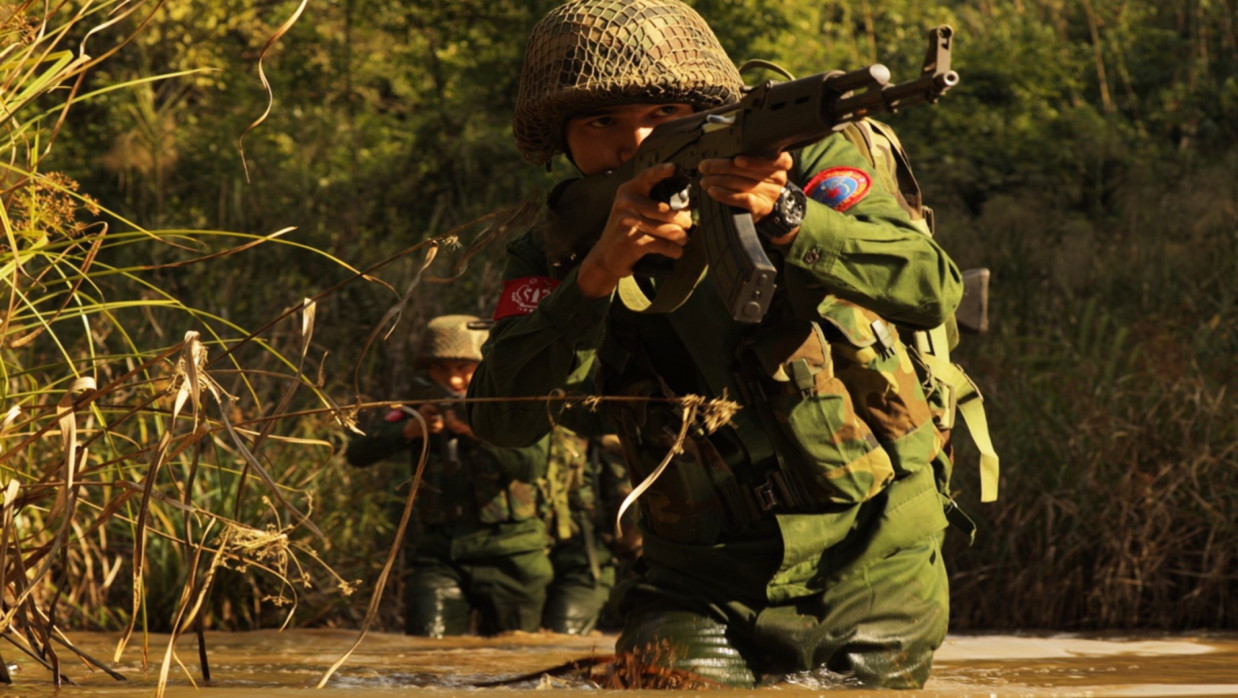
Bangladesh plans to build a border fence along its 270-kilometer border with Myanmar. Dhaka officials say the move is necessary due to increasing incidents of crime by illegal cross-border movements, including drug trafficking, irregular migration and instability caused by Myanmar’s ongoing civil war. Bangladesh announced plans to build a border fence on June 20,26 to reinforce security with additional border roads, thermal cameras, CCTV, night goggles, and drones. Bangladesh wants to improve security at the border and is demonstrating its resolve to modernize its capabilities.
However, a more profound question than mere border security remains: Who controls the land on the other side? As it turns out, the answer may not be what your politics textbooks lead you to believe and is proof of how drastically Myanmar’s political landscape has shifted.
A Border No Longer Controlled by Naypyitaw
For years, Bangladesh has dealt with Myanmar at the official level to manage issues along their border. The reality now is far from it.
Bangladesh’s border with Myanmar runs along the length of Rakhine State’s Maungdaw and Buthidaung townships, which currently lie under the control of the Arakan Army (AA). While Dhaka still maintains official relations with Myanmar’s internationally recognized administration, Naypyitaw’s military rulers have little sway over large swathes of the borderland.
So when it comes to dealing with the realities on the ground, whether that be border security, humanitarian access, refugee returns, or facilitating trade, it matters little who you officially deal with; it matters who you can deal with.
Security and Sovereignty Are No Longer Identical
Bangladesh certainly has every reason to secure its borders. There are still over 1.2 million Rohingya refugees in Bangladesh. And issues such as weapons smuggling, drug trafficking, human trafficking, and illegal migration remain serious problems.
Securing its border is absolutely a right and responsibility of every independent nation.
But good border security policy also recognizes new realities on the ground. Since the AA seized control of Maungdaw late last year, Bangladesh now has a border with AA-controlled territory, not with Myanmar’s military regime.
Acknowledging that reality doesn’t mean Bangladesh has to officially recognize the AA. Many governments have cooperated with all sorts of de facto authorities over the years on issues such as humanitarian access, ceasefires, border management, and trade without legitimizing them.
Bangladesh now faces that choice.
Infrastructure Cannot Replace Political Solutions
Border fences and high-tech surveillance equipment might help stem illegal infiltration and enhance border monitoring, but they do not address underlying political factors fueling insecurity.
Checkpoints and border outposts dotting the Bangladesh- Rakhine borderland are symptomatic of civil war, contested sovereignty, refugee flows, organized crime, and regional power rivalry.
No matter how high-tech and robust border infrastructure gets, without pragmatic cooperation between stakeholders who exercise de facto control over border regions, its efficacy may fall short of desired goals.
“A lot of regional analysts believe that functional cooperation between stakeholders who exercise border control matters more than fences.”
Humanitarian Challenges Continue to Intensify
At the same time border security is being debated, the humanitarian situation within Rakhine continues to deteriorate.
Myanmar’s military may have relinquished control of large swaths of territory but has continued to carry out airstrikes in AA-controlled areas. Airstrikes last week in Kyauktaw, Buthidaung, and Maungdaw are said to have killed civilians, wounded children, destroyed homes, and displaced more families who have already endured years of fighting.
This underscores fences' limitations when constructed on people. When countries fail to confront root causes that fuel humanitarian need, a border fence will not prevent explosives from raining down on civilians, stabilize conflict-affected fragile areas, or create the conditions necessary for Rohingya to willingly, safely and with dignity repatriate.
Humane considerations should be viewed through broader security lenses.
A Regional Strategic Frontier
Clearly, managing and securing the Bangladesh–Rakhine frontier is becoming increasingly important as Bangladesh's eastern border emerges as one of South Asia's newest and potentially most dangerous flashpoints.
Border trade is beginning to pick up here and there, humanitarian agencies are scrambling to reach those most in need across the border, and the Government of Bangladesh is coming under increasing international pressure to find long-term solutions for the Rohingya.
Negotiating relationships with armed groups like the Arakan Rohingya Salvation Army (ARSA), Rohingya Solidarity Organization (RSO), and Arakan Rohingya Army (ARA) operating along the border region will also play a critical factor in how unstable the area remains.
But building border infrastructure won’t solve these complex problems alone. Political negotiations, good governance, humanitarian access and continued regional engagement will also be needed.
Adapting to a Changing Political Geography
The violence inside Myanmar has turned the Bangladesh- Rakhine border into a powerful lesson on how political maps can change faster than politics itself.
The proposed border fence might allow Bangladesh to better monitor the border and reduce some border crimes. But effective border management in the long run requires much more than fencing alone. It hinges on creating political stability, establishing functional governance, protecting civilians, and engaging with whoever is governing on the ground.
Diplomatically, it remains to be seen if Bangladesh will officially recognize the Arakan Army. But in practice, if Bangladesh wants to maintain any semblance of border management, it will have no choice but to coordinate with the AA and other forces that control significant parts of Rakhine territory.
Bangladesh is not alone in facing this new border reality. As the war in Myanmar increasingly shapes geopolitical equations in South Asia, leaders and policymakers in the region may have no choice but to redraw the lines when it comes to how they think about sovereignty, security and borders.


0 Comments
LEAVE A COMMENT
Your email address will not be published