

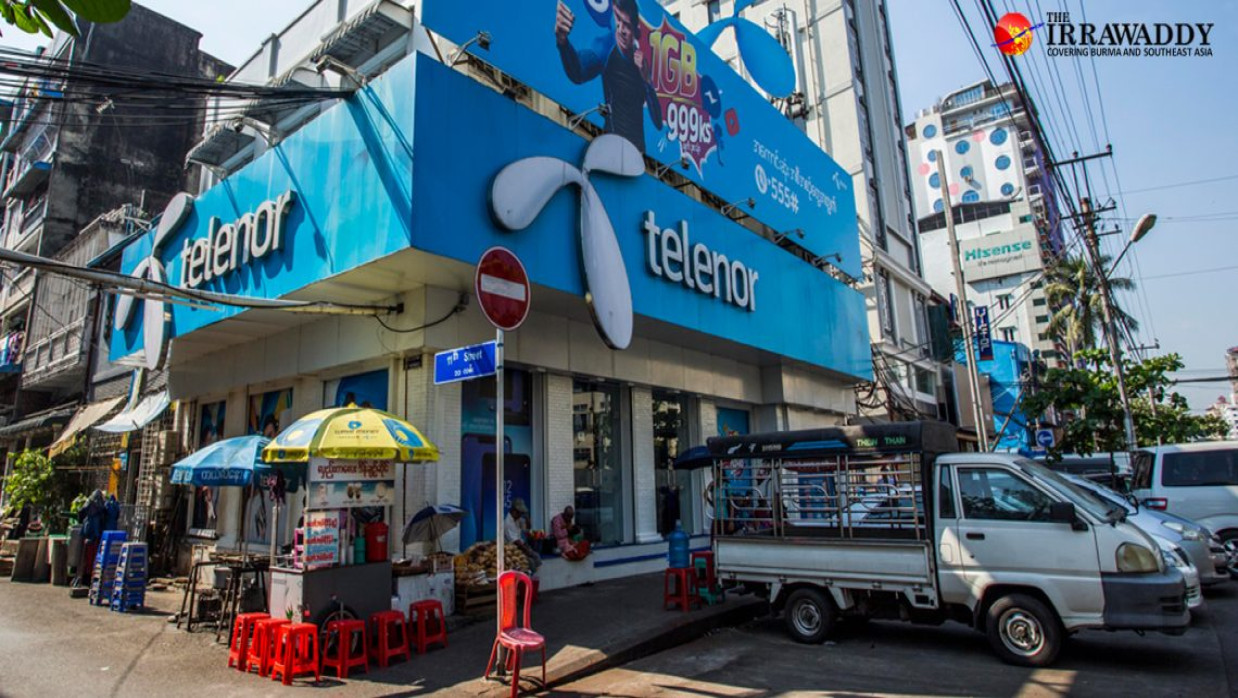
Swedish non-profit Justice and Accountability Initiative (JAI) filed a civil class action suit on Wednesday against Norway’s state-controlled telecom giant Telenor, claiming damages on behalf of Myanmar customers whose private data was shared with the military regime. According to a press statement by the Open Society Justice Initiative (OSJI), which is supporting the lawsuit, the legal action in Norway is seeking corporate accountability for disclosing personal data of activists to a regime committing widespread human rights abuses.
Telenor sold its Myanmar subsidiary to a military-linked firm in March 2022, one year after the coup.
The transfer to Investcom PTE LTD—a joint venture between Lebanese investment firm M1 Group and Myanmar company Shwe Byaing Phyu (SBP), owned by junta crony Thein Win Zaw—proceeded despite widespread protest and legal challenges by civil society organizations.
Khin Thiri Thet Mon, the daughter of coup leader Min Aung Hlaing, has a stake in SBP, which controls roughly 80 percent of Telenor’s old Myanmar operations under the name ATOM.
The suit alleges that Telenor handed over users’ private data to military authorities following the coup, directly facilitating human rights abuses.
The plaintiffs said the disclosures included call logs and location data; names, addresses and ID numbers; and Facebook and bank accounts linked to mobile numbers.
The junta regularly requested this data to prosecute individuals suspected of opposing military rule, reportedly leading to arbitrary arrests, torture and even executions.
The plaintiffs said Telenor Myanmar shared data from at least 1,253 phone numbers with the regime, despite its own assessments warning of systematic human rights abuses.
The lawsuit is seeking damages of 9,000 euros (roughly US$ 10,500) per customer.
“For us as civil society representatives, we want to hold Telenor accountable on behalf of other users of Telenor, not only for specific people but also for the wider community that was harmed. This is why we are bringing the case,” JAI chairperson Ko Ye said.
Additional damages are being claimed by Tha Zin, the widow of popular rapper and lawmaker Phyo Zeyar Thaw who was executed by the regime in 2022, and Aung Thu, a pro-democracy activist who was re-arrested by the regime.
The plaintiffs claim that Telenor Myanmar handed Phyo Zeya Thaw’s phone data to the regime on October 31, 2021, with the knowledge of its parent company. Phyo Zeya Thaw was arrested in Yangon just over two weeks later, before being sentenced to death in a closed trail in January 2022 and hanged the following July along with three other pro-democracy activists.
“I lost my husband. It is not just a wife losing her husband. It is also a loss to the movement. It is also a loss to democracy because my husband was committed to democracy and a youth leader. Losing him means a loss to the country,” said Phyo Zeya Thaw’s widow, Tha Zin.
Activist Aung Thu was set to be freed without charge in October 2021 but was re-arrested at the prison gate after Telenor Myanmar handed his user data over to the military.
He was sentenced to five years in prison under terrorism laws and was released last year after serving two-thirds of his sentence.
“Telenor in Norway clearly contributed to the practice of handing over user data, despite the inherent risks for its customer in Myanmar. We have evidence of cases where the team at HQ expressly recommended the data to be handed over,” said Jan Magne Langseth, lawyer at the firm Simonsen Vogt Wiig representing the plaintiffs.
Two other human rights groups, Justice for Myanmar (JFM) and ICJ Norway, have filed a separate criminal case with Norwegian police against Telenor Group and its former Myanmar management for breaking Norwegian sanctions by installing state surveillance equipment that came under regime control following the coup.
Meanwhile, Norway’s parliament has launched a probe into reports that Telenor exposed hundreds of Myanmar opposition figures to arrest and detention during its exit from the country after the 2021 coup.
The article appeared in the irrawaddy

0 Comments
LEAVE A COMMENT
Your email address will not be published