

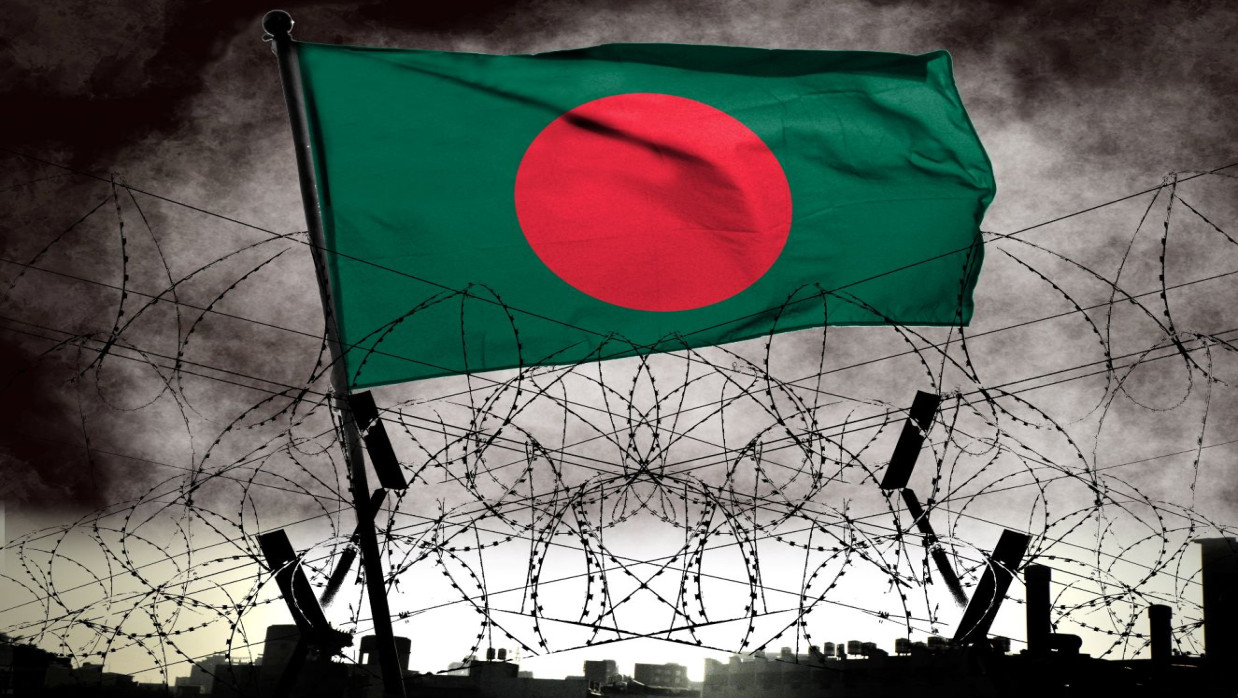
In Kashmir, India rules through the visible hand of force: soldiers on every corner, curfews that choke daily life, and emergency laws which are the subject of serious human rights violations on the population. What the world witnesses in terms of optics are the guns and the barbed wire. It is a blatant display of control and force.
In Bangladesh, until the seismic events of August 5, 2024, the approach was subtler, yet arguably very effective. India operated for years through its political alignment with a favored regime, deepening economic reliance, the securitization of dissent, and a resulting public silence on uncomfortable truths. What India packaged as friendship was viewed by Bangladeshis as dominance. This asymmetry explains why India occupies such a central, often obsessive position in Bangladesh’s political discourse.
For decades, the relationship was projected in Dhaka’s official circles as one of “eternal friendship,” rooted in India’s 1971 role in Bangladesh’s liberation. The time frame and scope of that role, it must be stated, is disputed amongst many Bangadeshis. In any case, beneath the rhetoric and outward optics of friendship lay deep-rooted imbalances.
Trade and water-sharing
Bangladesh had massive deficits with India, importing far more than it exported, with non-tariff barriers limiting Bangladeshi goods. Transit agreements and connectivity projects visibly benefitted India’s northeastern states more visibly. Meanwhile, the vulnerabilities that Bangladesh faced, exemplified by the long-festering Teesta water-sharing dispute and the Farakka Barrage—left downstream agriculture and livelihoods at the mercy of Indian decisions. This situation was accepted unconditionally under the “eternal friendship” umbrella between Sheikh Hasina’s administration and India.
It must be noted that the significant trade deficit and water-sharing issues have not been solved yet. The point is that there is no longer a political climate in Bangladesh where the focus is merely on the benefit of its neighbor.
Politics
Politically, the alignment was even clearer. During Sheikh Hasina’s rule, which spanned a period of 20 years and 8 months across two separate periods, India found a reliable partner which willingly cracked down on anti-India dissent and cooperated on security. In return, India offered crucial external backing.
Critics in Bangladesh, however, saw beyond this: a powerful neighbor invested in sustaining a government that increasingly centralized power, marginalized opposition, and suppressed uncomfortable questions about sovereignty. Bangladesh, for many, was treading along the dangerous path of potential vassalhood.
Dissent on issues like border killings by India’s Border Security Force (BSF), interference, or imbalanced economic deals was often securitized—portrayed as anti-national or destabilizing. In other words, the classic formula of masquerading healthy political debate and dialogue about Bangladesh’s sovereignty were weaponized as being “anti-national”. This led to a culture of disciplined silence amongst Bangladeshis who valued their own autonomy, where questioning the relationship too loudly invited accusations of rocking the boat at best, but more often led to grave state-sponsored human rights violations.
This was a classic case of hegemony. Unlike India’s overt militarization in Kashmir, Bangladesh’s version relied on soft power tools: economics, diplomacy and the quiet understanding that challenging the status quo carried severe costs.
August 2024
The events of August 2024 shattered this unequal relationship. The student-led uprising that ousted Sheikh Hasina, followed by her flight to India, exposed the fragility of the old arrangement. India’s “golden era” of control ended abruptly. In its aftermath, relations have soured significantly.
Bangladesh’s trust in its neighbor has eroded and it has begun to diversify partnerships, including warmer ties with China and even Pakistan. Border incidents, trade discords and India’s perceived ill treatment of Bangladeshi minorities have amplified the tensions. But most significantly, India’s decision to shelter Hasina has become a particularly potent powder keg, fuelling public outrage and reinforcing narratives of interference.
The obvious
Geography is destiny: the two countries share a long, porous border that encircles much of Bangladesh. India controls upstream rivers that determine floods and droughts. Its economy is much larger than that of Bangladesh. Culturally and historically both countries are intertwined but for Bangladeshi nationalists, asserting sovereignty inevitably means demanding space from the giant next door.
Small nations living beside giants naturally fixate on the power imbalance. For Bangladesh, the question is existential: how to maintain dignity and autonomy? For India, the matter is strategic: securing its northeastern states, countering China’s influence, and managing its borders. However, pursuing these objectives through perceived overreach breeds exactly the acrimonious Bangladeshi sentiment that India fears.
At the core of the Bangladesh-India conflict lies a simple fact: India needs to learn that true friendship cannot depend on alignment with one leader or one party. It must build a relationship with the people and institutions of Bangladesh as a whole.
The post-2024 reality offers a chance for serious recalibration, despite the challenges. Bangladesh, for its part, is moving forward in a pragmatic sense with diplomacy that safeguards its sovereignty. At the same time, it seeks mutually beneficial deals on water, trade, and borders.
India, for its part, should recognize that treating Bangladesh as a subordinate has costs. A stable, prosperous, and sovereign Bangladesh is in India’s long-term interest. Hegemony, whether overtly as in Kashmir or subtly as was practiced in Bangladesh, is ultimately detrimental to the goodwill necessary for a genuine and healthy partnership.
The path forward demands maturity, reciprocity, and mutual respect. Anything less will perpetuate the very tensions both nations hopefully want to overcome.


0 Comments
LEAVE A COMMENT
Your email address will not be published