

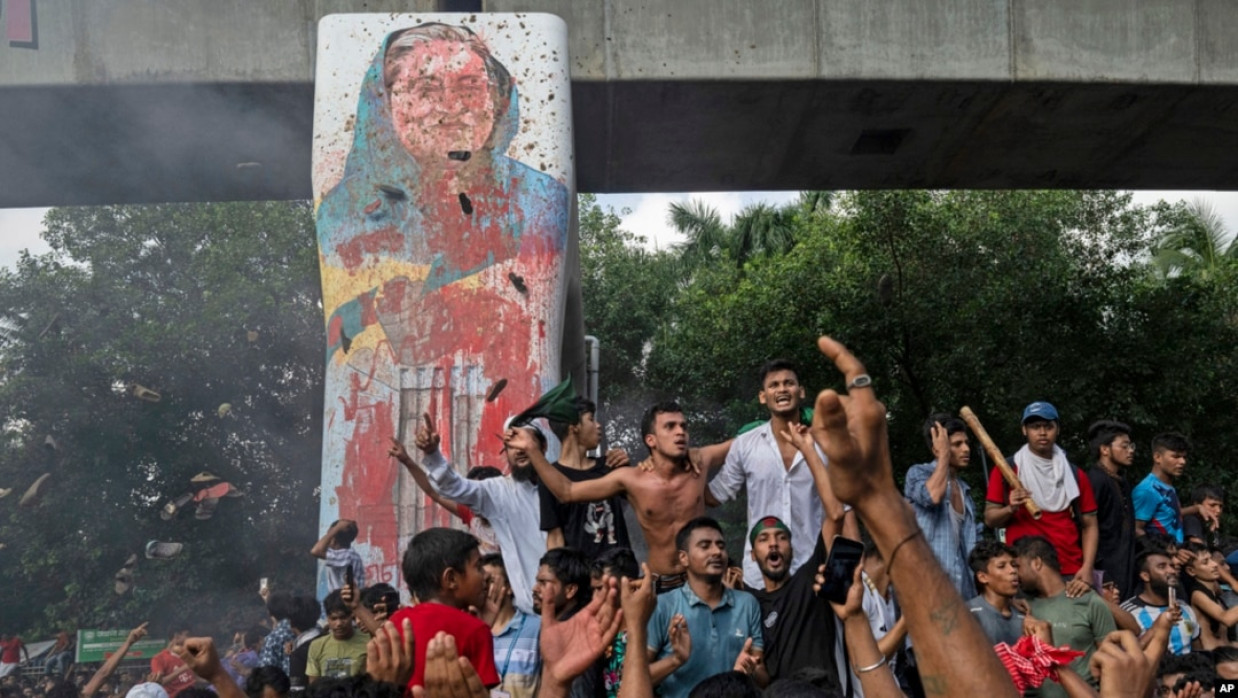
The question of Sheikh Hasina’s return to Bangladesh has become one of the most consequential legal, diplomatic, and political challenges facing the country. She served as Bangladesh's prime minister for over 15 years until she was ousted in August 2024. She currently resides in India after being convicted and put on trial by Bangladesh for crimes she and her party committed during their time in office. This situation is not only debatable in terms of extradition, but her staying in India also raises many questions. Questions about the consistency of the law, national sovereignty, and political accountability, to name a few. And whether we hold ourselves to international law standards or not.
An irony plays into this whole situation. While Hasina was in power, the International Crimes Tribunal (ICT) tried people in absentia and handed down death penalties. Under laws that international human rights organizations and attorneys constantly disputed. Those who were considered guilty of these crimes were stripped of their ability to hire lawyers of their choice. Travel abroad and have fair access to trial. This is ironic because some of those same standards are being raised now regarding Hasina's trial.
Should Bangladesh continue to practice law as it did under Hasina's rule? Or should we improve our practices to align with international law? We should decide this based on our constitution and past practice. Not what may be easier politically.
The International Crimes Tribunal and the Precedent Established Under Hasina
The International Crimes (Tribunals) Act of 1973 was originally enacted to prosecute genocide, crimes against humanity, and other international crimes associated with the 1971 Liberation War. Although the legislation preceded Hasina’s premiership, her government revived the tribunal in 2010 and subsequently amended its governing legislation.
In 2012, an amendment allowed trials in absentia if the accused fled or went into hiding to avoid trial. The act allowed an accused in absentia to have counsel, but it did not include all the provisions seen in some foreign tribunals.
The tribunal held some of these trials.
Abul Kalam Azad, also known as Bachchu Razakar, was sentenced to death in his absence on January 21, 2013. On November 3rd 2013, Chowdhury Mueen-Uddin and Ashrafuzzaman Khan were sentenced to death in their absence for involvement in killing intellectuals during the liberation war. In November 2021, Abdul Momin Talukder was also sentenced to death in his absence.
So, trials in absentia and sentencing to death in absentia are not something that came about after Hasina was removed. It was done under her rule.
It is important to remember this. There was nothing unusual about sentencing someone to death in their absence while she was ruling. So why can't we do it now?
Just because we did something in the past doesn't mean it's fair to keep doing it. Although it may be legal under Bangladeshi law, it may not meet other countries' standards for conducting trials. We need better ways to conduct trials than we did before.
British journalist and legal commentator David Bergman has raised important questions about the procedural legitimacy of Hasina’s trial and the consequences of denying defendants meaningful opportunities to challenge convictions entered in their absence.
His central argument concerns the difference between domestic legal authorization and internationally accepted judicial safeguards. The ICC statute stipulates that the defendant must be present at his or her trial. When the Special Tribunal for Lebanon (STL) allowed trials in absentia, it ensured that measures would be taken for the absent defendant to appoint a lawyer and, if certain conditions were met, to receive a new trial when appearing before the STL.
No such measure would allow Bangladesh's ICT to automatically grant a new trial if the accused appeared before the court. By allowing the death penalty and limiting one's choice of attorney, as well as providing little means to dispute the verdict, one could question whether or not trials in absentia should be used.
These concerns deserve consideration. However, the historical record also requires examining why comparable objections during Hasina’s administration failed to produce meaningful reforms.
International human rights organizations, legal scholars, and defense lawyers criticized the earlier ICT proceedings. It would therefore be inaccurate to suggest that the international legal community remained entirely silent. Human Rights Watch, Amnesty International, and other observers raised concerns about procedural fairness, defense rights, and the use of capital punishment.
But how consistent have they been with these measures? How come, after all these lessons, we still don't have legislation to address these situations? What about all the previous defendants who didn't receive what was asked of our previous Prime Minister?
We cannot turn a blind eye to the current flaws in the Bangladeshi court system. But if we want justice, it should apply to all. Not just former leaders or those with certain political affiliations. International laws should be upheld as Sheikh Hasina stands trial, as well as those who stood trial under her leadership.
Many individuals were put to death under Sheikh Hasina's dictatorship. They were tried in absentia and sentenced to death under laws that have been called unfair. Political pressure was placed on these cases and their courts. This made it nearly impossible to challenge the charges' validity. Organizations around the world took notice but did nothing to improve the situation.
When the interim government took over, they were tasked with re-establishing democratic values and holding elections for an elected government. During this time, they could have reformed the International Crimes Tribunal to allow more Western-style proceedings. For example, they could have allowed defendants who were convicted in absentia the opportunity to plead for a retrial. Implementing these reforms would require changes to many laws, processes, and timelines. The Interim Council and future elected government also had to address many domestic issues.
David Bergman raises some good points to consider when evaluating our current justice system. When looking at these proceedings, we should also consider the circumstances that led us here. Bergman has spoken against some of these procedures during the Sheikh Hasina administration. These problems have been going on for years; why weren't more procedures put into place when previous defendants were given death sentences? There have been many claims of court tampering, political persecution, and lawyers being hindered from practicing. Nothing was done to address these problems.
We all deserve a fair trial, including Sheikh Hasina. But what about all those who were detained or disappeared, and others who were politically persecuted during her rule? We can't ignore what those people went through because of how we feel about her situation.
Bangladesh needs to ensure justice is served while not repeating the mistakes of the past. As we work to improve our judicial system, we need to consider how we can better the lives of those who have suffered. Not only those being charged with crimes but those who have been hurt as well.
Shahbag, Political Pressure and the Independence of the Judiciary
The credibility of the ICT under Hasina was further complicated by the political atmosphere surrounding its proceedings.
The Shahbag movement, which emerged in February 2013 following the tribunal’s judgment against Abdul Quader Mollah, mobilized enormous public demonstrations demanding harsher punishment for individuals convicted of atrocities committed during the Liberation War.
This showed public outrage over past atrocities and a desire for justice. This allowed political movements and trials to go hand in hand.
Laws were changed to allow appeals of sentences deemed too lenient. Many protesters called for the death penalty and put pressure on the government to act.
Public demands for accountability are legitimate in a democratic society. Judicial decisions, however, must remain independent of street demonstrations, executive expectations, and partisan demands.
The concern was not whether crimes committed in 1971 deserved prosecution. They unquestionably warranted investigation and, where proven, punishment. The concern was whether individual defendants received fair trials based on admissible evidence and established legal principles.
The distinction remains equally important today. Public anger over the killings associated with the 2024 uprising cannot substitute for proof of individual criminal responsibility. Neither should a defendant's public prominence justify procedural privileges unavailable to ordinary citizens.
Foreign Lawyers, Judicial Independence and Political Interference
There has also been the question of whether lawyers and a fair court system were available during the Hasina regime.
As previously mentioned, many foreign lawyers wanted to represent the accused before the ICT. There were issues with allowing these foreign lawyers to practice law before the ICT. Reports indicated that some foreign lawyers had trouble entering the country through airports. This was raised because many cases involving crimes against humanity require knowledge of how evidence is handled and other aspects of international law.
More documentation is needed to understand what happened at each airport that denied certain lawyers entry into Bangladesh. But there was definitely an issue with foreign lawyers trying to defend people in the previous tribunal.
Many have questioned Khaleda Zia's case. Although it was not a crime against humanity case, she was still imprisoned by the state. She was not allowed to leave the country for medical purposes and had many legal issues with trying to appeal her sentence.
Judicial independence suffered another serious blow through the circumstances surrounding former Chief Justice Surendra Kumar Sinha.
Sinha became Bangladesh’s first Hindu chief justice in 2015. In 2017, after the Supreme Court struck down the Sixteenth Amendment to the Constitution, he became embroiled in an extraordinary confrontation with the government. The amendment would have restored Parliament’s authority to remove Supreme Court judges.
Sinha subsequently left Bangladesh and resigned while abroad. He later alleged that he had been pressured and effectively forced into exile. The government disputed aspects of his account, and he subsequently faced corruption proceedings.
His departure nevertheless raised grave questions about the vulnerability of judicial independence when constitutional judgments conflict with executive interests.
It is important to distinguish Sinha’s case from the ICT proceedings: he was not an ICT trial judge whose disputed tribunal decisions led to his removal. His significance lies in the broader constitutional confrontation between the judiciary and the Hasina administration.
The current government in Bangladesh should learn from this mistake. An independent judiciary does not mean installing judges or public prosecutors with no ties to previous governments. The system must be protected from political influence, no matter who sits in parliament.
Passport Rights and the Contradictions of Hasina’s Proposed Return
Hasina being asked to get a new Passport and National ID card for Bangladesh has also raised another issue.
In November, reports said her British lawyers contacted the Bangladeshi Embassy in New Delhi to request a new passport. She was expected to return in December, but the government rejected her application, stating it was invalid.
Md Aminul Islam, the chief prosecutor, stated that since Hasina is convicted and currently on the run from justice. A new passport cannot be issued to her. She should return through the extradition treaty with India. It was also confirmed that her extradition was asked for.
The passport controversy invites comparison with how opposition figures were treated during Hasina’s administration.
Sadeque Hossain Khoka, a decorated freedom fighter, former Dhaka mayor and senior BNP politician, spent his final years undergoing cancer treatment in the United States. His passport and his wife's expired in 2017, and their renewal applications reportedly remained unresolved for about two years.
As Khoka continued to become sicker, he wanted to go back to Bangladesh and die in his home country. The government was able to give him an emergency passport; however, he passed away in New York on November 4th 2019, not getting to make it back alive.
The failure to renew his passport for so long remains troubling. However, the available evidence does not conclusively establish that Hasina personally ordered the delay.
The experience of Salahuddin Ahmed, now Bangladesh’s home minister, provides another example.
Salahuddin went missing in Dhaka in March 2015 and appeared in Shillong, India, about 2 months after that. He claimed he was kidnapped by Bangladeshi authorities and smuggled into India. An Indian court found him not guilty, but it took years for him to return.
Bangladesh issued him a travel document in June 2023, when Hasina was still in power. However, he could not be sent back to Bangladesh as India had not allowed him to leave. He came back to Bangladesh in August 2024.
These cases show how passport administration, immigration controls, and diplomatic procedures can become powerful instruments used against political opponents.
Yet a distinction exists between the constitutional right of citizenship and the entitlement to a particular travel document. A convicted person may face lawful restrictions on passport issuance without necessarily losing the underlying right to nationality or the ability to return to the country.
Hasina’s request should therefore be assessed under applicable law rather than dismissed solely because of her previous conduct. At the same time, a passport application cannot erase an outstanding conviction or require Bangladesh to disregard established extradition procedures.
The India–Bangladesh Extradition Treaty
Bangladesh will use the 2013 extradition treaty between the two countries to ask India to hand over Hasina.
Article 1 states that each country must extradite an individual if they are charged with or convicted of a crime that this treaty allows extradition for. Article 2 will most likely apply, as any crime punishable by 1 year or more of imprisonment in both countries may be extraditable.
One thing to note is that Article 6 separates political crimes from heinous common-law offenses. Offenses such as murder, culpable homicide, kidnapping, and illegal confinement are just some examples that are listed under this section.
The extradition treaty between Bangladesh and India was formed in 2013. Bangladesh is using this treaty to request that India hand over Hasina.
Article 1 states that both parties shall deliver to each other fugitives charged with extraditable offenses if all criteria are met. Article 2 typically lists offenses punishable by at least a year of imprisonment.
The death sentence and concerns about the fairness of an in absentia trial may complicate that assessment.
India’s official position is that Hasina’s presence is being handled on humanitarian grounds and that her extradition request is under legal review. An Indian parliamentary committee record also states that the government does not permit its territory to be used as a platform for political activity directed against Bangladesh.
This creates a diplomatic obligation for both countries to distinguish humanitarian protection from political intervention.
India has legitimate interests in ensuring that extradition complies with its legal obligations. Bangladesh has an equally legitimate interest in seeking custody of a person convicted of grave crimes by its national tribunal.
The appropriate solution is a transparent treaty-based process rather than indefinite political bargaining.
The Awami League, Political Mobilization and National Security
Hasina’s proposed return also carries serious political implications.
The Awami League has held a stranglehold on Bangladeshi politics for over 15 years, so it's no surprise it still wields influence. While its supporters will not disappear overnight, they have built strong relationships and connections with those who once held power in the country.
As news continues to surface about Awami League activity, we can assume there is more violence on the horizon. There have been protests in November 2026 and cases of arson and homemade bombs. Police claim some of these acts were done by former Awami League followers.
If Awami League followers are working within cantonments or other facilities, we need to look into this further. We should not take this information as true until it has been investigated and backed up with facts.
However, it is understandable that a political group that took over a country for many years would be suspected of trying to take power again.
There should be a difference between opposing governments and trying to dismantle Bangladesh's constitution. We need to give the Awami League a chance to reform itself into a viable political party. They can take accountability for the crimes found during their rule and help move Bangladesh toward a more constitutional democracy.
Other countries have shown us this as well. Germany allows for the banning of certain political parties if they try to overthrow their free democratic basic order. As long as a decision is made by the federal constitutional court. Italy also bans parties that resemble its former fascist party.
Bangladesh has done this as well. When the Hasina government decided to ban Jamaat-e-Islami and Islami Chhatra Shibir, our current interim government later lifted the ban. But the question we need to ask when looking at the bans placed on the Awami League after the ouster of Hasina is whether these actions were taken against crimes committed by their organization or the previous rulers of Bangladesh.
No matter what you look at from other countries or Bangladesh's history of banning the Jamaat. It does not mean all organizations should be banned because they helped an evil ruler come to power. Crime is usually judged on an individual basis, not a group basis. If there is reason to believe a group did wrong, that belief should be backed by facts and tested in an unbiased court.
We need to separate what is good for Bangladesh's constitution from banning our political rivals. There should be standards for banning political parties, and they should be applied consistently.
Accountability for Crimes Against Humanity
The United Nations’ investigation into the violence surrounding the July–August 2024 uprising estimated that as many as 1,400 people were killed. Its findings described grave violations involving state security forces and elements associated with the former government. These findings provide substantial grounds for investigation and prosecution, although judicial proceedings must establish the criminal responsibility of particular individuals.
Hasina was given the death penalty by the ICT in November 2025. This was done in her absence. She claims innocence and believes the trial is illegitimate.
The Prosecutor General currently believes that there is no time left to file an ordinary appeal. So, nothing more can be done through normal channels. This is just the prosecution's opinion on what current law allows. It does not address the international debate.
Bangladesh has a decision to make.
If Bangladesh decides to follow the path it took under Hasina's government, It can stand by its actions. But by doing so, it will continue the problems that arose from previous ICT cases.
By creating legislation that allows for a retrial if someone is found after being convicted in absentia. They can open the door to fixing this issue. This would also allow them proper counsel and time to prepare for trial. It would also allow them to appeal their sentence.
Such reforms should apply universally, including to defendants convicted during Hasina’s administration.
This would not absolve Hasina of responsibility. Nor would it diminish the suffering of victims or their families. It would strengthen the legitimacy of any conviction ultimately sustained.
Justice Must Be Stronger Than Political Revenge
It all comes down to whether Bangladesh can learn from its past with political justice and turn it into the rule of law.
There is no way she should think the courts will ignore what her party did while in power. Trials were held without defendants present, the death penalty was supported, and they failed to meet many demands that would provide better safeguards.
These decisions will also need to be considered when trying her.
But the sins of a past government shouldn't be allowed to continue.
Our current government needs to work with India to extradite Hasina. They should look into allegations of attempts to create political unrest. And try those who have enough evidence against them. While improving ICT procedures and ensuring there isn't any political bias.
India should not harbor someone whom they believe should stand trial for their crimes. Bangladesh should not ignore a defendant's flaws just because they held power before.
Many people harmed in the events of 2024 deserve to see those who wronged them tried. Those on trial deserve a fair trial. Bangladesh deserves courts that will outlast their politicians.
The defining question is not whether Sheikh Hasina should be judged under the laws her government employed against others. It is whether Bangladesh possesses the political courage to establish a standard of justice that neither Hasina nor her successors can manipulate.
That standard, rather than the execution of any particular sentence, will ultimately determine whether Bangladesh has learned from its history.


0 Comments
LEAVE A COMMENT
Your email address will not be published