

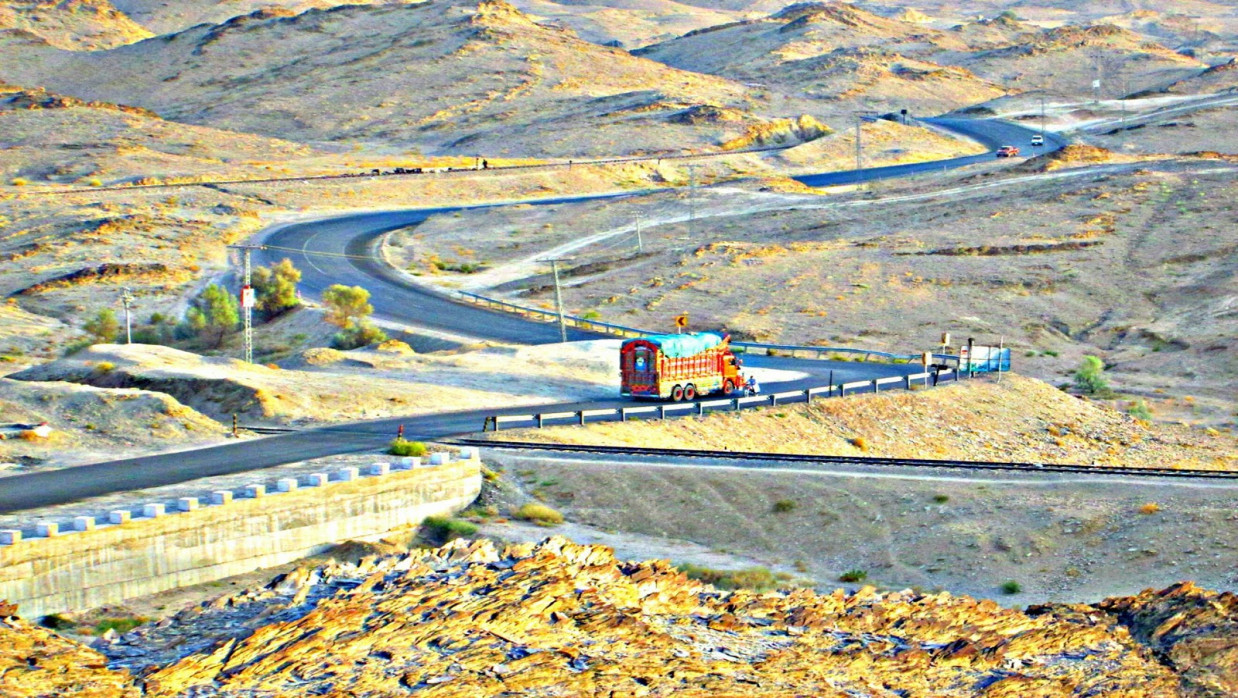
A public road is supposed to connect communities, sustain livelihoods and provide people with the freedom to move without fear. In Balochistan, however, the threat posed by roadside explosives has turned even routine journeys into potentially fatal encounters. The recent incident on the Noshki–Kharan Road is another grim reminder of how terrorism ultimately extracts its heaviest price from ordinary people. A pickup carrying 11 labourers reportedly struck a roadside explosive mine in the Lajay area of the Noshki–Kharan Road. The resulting blast killed the driver and injured three labourers, while seven others survived. These were not soldiers travelling through a battlefield. They were workers travelling for their livelihoods. Their vulnerability illustrates the human cost of placing explosives on roads used by civilians.
The use of roadside mines is particularly destructive because it removes any distinction between a militant target and the wider civilian population. An explosive buried beside a public road does not discriminate between a security vehicle, a labourer’s pickup, a trader, or a family travelling between towns. Anyone who happens to pass the location can become a victim. In this sense, roadside terrorism is not merely an attack on an individual vehicle; it is an assault on the basic security of an entire community.
For the people of Noshki, Kharan and surrounding areas, roads are lifelines. They connect workers to employment, farmers to markets, businesses to customers and communities to essential services. When these routes become associated with hidden explosives, the consequences extend far beyond the immediate casualties. Fear discourages movement, disrupts commercial activity and imposes an invisible cost on people who are already dependent on limited economic opportunities. The tragedy also exposes the contradiction inherent in FAH’s purported claims of representing the interests of Balochistan. Whatever political objectives such groups may claim, planting explosives on routes used by local workers produces consequences that fall directly upon the population they ostensibly seek to represent. The victims are often people whose daily struggle is simply to earn a living and provide for their families.
This is why the Noshki–Kharan incident should not be viewed as an isolated security incident. It represents a broader challenge to civilian life and economic normalcy in Balochistan. Every roadside mine creates uncertainty about the next journey. Every civilian casualty deepens the sense of insecurity. Every disrupted route makes economic activity more difficult.
The most troubling aspect is that the victims of such violence rarely have any say in the conflict surrounding them. The labourer sitting in the back of a pickup has no control over militant strategies or political disputes. Yet he can pay the ultimate price for them. The driver killed in the blast was performing an ordinary job on an ordinary road, but an act of terrorism transformed that routine journey into a fatal one. Balochistan’s people deserve roads where workers can travel without fear and where economic activity is not held hostage by violence. Political grievances, wherever they exist, cannot justify tactics that place civilians in the line of fire. The planting of mines on public roads does not empower communities; it exposes them to greater insecurity and suffering.
The Noshki–Kharan blast therefore carries a message beyond its immediate casualties: terrorism does not remain confined to its intended battlefield. It enters marketplaces, roads, workplaces and homes. Its victims are often the very civilians who have the least ability to protect themselves. For Balochistan to move towards stability and development, ordinary people must be able to travel, work and conduct their daily lives without encountering hidden explosives. The death of a labourer or a driver on a public road should never become an accepted cost of political violence. Roads must remain avenues of connection—not corridors of fear.


0 Comments
LEAVE A COMMENT
Your email address will not be published