

A Crisis Greater Than a Security Problem
The worsening conflict in Balochistan and Pakistan’s adjoining Pashtun regions cannot be understood merely as terrorism or a breakdown of law and order. It is a multidimensional crisis shaped by armed insurgency, political exclusion, economic deprivation, ethnic grievances, weak civilian institutions and the consequences of decades of regional security policies.
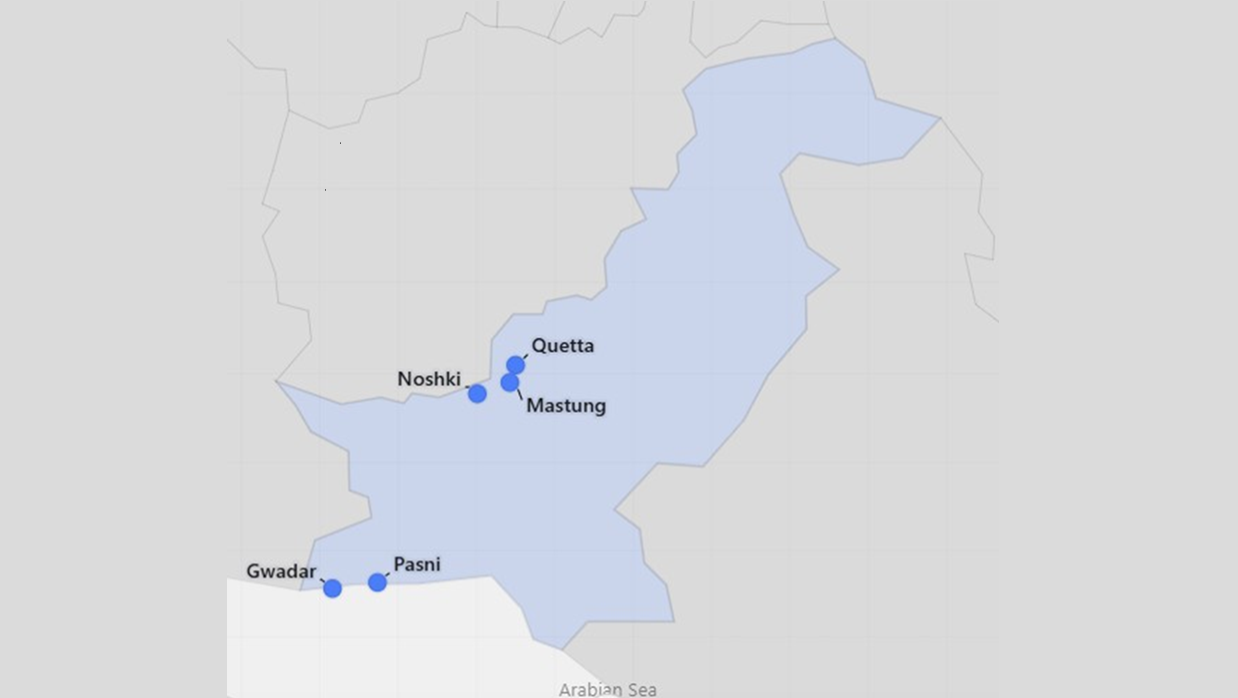
In January 2026, several attacks were claimed by the Baloch Liberation Army on Quetta, Gwadar, Mastung, Noshki and Pasni. Police stations, security check posts, banks, markets and other civilian areas were attacked by militants. Several civilians and security personnel were killed prior to security forces going on the offensive, claiming many militants were killed as well. The scale of these attacks showed that the insurgency can strike numerous places at once, making normal life difficult over a wide area, despite not controlling any territory for long periods.
The targeting of civilians by the BLA through violence must be condemned without reservation. Attacks which kill and/or put civilians at risk can never be justified under the guise of political objectives. However, delegitimizing their violent campaign does not address the question of why no Pakistani government has been able to win popular confidence, establish political legitimacy, or successfully administer civilian rule in the country's largest, most geo-strategically significant province.
Two Insurgencies with Different Foundations
Adding to this volatile mix are Baloch separatist groups and Tehreek- e- Taliban Pakistan. They have at times been portrayed as two wings of the same terrorist group. However, they have different origins, ideologies, goals, and bases of support.
The BLA and other Baloch insurgent organizations draw support from grievances involving provincial autonomy, enforced disappearances, resource ownership, political representation and the distribution of economic benefits. Their struggle is primarily ethno-nationalist and separatist. The TTP, by contrast, is an Islamist militant organization seeking to impose its interpretation of religious governance and overthrow or transform the Pakistani state.
Their main theaters of operation have also been distinct. The Baloch insurgents have been focused in Baloch-majority regions, while the TTP has been largely limited to Khyber Pakhtunkhwa and former tribal regions. The TTP encroaching on Pashtun-settled parts of northern Balochistan only adds another dimension of volatility to the region. Pashtun populations could end up resisting the militants' advances but also being wary of insensitive or coercive military action.
Tactical contacts or limited logistical cooperation between militant groups cannot be excluded. But such cooperation does not necessarily amount to a unified command or common political project. Treating Baloch separatism, TTP militancy, smuggling networks and peaceful political dissent as one indistinguishable threat is likely to produce ineffective and counterproductive policies.
The Blowback from Pakistan’s Afghan Policy
The resurgence of the TTP cannot be separated from Pakistan’s long involvement in Afghanistan. For decades, elements within Pakistan’s security establishment treated selected militant organizations as instruments of regional influence. The intention was to secure a friendly administration in Kabul, limit Indian influence, and obtain what strategists described as “strategic depth.”
The consequence of the policy has been grave. Militant groups amassed wealth, recruitment pipelines, and long-term ideological and logistical structures. They also reportedly found sympathizers from foreign adversaries of Pakistan. The militants were never fully under the state's control.
When the Taliban resurfaced in Afghanistan in August 2021, it allowed TTP militants to breathe relatively easy and use the territory as a base for their operations. Instead of the “strategic depth” Pakistan previously thought it was getting from Afghan soil, it started experiencing what experts call “reverse strategic depth”.
Pakistan’s war against the TTP has further exacerbated these concerns. A February 20 report from the International Crisis Group cautioned that if Pakistan intensifies its military operations against militants, “they could lash out inside Pakistan.” “Violence has surged as Pakistan stepped up its campaign against the TTP,” it added, noting Pakistan-Afghan Taliban relations were “at their worst point in years”. Raiding militants across the border will only scatter them temporarily. A lasting strategy must combine carefully calibrated security operations with regional diplomacy, stronger border governance, intelligence cooperation, and, most importantly, a decisive break from the long-standing use of militant proxies as instruments of foreign policy.
The Neglect of Local Security Institutions
The condition of the Balochistan Levies illustrates another structural weakness. As a locally recruited policing and security force, the Levies possess valuable knowledge of local languages, communities, terrain and tribal relationships. Yet their personnel have frequently been expected to confront heavily armed insurgents without adequate weapons, protective equipment, transport, communications, training or intelligence support.
It affects morale and subjects local forces to unnecessary risk. When local forces are attacked, it sends a message that reinforcements are insufficiently equipped or delayed to the point that they arrive only after the fact. We wait for militants to attack, vulnerable patrolmen to get killed, and then search high and low for clues to strike back with searches/arrests or an overextended troop presence for a limited time. When that operation dissipates, many of the same problems that caused the attack exist.
The Levies need modern equipment, professional training, reliable communications, intelligence integration and medical evacuation capabilities. Strengthening them, however, must not mean creating another unaccountable paramilitary structure. Local security institutions should remain subject to civilian law, judicial oversight and clearly defined chains of command.
Political Exclusion Narrows Peaceful Space
Durably peaceful societies require that people believe constitutional politics can make a difference. Peaceful protest should not be confused with political violence. Shutting down space for peaceful action is therefore potentially self-defeating. It can provide militants with one of their most potent recruiting slogans when protesters are attacked, rallies outlawed, politicians arrested, elections rigged, and peaceful dissent smeared as terrorism.
Rights activists have raised concern over Pakistan’s intensifying crackdown on peaceful dissent following the sentencing of Baloch human-rights activist Dr. Mahrang Baloch to life imprisonment by an anti-terrorism court in Quetta last week. Dr. Baloch and fellow Baloch Yakjehti Committee member Sibghatullah Shah were sentenced on charges of terrorism, sedition, and murder related to the killing of Frontier Corps soldier Shabbir Baloch during a protest in Gwadar on July 20, 2024.
The prosecution claimed that the activists had provoked the mob that killed the soldier. The defendants have denied the charges and claim prosecution witnesses were partly to blame for stoking the protest. Baloch’s attorney stated that the group plans to appeal the decision. Speaking after the sentencing, Shah called the decision “political victimization.” Human rights groups have criticized Balochistan’s ATC system in recent years, claiming that the charges prevent defendants from mounting an effective legal defense. Amnesty International stated that “No direct evidence was placed before the court linking the two activists to the killing.” Amnesty further criticized the trial itself, which was held behind prison walls. Pakistan responded that Shah and Baloch were afforded all legal rights in court and suggested peaceful protest should not have been used as justification for attacks against state forces.
Mahrang Baloch has gained international attention for her activism over the last several years. Last year she was nominated for the Nobel Peace Prize for her work highlighting “enforced disappearances, extrajudicial killings, and gross violations of human rights in Balochistan.” Pakistan’s handling of Baloch’s case could strengthen the view amongst some that peaceful avenues for grievance redressal are being shut down in Pakistan at a time when thousands of young Baloch are becoming increasingly alienated from mainstream politics.
Unrepresented Nations and Peoples Organization
The Balochistan government defended the ruling as the outcome of a fair judicial process. Human-rights organizations, however, raised serious concerns about the prison trial, the defendants’ limited participation and the alleged absence of direct evidence connecting them to the killing. Whatever the eventual outcome of the appeal, the controversy illustrates the danger of handling civil-rights activism primarily through anti-terrorism law.
The state undoubtedly has a duty to prosecute murder and political violence. The state also has a duty to distinguish armed insurgency from peaceful dissent. Penalizing nonviolent opposition muzzles potential allies and drives youth to radicalization.
Resources, Land and Economic Justice
Balochistan is rich in minerals, natural gas, coastline and strategic infrastructure. But still some of its communities are among Pakistan's most impoverished. Mega projects are heralded as evidence of national wealth, but people ask: Who owns the land? Who gets the contracts? Who gets jobs? Who profits from natural resources?
Mobility constraints and highway ambushes have affected the informal cross-border trade on which families depend. Land transfers to government entities or private entities without legitimate local input foster notions of internal colonialism. Hand-down development, protected by army checkpoints, will never gain the people's trust.
Meaningful reform must therefore extend beyond announcing megaprojects. It should protect local land rights, create transparent revenue-sharing mechanisms, expand education and healthcare, develop skilled employment and empower elected provincial and local authorities. The people most affected by development must have a genuine role in designing it.
Security Must Create Space for Politics
Pakistan is well within its rights - and has a responsibility - to defend its citizens against militancy. However, military operations can provide the environment for a political solution. They cannot be the solution alone.
Pakistan needs a sustainable policy founded on intelligence-led counterterrorism efforts targeted at actual threats, transparent and democratic elections, a civilian government we can hold accountable for its actions, an independent judiciary that works to end forced disappearances, and political engagement with peaceful Baloch and Pashtun movements. Development cannot come at the cost of exploitation. Security must remain professional and disciplined.
The people of Balochistan should not be seen as either a security challenge or as spoilers standing in the way of resource exploitation. If coercion replaces politics, each military success will only breed another generation of Baloch nationalists. Pakistan’s biggest test is not merely re-establishing the state’s writ but creating a political system where that writ is respected because it is seen as legal, representative and fair.


0 Comments
LEAVE A COMMENT
Your email address will not be published