

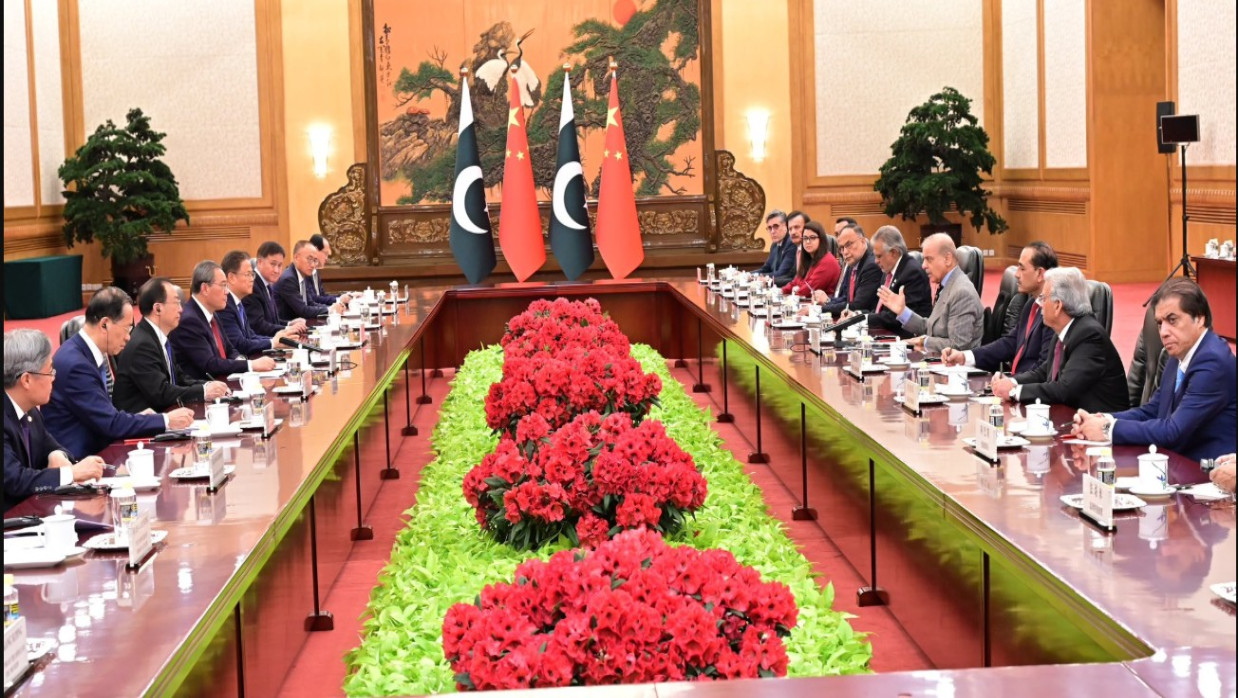
The joint statement released after PM Shehbaz Sharif’s 23-26 May visit to China wasn’t just another ceremonial nod of friendship between Islamabad and Beijing. No, it seemed more layered than that, like there’s a steady movement, toward a longer term strategic set up, for a world that’s getting more fragmented day by day.
Right now, when lots of alliances globally are turning transactional, a bit shaky, and easily pulled by internal politics, China and Pakistan are trying to show something else: continuity, institutional trust, and strategic patience. The wording inside the statement mattered a lot. Both sides promised to step up cooperation on building an “even closer China-Pakistan Community with a Shared Future in the New Era” and that phrase really sounds intentional. It implies Beijing is increasingly viewing Pakistan not only as a regular bilateral partner, but also as a meaningful geopolitical pillar, within its broader regional, and Eurasian, direction.
That shift is unfolding amid profound international transformation, and somehow it feels like everything is moving at once. Global politics is stepping into a phase that’s defined by technological rivalry, economic fragmentation, strategic competition, and a noticeable softening of confidence in older Western-led frameworks. Supply chains are getting more politicized by the day, not just nudged. Competition is now spreading into artificial intelligence, digital governance, maritime access, cyber infrastructure, and space technology too. In this kind of environment, the China-Pakistan relationship is not really stuck in conventional diplomacy, or even only traditional military cooperation anymore.
The range of what both sides are doing really shows how far China-Pakistan relations have traveled. Today, not many bilateral arrangements manage to combine defense cooperation, industrialization, artificial intelligence, regional diplomacy, digital economy integration, counterterrorism coordination, connectivity infrastructure, and space collaboration all in one orbit. And more importantly, the relationship seems to be increasingly geared toward future power domains, rather than lingering on old-style geopolitics only.
Artificial intelligence governance, scientific invention and digital linking are showing up as kind of central pillars for the partnership’s next phase . The cooperation tied to Huawei-backed digital infrastructure projects, BeiDou satellite navigation integration and the broadening of cloud and telecommunications ecosystems, suggests the relationship is slowly reaching into a more strategic technology blueprint, not just staying in the usual lane of economic cooperation.
Pakistan’s support for China’s proposed global AI governance framework also shows Islamabad trying to place itself inside the emerging tech rule-making structures, instead of looking like it’s outside them. It matters strategically too, because tech governance is quickly turning into one of the main stages for global rivalry, and not only a background topic.
For years, Pakistan’s international image has stayed pretty securitized-associated, mostly tied to counterterrorism, instability, or economic crisis management. The newest statement, though, seems to nudge a new path, not just a small tweak. Islamabad looks like it is trying to position itself inside the fast-growing technological and geoeconomic structures, instead of only being stuck in reactive regional politics.
The space cooperation angle was especially eye catching. China said that two Pakistani astronauts will get training, which could potentially open the door for the first foreign astronaut to enter the Chinese Space Station, and that kind of political and scientific trust is not usually handed out by major powers like that.
Space collaboration is still among the most strategically sensitive corners of global technological cooperation , and frankly it tends to move slower than people expect. The cooperation in space and scientific research that’s been growing lately also seems to mirror China’s wider push to internationalize parts of its technological ecosystem. When you look at what’s being said about lunar research collaboration , and the longer term vision of peaceful space projects, it feels like the partnership is already creeping past just terrestrial infrastructure and into future scientific areas, with clear strategic meaning. Beijing’s openness about bringing Pakistan into that same lane therefore gives off a more pointed geopolitical message, not just a small adjustment in ties, but something deeper.
At the same time there’s another, more low key shift happening inside the China Pakistan Economic Corridor . The earlier stage of CPEC was mostly about transport corridors , and about steadying energy supply. But what’s now taking shape as a second generation framework looks quite different, in a way that’s hard to ignore, like a reframing rather than a simple continuation.
Projects tied to the ML-1 railway overhaul, Gwadar Free Zone expansion, mineral development agreements and industrial relocation increasingly point to CPEC evolving from a mere connection corridor into a more sweeping geo-economic integration framework. The attention seems to be sliding, a bit more, toward supply lines, logistics depth, industrial capability, and technological links that can tie Pakistan in a deeper way with surrounding regional economic networks.
At the same time, the focus is moving almost gradually toward industrial partnership, minerals, logistics, digital connectivity, supply chains, artificial intelligence-based uses, and high-value production sectors. Overall, this looks like strategic adjustment rather than any real standstill.
For years, some critics have painted CPEC as something that is, economically unsustainable or maybe strategically exposed. But Beijing’s newest pledges kind of show that Chinese confidence in Pakistan’s long term connectivity promise is still there, even with the regional instability, those sabotage efforts, and the constant hostile stories around the whole project.
Gwadar Port still sits at the middle of China’s regional calculations. To Beijing, Gwadar isn’t only an infrastructure investment. It’s more like a durable access point, tying together South Asia, Central Asia, the Gulf and those broader Eurasian trade routes. China’s ongoing focus on Gwadar looks less like a short-term money bet and more like strategic patience, plus long-range geopolitical thinking, rather than just immediate economic expectations.
The joint statement, as well it showed, growing convergence in regional diplomatic and security outlooks , if you think about it. China did publicly appreciate Pakistan’s role in facilitating de-escalation efforts during the recent US-Iran crisis, and it also acknowledged the Islamabad talks. That acknowledgment was diplomatically important because it made Pakistan look not just like a security actor, but more and more like a state that can actually do diplomatic mediation when the region gets volatile.
This seems especially relevant now, since the Middle East is going through rapid geopolitical restructuring after the Gaza war, which is in turn making US-Iran tensions worse. At the same time there’s broader uncertainty about regional normalization frameworks, and honestly that whole situation is hard to pin down.
On Afghanistan, both countries also talked about a rising sense of alignment in threat perception, like more and more , the same picture. The statement sort of stressed the need to stop militant groups from using Afghan territory to threaten regional security. Also, Beijing’s public siding with Pakistan’s worries about cross-border militancy shows how the overlap between Chinese regional security interests and Pakistan’s internal security calculations is getting tighter, not just by sentiment, but in practice.
This proposed future “China-Pakistan Security Partnership” may end up as one of the most meaningful aspects of how the relationship is evolving. It points to a move toward deeper institutional coordination, going past the usual defense cooperation and reaching into intelligence-sharing, counterterrorism coordination, and even a wider regional security architecture.
China has once again been saying, not just in words but really reaffirming Pakistan’s sovereignty and its territorial integrity, while also stressing that the Kashmir dispute still sits there as an unresolved historical matter, which needs a peaceful resolution, as per United Nations resolutions and those bilateral agreements. In a way, this is still strategically important, because it keeps Kashmir in an international and disputed space, even with India’s ongoing efforts to kind of internalize the issue diplomatically after August 2019, like push it inward through channels and narratives.
Meanwhile, Beijing keeps trying to steady its wider strategic rivalry with India. You can see this in how China seems to prefer a controlled competition rather than a kind of runaway escalation across South Asia. That balancing method helps Beijing keep its strategic partnership with Pakistan intact, while also dealing with broader regional stability worries, at the same time.
More broadly, the statement seems to mirror a widening sort of convergence between Beijing and Islamabad, kind of against coercive geopolitics, unilateralism and bloc confrontation, not just in one narrow way but in a broader sense.
Both sides, increasingly, frame themselves as advocates for negotiated stability sovereign equality, and multipolarity. This story lands well across large sections of the Global South, where a lot of states are after strategic flexibility not some rigid alignment inside competing geopolitical camps.
For a number of developing countries, the China-Pakistan relationship is, in practice, looking like a blueprint of long-term strategic cooperation: infrastructure investments, political coordination, technology partnership, and institutional continuity, though without overt political conditionalities.
At the same time, really important challenges stay in place. Pakistan’s domestic economic constraints, security environment and governance capacity will keep on shaping just how well many of these ambitious projects actually get carried out. Meanwhile, regional instability around Afghanistan and the wider geopolitical competition in South Asia also mean that the partnership will continue running inside a complicated strategic landscape
Yet the bigger direction of travel is hard to miss. China and Pakistan aren’t only managing a long-lasting friendship anymore. They are, step by step, building a long-term strategic ecosystem that can adapt at the same time to geopolitical turbulence, technological rivalry and changing regional alignments
The partnership is historic i n trust, pretty comprehensive in scope, and also, more and more future-leaning in ambition. As global alignments get more fluid, fragmented, and sort of transactional, Beijing and Islamabad look more and more set on putting into place and institutionalizing one of the few long-term strategic ties that’s still growing, not shrinking, at the same time. This happens across diplomacy, technology, security, and geoeconomic integration, with a kind of continuous emphasis that feels future-facing, even if it’s not always said out loud.


0 Comments
LEAVE A COMMENT
Your email address will not be published