

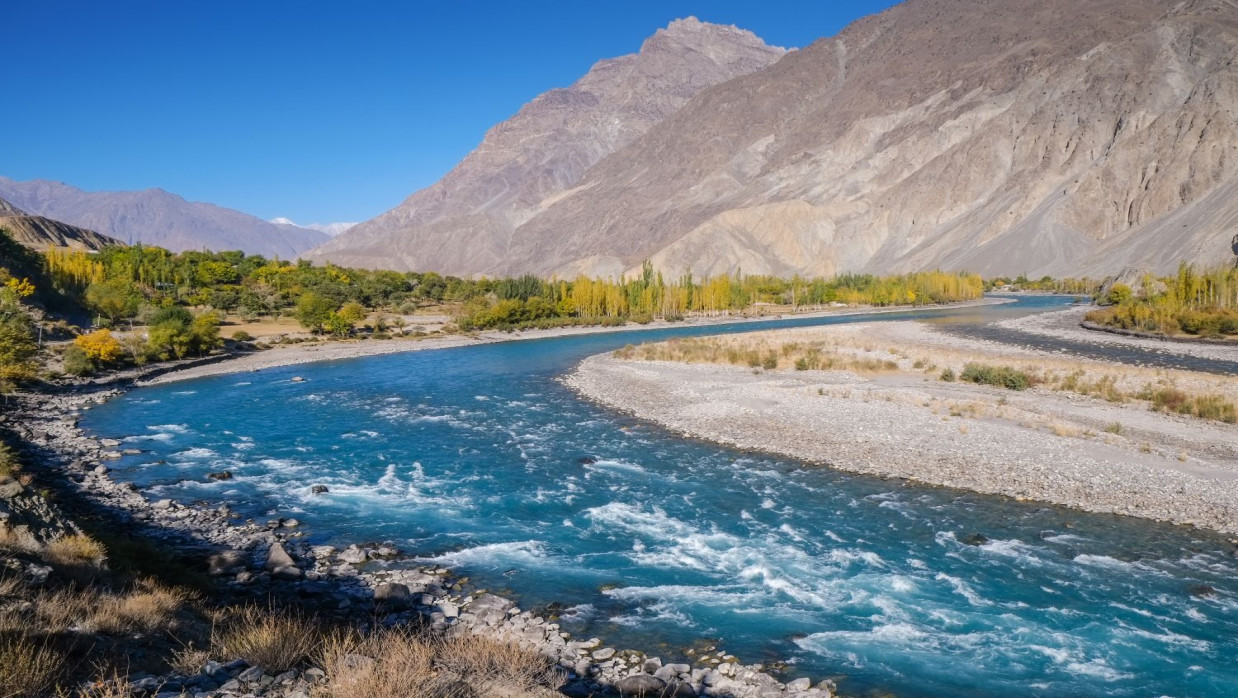
As the world observes World Climate Day on 15 May 2026, people are again looking at the fast-moving climate crisis, and also at the urgent need for resilience, cooperation and sustainable governance. In South Asia though, climate vulnerability is starting to mix in a messier way with geopolitical uncertainty. This is especially noticeable in the Indus Basin, where climate driven hydrological instability is getting added on, together with the tensions around the Indus Waters Treaty, (IWT).
For Pakistan, which is one of the world’s most climate vulnerable countries, the Indus River system isn’t just a water resource, it is the backbone of national survival. The river system backs agriculture, food output, hydropower generation, drinking water access and millions of livelihoods. In this delicate ecological setting, predictable and cooperative transboundary water governance has historically worked like a stabilizing mechanism, even while relations remained prickly. The 1960 Indus Waters Treaty set up that kind of framework for decades, it helped keep regulated flows and institutional coordination in place, despite repeating political tensions between India and Pakistan.
Today, though, climate strain and treaty uncertainty are coming together in a way that boosts regional risk quite a lot.
South Asia is already seeing serious climate disruption. With faster glacial melt through the Himalayas, monsoon systems that are getting more irregular, long run drought cycles, and then catastrophic flooding, the whole water pattern in the region is getting reshaped. Pakistan has, again and again, felt what that means in practice—recurring heatwaves and water scarcity, then also unusual floods that push millions out of their homes and smash important infrastructure.
In that kind of setting, keeping river governance steady matters even more than before. Climate adaptation across shared or transboundary basins relies on data sharing, coordinated responses for floods, drought preparation, and a sort of institutional predictability. If any part of those mechanisms gets interrupted, it brings more uncertainty into environmental systems that are already pretty unstable and hard to manage.
India’s decision to hold the Indus Waters Treaty in abeyance therefore carries implications that go beyond the usual diplomatic quarrels, in a sort of knock-on way. In real terms, uncertainty about river flow management can weaken Pakistan’s ability to plan irrigation cycles, run reservoirs efficiently, lessen flood impacts, and even set up for drought conditions. In a basin already tugged by climate variability, disruptions to the established coordination arrangements can end up magnifying both sides at once excessive water during flood windows, and at the same time severe shortages when rivers run lean.
Pakistan’s agrarian economy is, in particular, exposed to this kind of instability. Agriculture underpins a large share of employment and food security, yet it still depends very much on the Indus Basin irrigation network, which is among the largest continuous irrigation systems on the planet. Farmers depend on steady seasonal water availability for crop planning and cultivation. Any ambiguity about the timing or the overall volume of river flows then messes with agricultural output, boosts food insecurity, and adds yet more pressure on rural livelihoods, that already are dealing with climate related stressors.
The risks are not limited to agriculture only or so it seems. Water insecurity goes straight into public health, sanitation systems, and even the ability to reach safe drinking water. When climate driven drought conditions build up they can worsen water scarcity in both cities and villages, while severe flooding can foul up water supplies and then help spark outbreaks of waterborne illnesses. In that kind of situation, cooperative river governance is becoming, like a key piece, of climate resilience and human security.
Pakistan’s energy sector too has rising exposure; it’s also not just one story. Hydropower generation relies on river regimes that are fairly steady and still manageable. But increased hydrological unpredictability makes it harder for infrastructure planning, and for reservoir operations, plus it shakes long term energy security strategies. Since climate change keeps accelerating glacier retreat and also changes the seasonal flow patterns, institutional cooperation around shared rivers becomes more and more essential.
Experts have been warning that the slow erosion of treaty-based coordination mechanisms may in turn, weaken the broader adaptive capacity of the Indus Basin, and it gets more complicated than it sounds. Climate resilience in transboundary river systems cannot really work well if communication, transparency, and shared commitments are missing. Things like flood forecasting, glacial monitoring, sediment management, and drought mitigation are not one-off tasks either. They need steady regional cooperation, over time, in a sort of continuous way.
There is also a wider worry that environmental pressure, when it mixes with geopolitical instability, can morph into a more than one-dimensional security problem. Water insecurity can raise economic strain, increase displacement risks, trigger social disruption and even push humanitarian crises. In places that are especially climate vulnerable, water governance stops being only an environmental concern it becomes bound up with national stability and regional peace, whether people want it to or not.
World Climate Day sort of serves as a useful reminder, that climate adaptation can’t really work by itself. Shared ecosystems need shared responsibility, and not some vague promises. For upstream and downstream states both, cooperative water governance is essential—especially for lowering disaster risks and shielding vulnerable populations from climate impacts that keep on getting stronger.
Since India is an upstream state in a climate sensitive basin, it also carries real, legal, environmental, and moral duties. If actions chip away at the established coordination frameworks, then hydrological uncertainty can rise, across an already fragile region. And at a moment when climate change really calls for more international partnership, unilateral approaches to shared water systems may cause more instability instead of boosting security.
For Pakistan, this challenge is existential, like really. The country keeps getting hit by climate shocks a lot and it still relies, almost entirely, on the Indus River system for economic stability and for day-to-day human survival. So, protecting climate resilience across the Indus Basin means you have to keep water governance that stays predictable, also strengthen regional cooperation, and make sure humanitarian concerns aren’t dragged into political confrontation.
On World Climate Day 2026 the message coming from South Asia feels more and more obvious, climate security and water security are inseparable, basically. In a moment when floods are intensifying, droughts are lingering longer, and glacial volatility is becoming more unruly, cooperation around shared rivers is not a choice; it is essential for regional steadiness, sustainable development, and human survival, period.


0 Comments
LEAVE A COMMENT
Your email address will not be published