

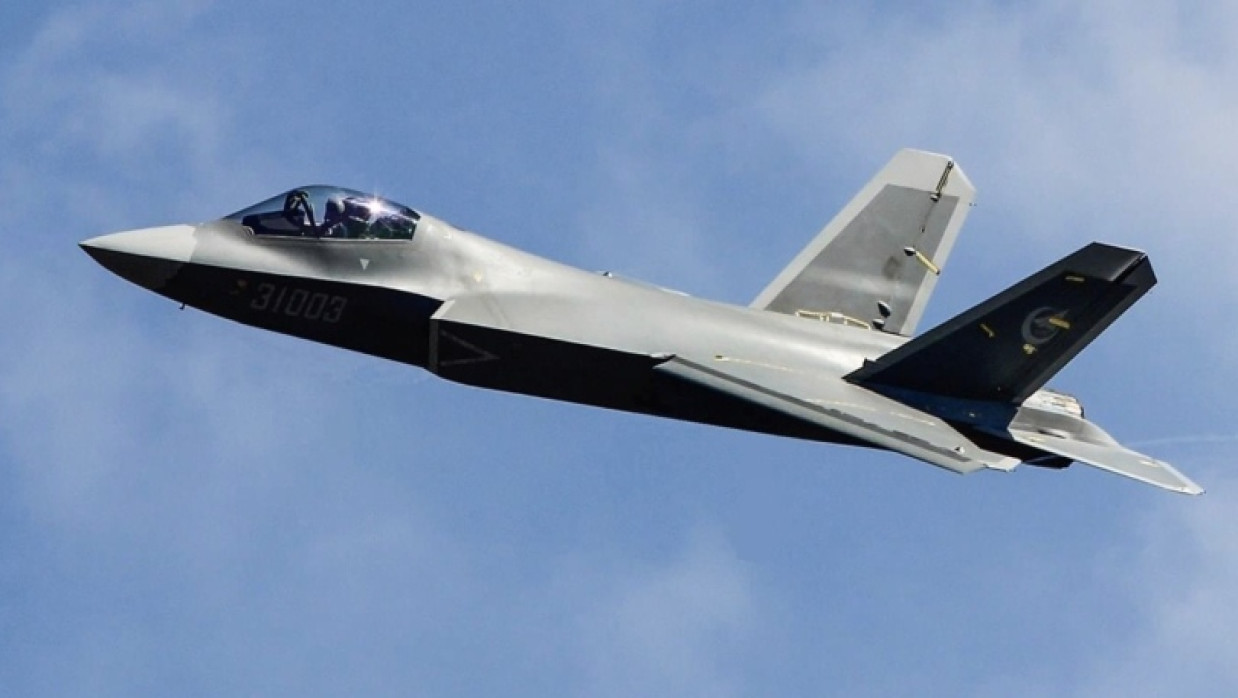
The Pakistan Air Force has announced that it has laid the groundwork for a wide range of procurements from China to revolutionise its combat capabilities, a year after engagements with Indian forces in early May, 2025, placed its Chinese-supplied equipment through unprecedented high intensity combat testing. The Air Force announced four separate planned procurement, including an unnamed long-range precision weapon, a next-generation fighter presumed to be the newly unveiled J-35, additional J-10C fighters, and upgrades for the existing JF-17 lightweight fighter fleet. The J-35 in particular is expected to provide a very distinct advantage over current Indian Air Force fighter types, although there have been a number of indications that India may have itself ordered Russian Su-57 fifth generation fighters preceding a planned major license production deal for the aircraft in India.
The J-35 was first confirmed to have entered service in both the Chinese People’s Liberation Army Air Force and in the Navy in 2025, serving as a lighter counterpart to the J-20 air superiority fighter in the former service. In December 2023 the head of the Pakistan Air Force Air Chief Marshal Zaheer Sidhu announced that the Defence Ministry was preparing to place an order for Chinese fifth generation fighters, with the service, after which the Pakistani government was reported by local media outlets in December 2024 to have approved the procurement of the J-35. Nevertheless, in mid-2025 Defence Minister Khawaja Asif stated that multiple reports that his ministry had already signed a contract to procure Chinese fifth generation fighter aircraft had been false, despite indications that procurements had long been under consideration.
The major recent successes which Chinese J-10C ‘4+ generation’ fighters had against Indian air power in May 2025, including its newly procured Rafale fighters, during clashes in early May, had long fuelled speculation not only that Pakistan would further expand its orders for the aircraft, but also that other countries would begin to show greater interest in making procurements. The J-10C is one of two new fighter types which Pakistan is currently procuring, alongside the aircraft’s lighter counterpart the JF-17 Block III. The announcement of upgrades to the JF-17 fleet could indicate plans to further enhance the JF-17 Block III, a relatively new design, with superior technologies, or could indicate plans to bring older JF-17 variants up to a similar standard by updating their avionics and weaponry. Older variants of the JF-17 are increasingly considered obsolete particularly in the air-to-air domain.
The J-35 is widely considered to be the most capable fighter type on global markets in terms of its air-to-air performance, and combines cutting edge stealth capabilities with advanced avionics and weaponry as only the F-35 and Su-57 otherwise do among export available fighters. The aircraft’s avionics and stealth capabilities are significantly more advanced than those of the Su-57, however, while its flight performance and range are considerably superior to those of the F-35, which is a single engine aircraft that was designed primarily for strike rather than air-to-air roles. Integrating the J-35 into service is expected to pose significant challenges for the Pakistan Air Force, which exclusively fields single engine lightweight fighter types, the majority of which are from the ‘very light’ category. The J-35 will have much higher maintenance requirements and operational costs, with its procurement potentially forcing the Air Force to reduce the number of fighter squadrons in service to be able to afford it.
The article appeared in the militarywatchmagazine
0 Comments
LEAVE A COMMENT
Your email address will not be published