

In politics, words outweigh actions, as they form narratives and are intelligently deployed to influence people's perception for greater gains. In May 2025, a limited conflict was instigated between India and Pakistan over the issue of the Pahalgam terror attack in Indian held Kashmir. India framed its action as counterterrorism, countering terrorist infrastructure and terror launchpads, and linked the Pahalgam attack to cross-border militancy originating in Pakistan. India relied on such rhetoric and launched Operation Sindhoor against Pakistan. On May 10, 2025, in response to India’s action, Pakistan, under the operation Bunyan ul Marsoos, gave a strategic signal that it would never allow any nation to violate its sovereignty.
Both nations have been trying to justify their actions through narratives, but in reality, it was a miscalculated attempt of the Indian military under the leadership of Bharatiya Janata Party (BJP), which had pushed the whole region into a dire wave of catastrophe. Conflict in any two nuclear-armed countries is not limited to just their border, but the consequences extend beyond, which the world could not afford. One year has passed, but the question persists: despite all the wherewithal and the presence of 2.31 lakh army troops, how did the terrorists manage such a misadventure in the Kashmir valley? Furthermore, without any concrete evidence, the Indian authority had abruptly accused Pakistan, which demonstrates the irresponsibility of the ruling elite. Terrorism at all levels must be condemned, but it should not be instrumentalized for achieving certain political goals.
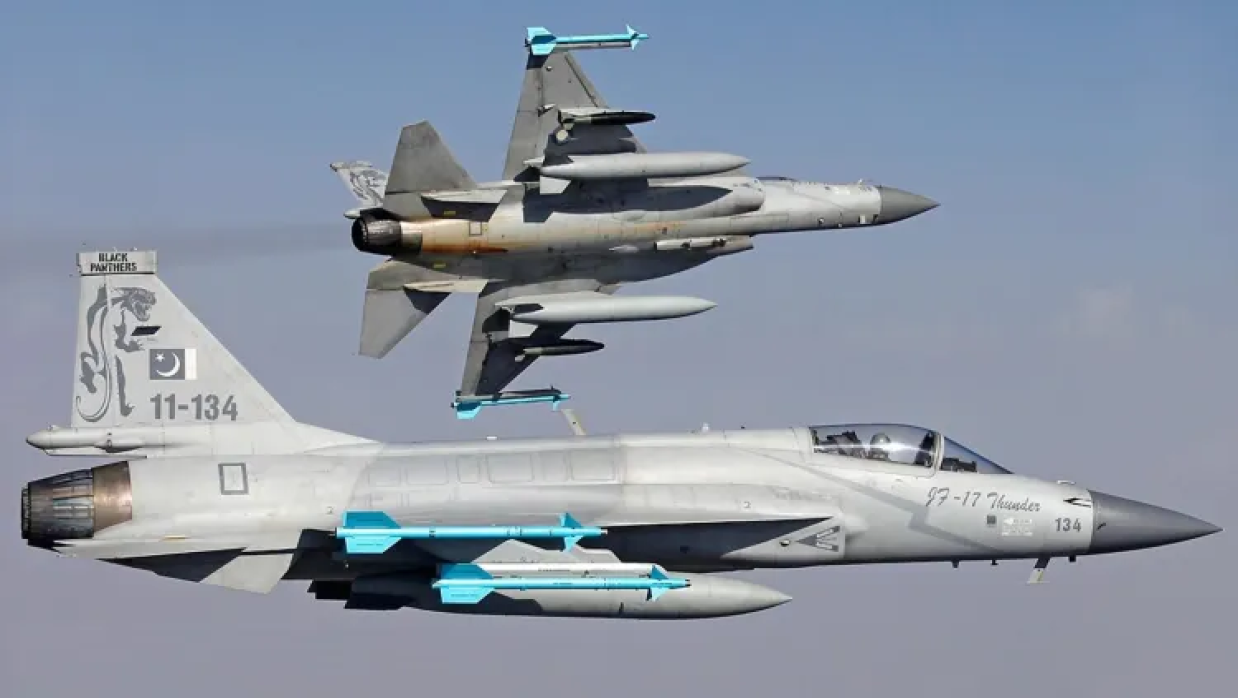
The May 2025 standoff not only altered established narratives but also changed the perception related to military hardware. For a long time, it was believed that Western military technology had some sort of qualitative edge over the East, especially over China. On May 7, 2026, history's longest beyond visual range (BVR) fight held among 125 fighters; however, the Chinese-made J-10C and jointly produced by Pakistan and China Jf-17 outperformed the French-made Rafael and Russian Sukhoi 30 in a dogfight, and Pakistan’s air force shot down six Indian fighter jets with the Chinese PL15 air-to-air BVR missile. The Pakistani authorities also claimed that it destroyed India’s air defence S-400 unit; however, it was not further confirmed by unbiased sources.
After announcing a ceasefire on May 10, both countries announced their victory, and a convergence of narratives had emerged. Upon looking at the objectivity, India, which spends $92.1 billion on its defence and has a much larger army and geographical proportion than Pakistan, still cannot manage a decisive victory. Pakistan initially offered a joint investigation into the Pahalgam attack, but it was rejected by India, and positioned itself within the post 9/11 discourse to gain legitimacy for its subsequent action.
The limited conflict has boosted the Chengdu Aircraft Corporation's stocks by 40%, following the combat success of J-10C. The conflict resulted in both gains and losses on both sides. In the Indian attacks, mosques were damaged, and civilian and military casualties occurred, which India considers to have dismantled the launchpads of the terrorists. However, Pakistan glorifies its defensive response in public by shooting down its front-line fighter jet and has negated the narratives of establishing new normal and reclaimed the conventional deterrence with a sheer response and celebrate it as “Marka-i-Haq”. However, there is no logic behind a one-sided victory, as civilians of both countries are vulnerable to loss because there is no buffer between the borders, and a large clash between two nuclear-armed countries would be a zero-sum game for the whole region. Looking to the broader patterns and the BJP’s Akhand Bharat inspiration, the operation Sindoor was premised on a fabricated pretext for greater political goals to gain public validation in the state’s elections.
The ruling elite, by persuasive language and rhetoric, tries to maximize gains from the conflict. The same aggression was shown at the time of the Pulwama attack, and the consequence was the same; the Pakistan air force shot down their plane and took their pilot into custody. However, Prime Minister Narendra Modi suggested that the outcome might have been different if they had had the Rafale fighter jets at the time. The Kashmir conflict is now acting as a paradox and narratives as a tool to glitter its domestic politics. Both nations maintain a reciprocal narrative regarding the sponsorship of terrorism: India points to insurgencies in Kashmir, whereas Pakistan alleges Indian support for extremist entities in Balochistan, specifically the Baloch Liberation Army (BLA) and Fitna al-Khawarij. However, under the nuclear shadow and nonstop narratives constraint on both sides, it is a pivotal and agreed fact-check mechanism for information exchange that needs policy attention for long-term peace and stability.


0 Comments
LEAVE A COMMENT
Your email address will not be published